



US Jobs Surprise Fuels Rate Hike Bets as Tech and Oil Slide | Weekly Recap: 2-6 November 2026


It was a volatile week for global markets. Stronger-than-expected US jobs figures raised expectations of another Federal Reserve interest rate increase, while concerns over artificial intelligence (AI) spending and regulation weighed on technology shares.
The US midterm elections added to market uncertainty, oil prices fell sharply, and gold recovered. Meanwhile, the UK and Australia raised interest rates as inflation remained a concern.
Economic Overview
Stronger US economic data, central bank decisions and the midterm elections shaped market sentiment throughout the week.
US Jobs Strengthen Expectations of Higher Rates
The US economy added 165,000 jobs in October, far above expectations of 65,000. Unemployment fell to 4.1% from 4.2%, while wages rose 0.4% month-on-month and 3.1% year-on-year. September’s employment gain was also revised higher to 60,000.
The stronger report increased expectations that the Federal Reserve (Fed) will raise interest rates again in December, with markets pricing in approximately a 77% probability of a 25-basis-point increase.
US business surveys also remained strong. The ISM Manufacturing PMI rose to 55.5 from 54.5, while the Services PMI eased slightly to 54.5 from 54.9. Both remained above 50, indicating continued expansion.
UK and Australia Raise Interest Rates
The Bank of England (BoE) raised its benchmark rate by 25 basis points to 4.00%, its first increase in more than three years. Eight members supported the decision, while Catherine Mann preferred a larger 50-basis-point increase.
The Bank warned that UK inflation, which reached 3.5% in September, could approach 5% by mid-2027 due to higher energy costs.
Australia’s central bank also raised its cash rate by 25 basis points to 4.85%.
In Europe, preliminary October inflation rose to 4.0%, its highest level since 2023, adding to pressure on the European Central Bank (ECB).
US Midterms Add to Market Uncertainty
The US midterm elections gave Democrats control of Congress, raising questions about the direction of economic and regulatory policy.
US equities rallied on Wednesday, while oil fell approximately 8% amid hopes of easing tensions involving Iran.
By Thursday, technology shares had dropped sharply as investors weighed concerns over tighter AI regulation and slower investment in data centre construction.
Equities, Bonds and Commodities
Equities
US equities fell as concerns over AI spending and regulation combined with stronger employment data and expectations of higher interest rates.
The S&P 500 declined 2.7%, its worst week since April 2025. The Nasdaq Composite lost 3.4%, while the Dow Jones Industrial Average fell 0.9%. Technology shares recovered some ground on Friday, but not enough to reverse the week’s losses.
European equities were steadier. The STOXX Europe 600 gained approximately 0.2% over the week, despite falling 1% on Friday.
The FTSE 100 declined around 0.5%, closing Friday at 10,673.94, down 1% on the day as AI concerns and uncertainty surrounding US regulation weighed on shares.
Bonds
US Treasury yields rose on Friday following the stronger-than-expected employment report, reflecting increased expectations of another Fed rate increase.
The 10-year US Treasury yield was approximately 4.9%, while the two-year yield reached around 4.5%.
Bond prices and yields move in opposite directions. Higher interest-rate expectations can push existing bond prices lower and yields higher.
Commodities
Oil recorded one of the week’s sharpest moves as expectations surrounding Middle East supply conditions shifted. Brent crude fell approximately 13%, with the January contract trading near US$ 98 per barrel on Friday.
Hopes of easing tensions involving Iran following the midterms, alongside concerns over growing global oil oversupply, pushed prices lower. However, attacks on vessels near the Strait of Hormuz continued to highlight risks to shipping and energy supplies.
Gold moved in the opposite direction, gaining approximately 5% to around US$4,070 per ounce, its strongest weekly performance in more than two months.
Prices jumped 3.3% on Wednesday as oil fell, before retreating on Friday as fluctuations in energy prices kept inflation concerns in focus.
Sector Performance
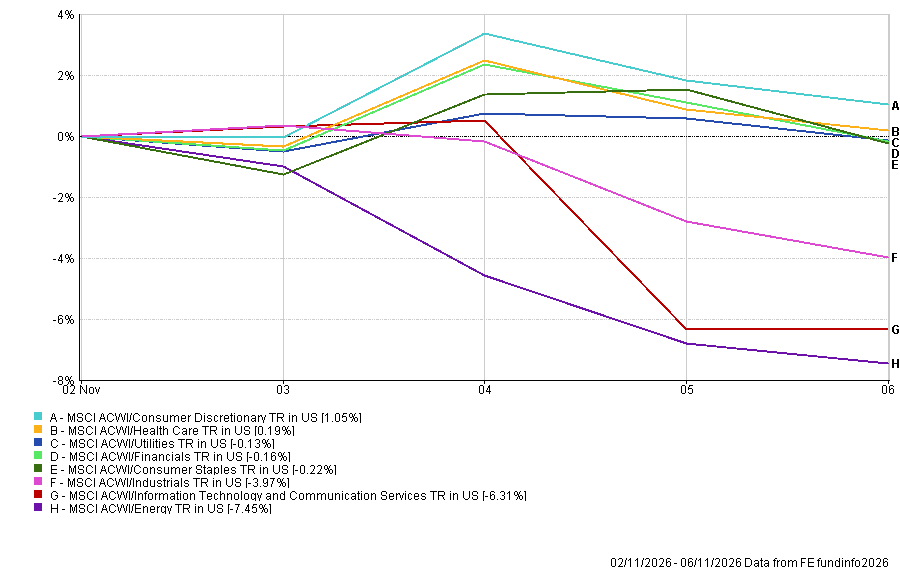
Global sector performance showed a clear divide between relatively resilient consumer and defensive shares and the industries most exposed to technology spending and energy prices.
Consumer Discretionary led the gains, rising 1.05%, while Healthcare advanced 0.19%.
Utilities declined 0.13%, Financials fell 0.16% and Consumer Staples lost 0.22%, showing relatively limited movements compared with the week’s weakest sectors.
Industrials fell 3.97%, reflecting broader pressure on economically sensitive shares.
The most significant losses were concentrated in technology and energy.
Information Technology & Communication Services declined 6.31%, with much of the weakness occurring on Thursday as investors reassessed AI infrastructure spending, regulatory risks and the pace of data centre development.
Energy was the weakest sector, falling 7.45%, as the sharp decline in crude oil prices weighed on producers.
Sector Performance November 2-6th, 2026
Source: FE Analytics. All indices total return in USD. Past performance is not a reliable indicator of future performance. Data as of 6 November 2026.
Regional Markets
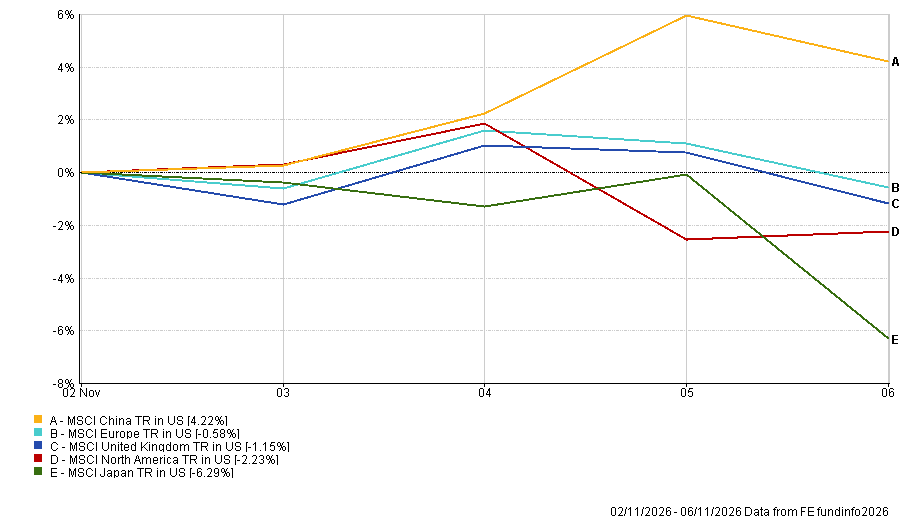
Regional performance also diverged sharply as technology exposure, currency movements and shifting investor sentiment influenced returns.
China was the strongest-performing region, with the MSCI China index gaining 4.22% in US dollar terms.
Europe declined 0.58% and the UK fell 1.15%, but both held up better than North America, which lost 2.23% as weakness in technology shares weighed on US markets.
Japan recorded the largest decline, falling 6.29%. The Nikkei dropped more than 6% on Friday following the US technology sell-off, contributing to its weakest week since March 2020.
Regional Performance November 2-6th, 2026
Source: FE Analytics. All indices total return in USD. Past performance is not a reliable indicator of future performance. Data as of 6 November 2026.
Currency Markets
The US dollar strengthened against the euro, sterling and Japanese yen as stronger employment data increased expectations of another Federal Reserve rate rise.
Comparing Monday’s opening levels with Friday’s closing prices:
- EUR/USD fell from 1.1159 to 1.1144, so the euro was marginally weaker.
- GBP/USD fell from 1.3390 to 1.3350. Sterling was slightly weaker despite the Bank of England’s rate rise.
- USD/JPY rose from 157.51 to 158.48, so the yen was weaker.
- GBP/JPY rose from 210.96 to 211.57, so sterling gained against the yen even though it fell against the dollar.
The dollar’s strength reflected higher US interest-rate expectations, while the yen remained under pressure against both the dollar and sterling.
Outlook and The Week Ahead
Attention now turns to inflation and growth data, which could help determine whether central banks face further pressure to raise interest rates.
Key events for 9-13 November 2026:
- Monday: China’s October inflation figures.
- Tuesday: US Consumer Price Index (CPI) for October.
- Thursday: UK preliminary third-quarter GDP.
- Friday: US Producer Price Index (PPI).
Tuesday’s US inflation report will be particularly important following the stronger employment figures. Another elevated reading could reinforce expectations of a December Fed rate increase.
In the UK, preliminary GDP figures will show how the economy is performing following the Bank of England’s latest rate rise.
Markets will also monitor developments involving Iran and shipping through the Strait of Hormuz, alongside concerns over AI spending and regulation.
With stronger US employment supporting expectations of higher rates, the next inflation figures could prove decisive for market sentiment in the weeks ahead.