














What Credit Spreads Tell Us About the Economy


Table of Contents
Economists and investors often monitor employment, inflation and economic growth for clues about the health of the economy. Bond markets, however, can begin signalling changes in risk before those official indicators move significantly.
One such signal is the corporate credit spread: the additional yield investors demand for holding a corporate bond rather than a comparable government bond. When these spreads widen or narrow, they can provide insight into how confident, or concerned, markets are about companies and the broader economy.
What Is a Credit Spread?
Companies and governments issue bonds to borrow money. Government bonds are commonly used as benchmark rates because they generally carry lower credit risk than corporate bonds issued in the same currency.
A credit spread is the difference between a corporate bond’s yield and the yield on a government bond with a similar maturity. If a government bond yields 4% and a comparable corporate bond yields 6%, the spread is two percentage points, or 200 basis points. One percentage point equals 100 basis points.
The spread compensates investors for risks that include the possibility of missed payments, lower market liquidity, economic uncertainty and company specific weakness. A corporate bond’s total yield can therefore move because the government benchmark changes, the credit spread changes, or both.
Why Credit Spreads Widen or Narrow
Spreads widen when investors demand more compensation for holding corporate debt. This can happen when economic growth slows, profits weaken, expected defaults rise or market liquidity deteriorates. Investors may also become less willing to accept risk before company fundamentals have changed materially.
Wider spreads can reinforce economic weakness. Companies refinancing debt or issuing new bonds face higher costs, which may discourage investment, hiring or expansion. This does not mean every widening leads to recession, but it can indicate that financial conditions are becoming less supportive.
Spreads generally narrow when investors become more confident that companies can repay their debts. Resilient growth, improving profits, lower expected defaults or strong demand for corporate bonds may encourage investors to accept less additional yield.
This can reduce financing costs, although unusually narrow spreads may also mean investors are receiving relatively little compensation for risk.
Investment Grade and High Yield Bonds
Investment grade bonds are issued by companies with relatively stronger credit ratings. High yield bonds carry lower ratings and generally greater default risk. Their issuers may have heavier debt burdens, less stable cash flow or greater refinancing needs, making their spreads more sensitive to changes in economic expectations.
Credit ratings are informed opinions about creditworthiness, rather than guarantees. Companies can be upgraded or downgraded, and market spreads may change before rating agencies act.
Why Spreads Can Move Before Economic Data
Bond markets are forward looking. Investors continuously update expectations for growth, earnings, interest rates and defaults, so spreads can change as new information arrives.
Official figures such as gross domestic product and unemployment are published after the period they measure and may later be revised. Spreads may therefore widen before a slowdown becomes clear in economic data or narrow before a recovery becomes visible. Moving earlier does not mean they always send the correct signal.
Federal Reserve research separates a broad corporate credit spread into expected default risk and an “excess bond premium” associated with credit market sentiment or investors’ willingness to accept risk. The research found this premium useful for assessing future downturn risk, but it also documented false signals.
Credit Spreads and Financial Conditions
Central bank policy rates do not provide a complete picture of borrowing conditions. A central bank may cut interest rates while corporate financing remains expensive because spreads widen sharply. Stable policy rates can also coexist with easier financing if spreads narrow.
The rate a company pays depends partly on the government benchmark and partly on its own credit spread. This is why corporate borrowing conditions can move differently from the central bank’s policy rate.
The 2020 Market Shock
The early 2020 pandemic shock illustrates the signal. In the Federal Reserve’s monthly data, the broad Gilchrist and Zakrajšek, or GZ, corporate credit spread rose from 1.66 percentage points in January to 3.82 percentage points in March. The excess bond premium increased from negative 0.24 to 1.19 percentage points, signalling an abrupt deterioration in credit market sentiment.
The National Bureau of Economic Research dates the US recession from February to April 2020. As uncertainty increased, corporate financing conditions tightened and market liquidity came under strain.
On 23 March, the Federal Reserve announced corporate credit facilities intended to support market functioning and the availability of credit. Spreads subsequently narrowed as liquidity improved, policy support expanded and expectations began to stabilise. Their movement reflected and contributed to tighter financial conditions, but it did not cause the downturn by itself.
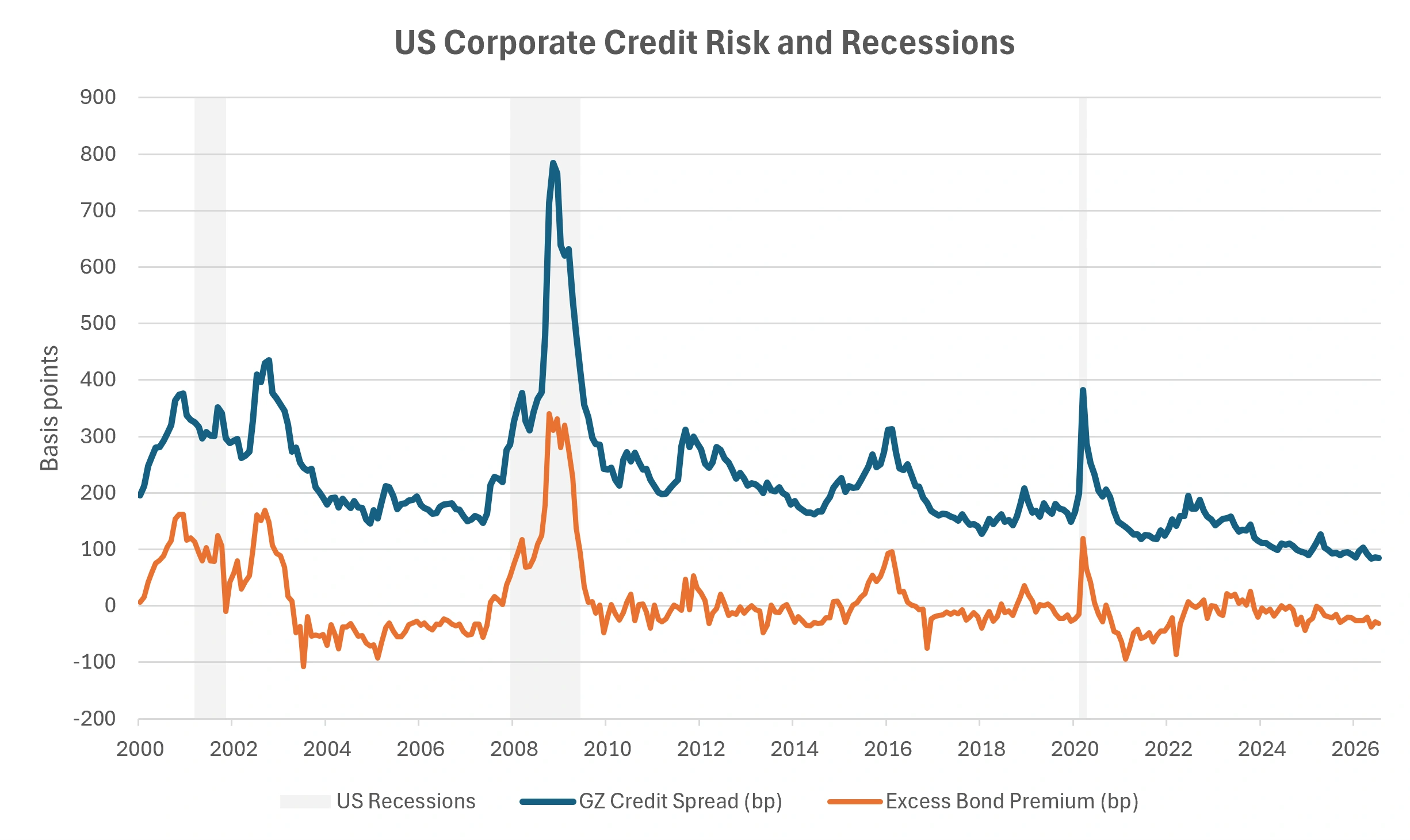
Source & Methodology: Federal Reserve Board and National Bureau of Economic Research. The chart shows the monthly Gilchrist and Zakrajšek corporate credit spread and excess bond premium from January 2000 to July 2026. Both series are converted from percentage points to basis points. The GZ spread averages bond level spreads over matched synthetic risk-free securities, while the excess bond premium represents the portion not directly attributable to expected default risk. Shaded areas indicate NBER dated US recessions. The Federal Reserve Board notes that the series is a staff research product and may be revised. Data downloaded on 6 August 2026 and available through July 2026.
What Credit Spreads Cannot Tell Us
Spreads can be affected by market liquidity, central bank purchases, institutional demand, index composition and sector specific events. Investors’ expectations may also prove incorrect.
Credit spreads cannot identify a precise recession date or reliably measure how severe a downturn will be. Their message is strongest when considered alongside employment, business activity, lending standards, company earnings and other measures of financial conditions.
How Should Investors Interpret Credit Spreads?
| Credit Spread Move | What It Can Suggest |
| Spreads widening | Risk concerns increasing and financing conditions tightening |
| Spreads narrowing | Risk appetite improving and financing conditions easing |
| High-yield spreads widening faster | Greater concern around lower-rated borrowers |
| Spreads widening despite rate cuts | Corporate financing conditions may still be tightening |
| Very narrow spreads | Strong confidence, but potentially limited compensation for credit risk |
Bottom Line
Credit spreads provide a useful window into how markets assess corporate risk and broader economic conditions. Widening spreads generally indicate rising concern and tighter financing conditions, while narrowing spreads tend to signal stronger confidence and easier access to funding.
Because bond markets are forward looking, changes in credit spreads can sometimes appear before shifts become visible in official economic data. But they are not reliable recession forecasts on their own.
Credit spreads are therefore most useful when considered alongside employment, business activity, corporate earnings, lending conditions and other economic indicators.