














Interest Rate Cuts and Stocks: Why Lower Rates Don’t Always Lift Markets


Interest rate cuts and stocks are often expected to move in the same direction, with lower rates generally viewed as positive for equity markets. Lower rates can reduce borrowing costs, support economic activity and increase the value investors place on future company earnings. This is why expectations of lower rates can sometimes lift equity markets before a central bank has even acted.
However, stocks do not respond to the rate cut alone. Investors also consider why rates are being reduced and what the decision suggests about economic growth, corporate earnings and financial stability. A cut designed to protect an otherwise resilient economy can support markets, while one introduced in response to a recession or financial crisis may not be enough to prevent stocks from falling.
Why Rate Cuts Usually Support Stocks
One of the main ways interest rates affect stock valuations is through the discount rate.
A company’s value depends partly on the profits and cash flows investors expect it to generate in the future. Because money received several years from now is not worth the same as money received today, those future cash flows are discounted back to their present value.
When interest rates fall, the discount rate used in this calculation may also decline. All else being equal, this increases the present value of expected future earnings and can raise the valuation investors are willing to pay for a company.
Lower rates may also reduce financing costs. Companies can potentially borrow more cheaply to invest, expand or refinance existing debt. Households may also face lower borrowing costs, which can support consumer spending and business revenues.
This creates a generally supportive environment for stocks, particularly when economic growth.
Why Interest Rate Cuts Matters for Stocks
Central banks reduce interest rates for different reasons.
Sometimes rates are cut as a precaution. Inflation may be easing, economic growth may be slowing modestly, and policymakers may want to prevent a more serious downturn. These are sometimes described as “insurance cuts” because they are intended to protect the expansion against emerging risks.
In this environment, lower rates may support stocks because the economy is still growing and company earnings remain relatively resilient. Investors can benefit from both a lower discount rate and a stable profit outlook.
At other times, central banks cut rates because the economy is already deteriorating. Unemployment may be rising, consumer spending may be weakening, or financial stress may be spreading through the banking and credit markets.
In these circumstances, the cut itself can confirm that the economic outlook has become more serious. Investors may focus less on cheaper borrowing and more on the possibility of falling corporate profits.
This is the key distinction: a rate cut can support valuations, but it cannot automatically offset a major decline in expected earnings.
What History Shows
The 2001 downturn offers another example. On 3 January 2001, the Fed reduced its target for the federal funds rate from 6.50% to 6.00%. Further cuts followed, taking the rate to 1.75% by the end of the year. However, the collapse of the dotcom bubble continued, and the US economy entered a recession that lasted from March to November 2001.
Technology shares remained under pressure because company valuations had become stretched and earnings expectations were being revised lower. Lower interest rates could not immediately repair those underlying problems.
The Global Financial Crisis provides an even clearer example. The Federal Reserve began cutting interest rates in September 2007 as stress in credit and housing markets intensified.
Rates continued falling throughout 2008, eventually reaching a target range of 0% to 0.25% in December. However, US equities continued declining as the banking crisis deepened, credit conditions tightened and expectations for corporate earnings deteriorated.
In this environment, lower interest rates were outweighed by concerns over financial stability and the severity of the economic downturn. The episode demonstrated that monetary easing may take time to influence markets when the underlying problem extends beyond borrowing costs.
A similar pattern appeared during the COVID-19 market shock. The Fed announced an emergency cut on 3 March 2020, followed by another major reduction on 15 March that lowered the target range to 0% to 0.25%. Stocks nevertheless continued falling as lockdowns brought large parts of the global economy to a sudden stop.
The S&P 500 ultimately declined by approximately 34% from its February peak to its 23 March low. The market began recovering only after investors considered the combined impact of monetary support, fiscal stimulus and the possibility that economic activity could eventually restart.
S&P 500 vs Effective Federal Funds Rate (2000-Present)
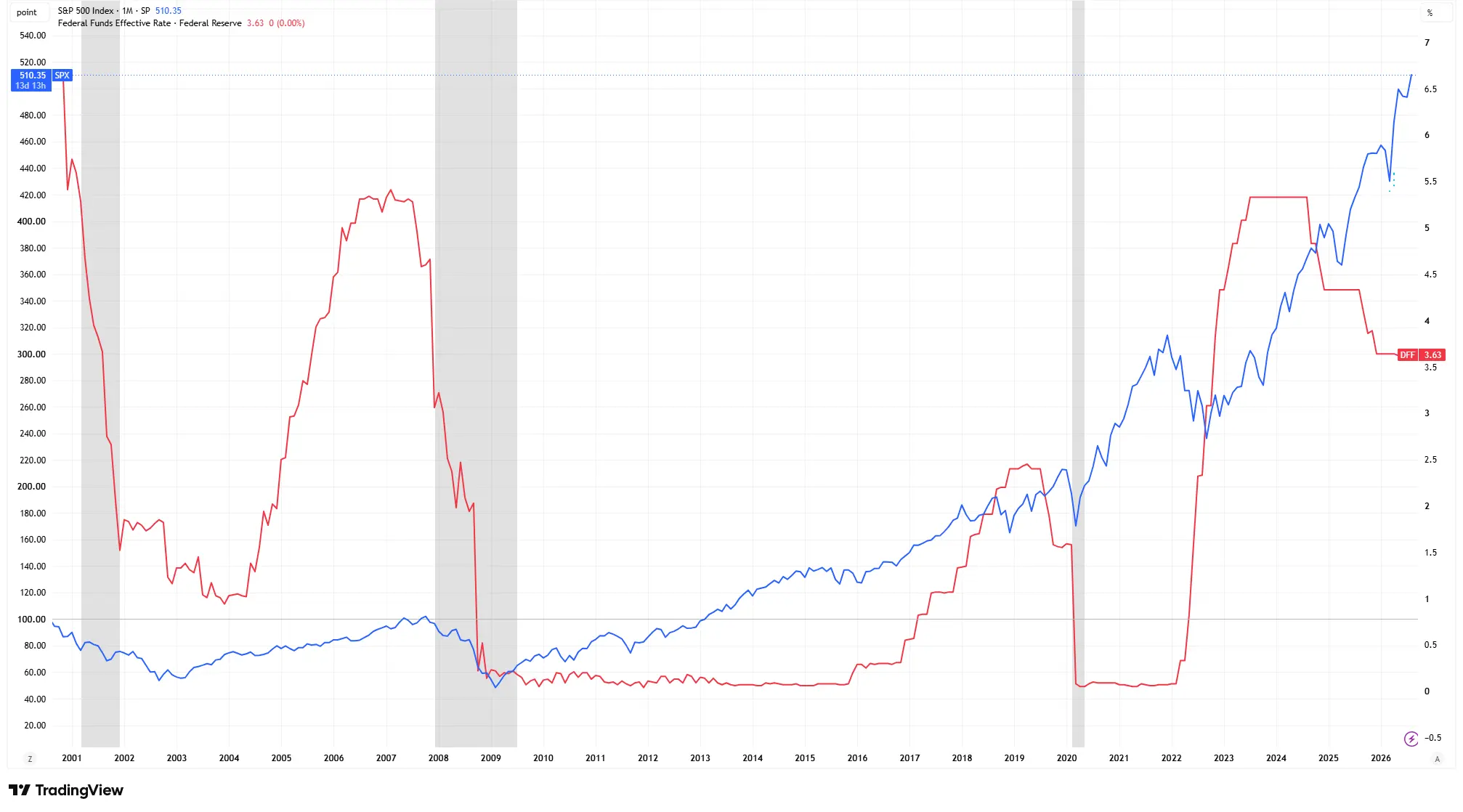
The chart compares the indexed performance of the S&P 500 with the level of the US Effective Federal Funds Rate. During the 2001 downturn, the Global Financial Crisis and the 2020 pandemic shock, stocks initially fell even as the Federal Reserve reduced interest rates. This illustrates that lower rates do not automatically lift equity markets when weaker growth, declining earnings expectations or financial stress outweigh the valuation benefits of easier monetary policy.
Why Markets May Fall After a Cut
Stock markets are forward-looking, which means they often react before a central bank announces a decision.
The Rate Cut May Already Be Priced In
If investors have already anticipated a cut, it may be reflected in market prices.
The announcement may therefore provide little new support. Markets could even fall if the reduction is smaller than expected or if the central bank’s accompanying statement signals greater concern about the economy.
Earnings expectations also matter. If analysts reduce their profit forecasts while interest rates are falling, the weaker earnings outlook may outweigh the benefit of a lower discount rate.
Credit conditions provide another important signal. During periods of financial stress, banks may become reluctant to lend even after policy rates have been reduced. If credit spreads continue widening and access to financing remains limited, the rate cut may take time to influence the broader economy.
Bottom Line
Interest rate cuts can support stocks by lowering borrowing costs, reducing discount rates and making government bonds less competitive relative to equities. However, these benefits do not operate in isolation.
When cuts are introduced while growth and earnings remain resilient, stocks may respond positively. When they are made in response to a recession, financial crisis or sharp decline in corporate profits, markets may continue falling despite lower rates.
The direction of interest rates matters, but the reason behind the change matters just as much.