













Gotcha! How to Avoid Being Fooled by a False Breakout


Many traders have experienced a false breakout. Price moves above a resistance level or below a support level, suggesting a new trend may be starting. But shortly afterwards the market reverses and returns to the previous range.
A breakout often attracts attention because traders expect momentum to continue in the same direction. But markets don’t always move in a straight line. Sometimes a breakout fails because the underlying conditions aren’t strong enough to sustain the move.
Understanding why false breakouts happen can help traders interpret market behaviour more clearly.
What is a Breakout?
A breakout occurs when price moves beyond a level where it has previously struggled to continue higher or lower.
These levels are known as support and resistance. Support is an area where buying pressure has previously stopped prices from falling further. Resistance is where selling pressure has previously limited upward moves.
When price breaks beyond these areas, traders often interpret it as a shift in sentiment. For example, if resistance is broken, it may suggest buyers are becoming stronger. If support is broken, it may signal increasing selling pressure.
Because of this, breakouts are widely watched as potential signals that a new trend could begin.
How Liquidity Can Cause a False Breakout
One reason false breakouts occur is related to liquidity, which describes how easily assets can be bought or sold in the market.
Markets move when buy and sell orders interact. If there is a temporary imbalance between buyers and sellers, price may briefly move beyond a key level.
However, if there is not enough continued buying or selling interest, the move can quickly lose momentum. When this happens, price may fall back into the previous trading range.
This means the breakout was driven more by short-term order flow than a lasting change in market sentiment.
Stop-Loss Orders and Market Positioning
Gold False Breakout Near Key Resistance
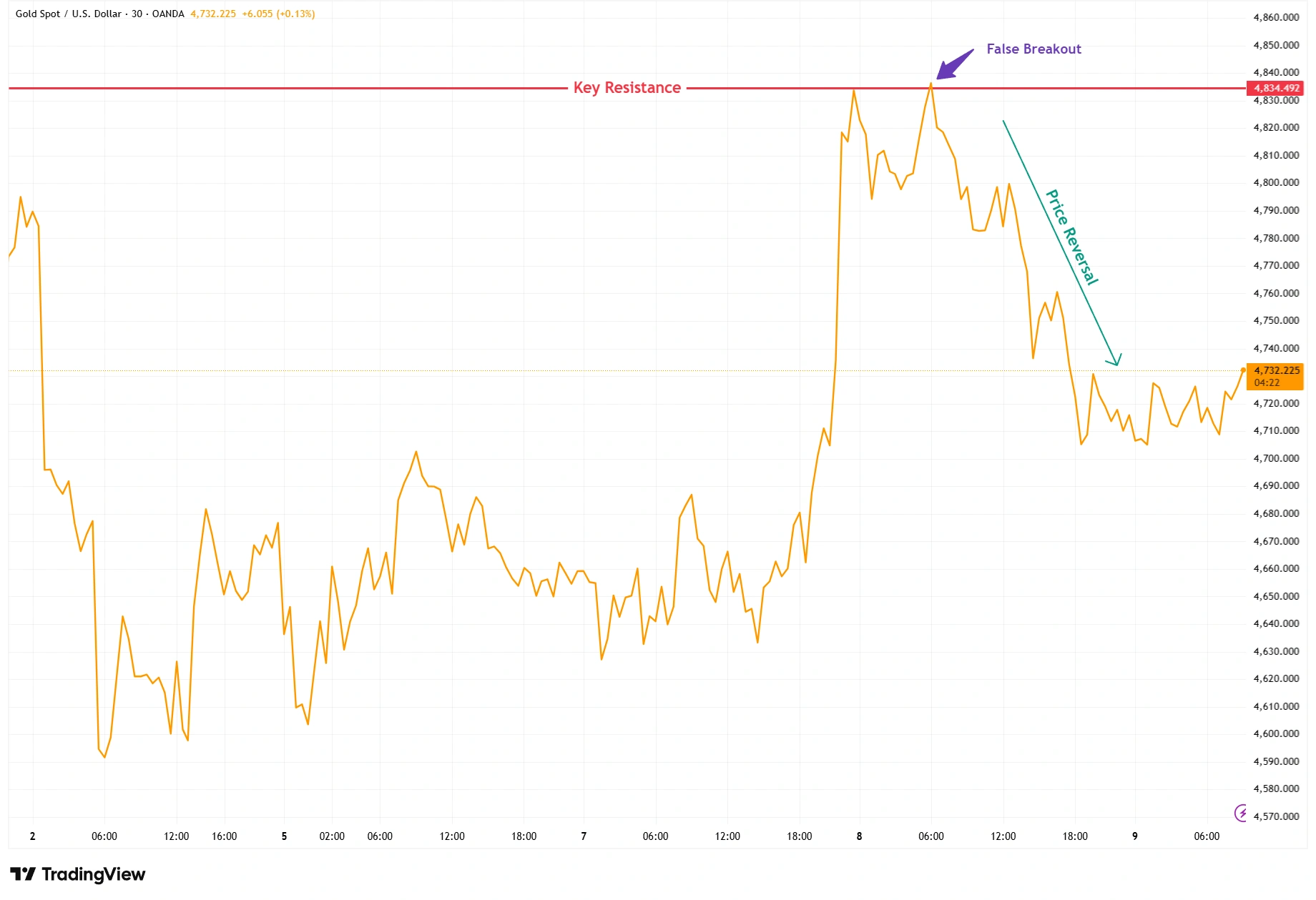
False breakouts can also occur because of stop-loss orders.
Many traders place stop-loss orders just above resistance or just below support in order to manage risk. When price reaches these levels, a cluster of stop orders may be triggered at the same time.
This can temporarily push price further in the breakout direction. But once those orders have been filled, the market may lack enough new participants to sustain the move.
As a result, price often reverses back into the previous range.
Expectations and Trader Behaviour
Some traders try to anticipate breakouts by entering positions before price fully moves through a level. This activity can create short bursts of momentum.
If the market does not receive further buying or selling pressure, those traders may quickly close their positions. Their exit can accelerate the reversal, turning what initially appeared to be a breakout into a failed move.
In this way, expectations and positioning can influence market behaviour even without new economic information.
What Can Traders Learn From a False Breakout?
False breakouts are a normal part of financial markets. Not every breakout leads to a sustained trend.
For traders, this highlights the importance of patience and risk management.
Rather than reacting immediately to every move beyond support or resistance, some traders wait for confirmation. This may involve observing whether price remains above or below a level for a period of time or whether momentum continues in the breakout direction.
Recognising that markets often test key levels multiple times can help traders avoid reacting too quickly to short-term price movements.
Bottom Line
False breakouts happen because financial markets are driven by liquidity, positioning and trader behaviour.
Price may briefly move beyond a support or resistance level due to temporary order imbalances or clusters of stop-loss orders. Without sustained buying or selling pressure, these moves can quickly reverse.
Understanding why false breakouts occur can help traders interpret price action more clearly and manage risk when markets behave unexpectedly.