
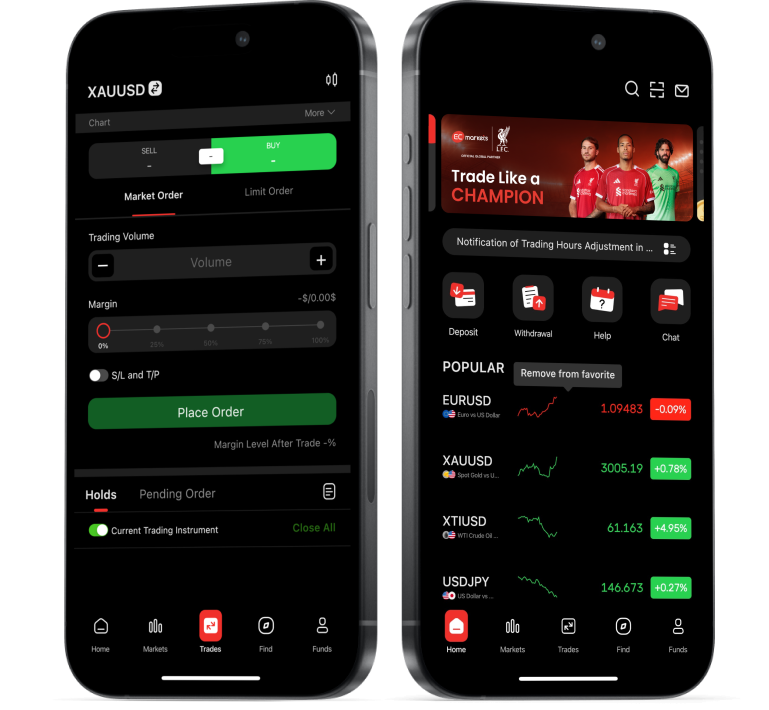












Demo Trading Account & Backtesting Trading Strategies
The biggest mistake beginner traders make is funding a live account before proving their strategy works. This is why traders must backtest trading strategies on historical price action to prove their rules work, then run those same rules on a demo trading account to confirm they can be followed under live conditions. This article covers how to run both stages, what the results actually mean, how to open a trading demo account and the standards that must be met before going live.
What is Backtesting?
When traders backtest trading strategies, they are running the strategy’s rules through historical charts to test how it would have performed. This gives traders a realistic idea of how their strategy may hold up in both good and bad trading conditions over the long run. To backtest trading strategies is to set a benchmark, which is especially important on a losing run as it reminds traders that drawdowns are normal and expected – preventing them from abandoning a valid strategy prematurely.
A solid backtest answers the following core questions:
- Expectancy: Over a large sample (100+ trades), do the average wins outweigh the average losses?
- Drawdowns: How bad are the worst losing streaks and how long do they last before the strategy recovers?
- Consistency: Does growth look reasonably consistent or does it rely on a handful of lucky trades to survive?
- Friction: Do the results still hold once spreads, slippage and imperfect fills are priced in?
How to Backtest Trading Strategies
When building a backtesting framework, the key thing to take into account is market friction. Many beginners fail here because they log historical trades as though every order filled at the exact price on the chart.
To properly backtest trading strategies, traders must ensure they do the following:
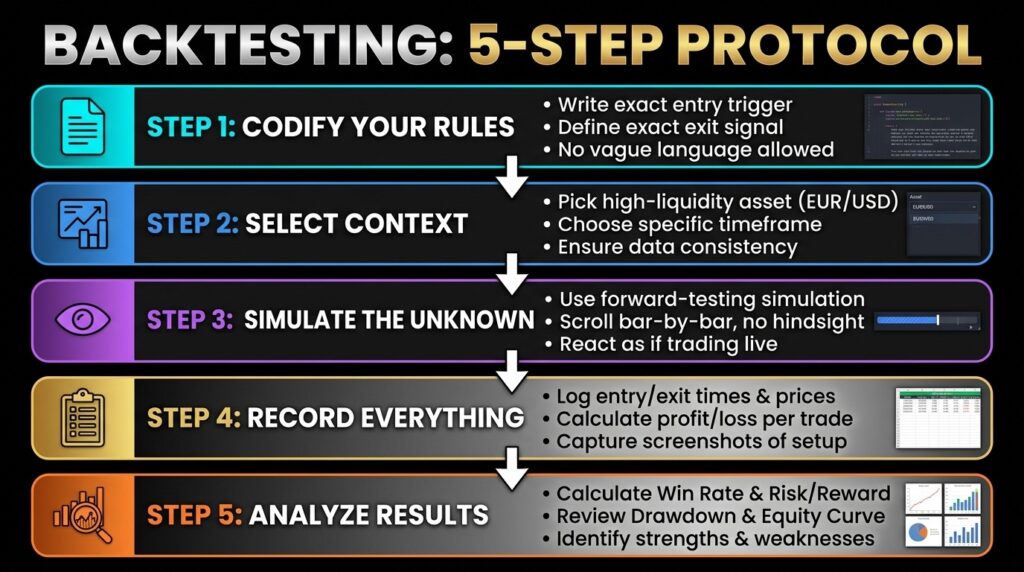
- Clearly define the rules
Write down the exact technical trigger for entry and the non-negotiable condition for exit, along with the stop loss, the target and the position size. - Fix the market and timeframe
Pick one high-liquidity asset, such as EUR/USD or GBP/USD, and one timeframe, then hold both constant for the entire test. Major pairs offer reliable data and tight spreads, whereas exotic pairs produce results that cannot be replicated. Timeframe matters just as much, because a strategy that works on the daily chart often collapses on the 5-minute chart. Mixing assets or timeframes mid-test averages several different strategies together and reveals nothing about any of them. - Hide the future
The the 'Visual Mode' within the Strategy Tester on MT4/MT5 (or ‘Bar Replay’ on TradingView) is a charting tool that allows traders to replay past price action candle by candle from a chosen point in the past. This is a reliable way to backtest trading strategies as it eliminates hindsight bias – the near-automatic belief that the winning trade would have been obvious on a completed chart. This forces traders to make decisions based only on the information available at that exact moment. It tests a trader’s ability to follow their rules when the outcome is unknown. - Log the friction
Record every execution, but apply the spread. If the entry signal fires at 1.1000 on a two-pip spread, log the entry at 1.1002 and the exit at the correspondingly worse price. Add commission where the broker charges it, and widen the spread around news events and session opens, where fills genuinely deteriorate. This ensures the real cost of doing business is accounted for. - Read the verdict
After 100 trades, look past the win rate. Focus on ‘Profit Factor’ and ‘Maximum Drawdown’.
- Profit Factor (PF) is Total Gross Profit ÷ Total Gross Loss. A PF of 1.5 to 2.0 is considered very healthy. A PF of 2.0 means for every $1 lost, $2 is made. If the PF is below 1.0, it means the strategy is losing money, and if it is above 3.0, it is often a sign that the backtest is unrealistic or that only the best trades are being cherry-picked.
- Maximum Drawdown is the largest peak-to-valley drop in the account balance during a losing streak. The common professional benchmark is under 15–20%. At around 40%, traders are at risk of panicking and may stop following their rules.
- Profit Factor (PF) is Total Gross Profit ÷ Total Gross Loss. A PF of 1.5 to 2.0 is considered very healthy. A PF of 2.0 means for every $1 lost, $2 is made. If the PF is below 1.0, it means the strategy is losing money, and if it is above 3.0, it is often a sign that the backtest is unrealistic or that only the best trades are being cherry-picked.
What is a Demo Trading Account?
A demo trading account provides a practice environment in which a trader can trade real-time market prices using virtual funds. It is a great practical way to refine trading skills by putting theory to the test without risking any actual capital before using a live account.
Here are the key benefits of practising on a demo trading account:
- Platform fluency: Getting comfortable using the trading platform, including placing various order types and setting targets and stop-losses.
- Cost awareness: Understanding how spreads, rollover/overnight swaps and session changes affect trading results.
- Rule testing: Traders can test how well their rules work when prices are moving in real time.
- Position sizing practice: Getting the hang of calculating lot size with leverage involved so that the risk per trade stays within limits.
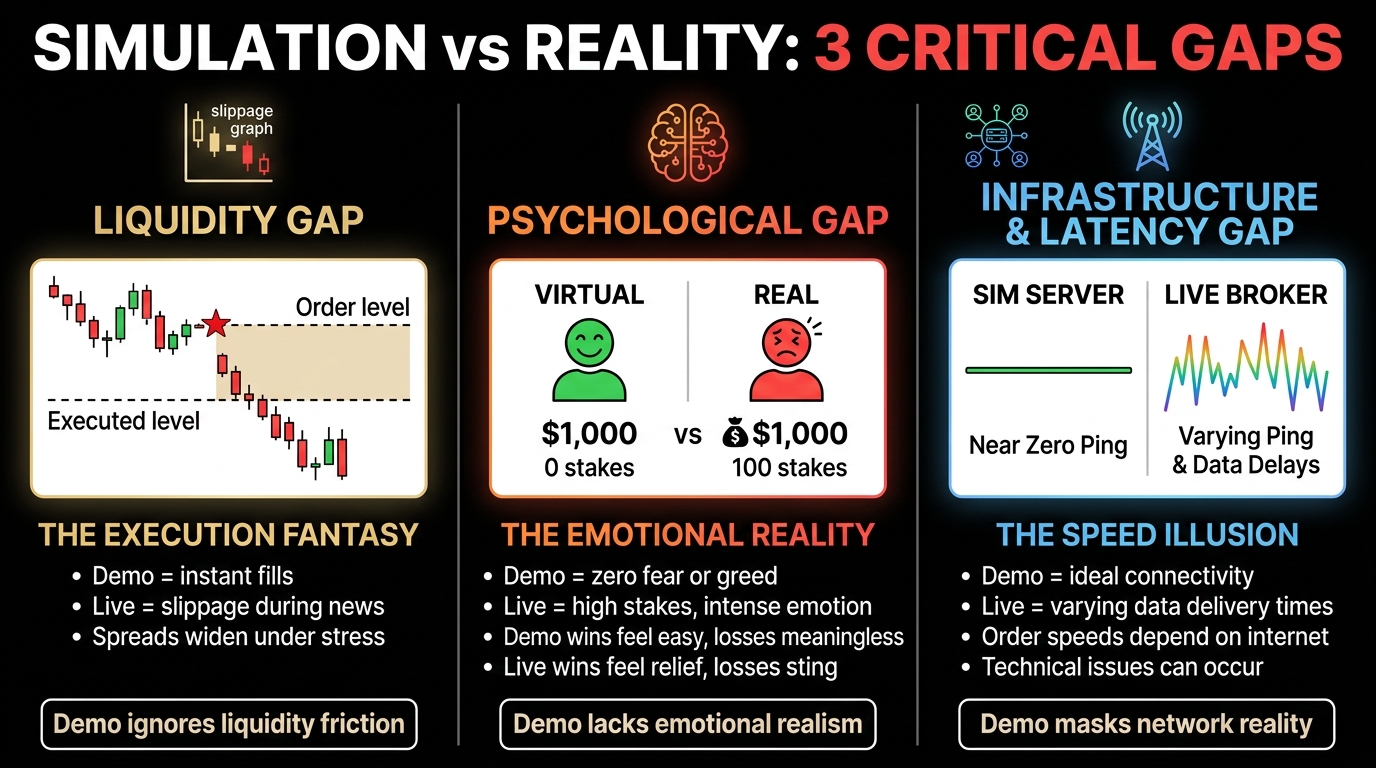
At the same time, it is crucial to be aware of what cannot be replicated on a demo trading account.
- Emotions: Trading using real money introduces pressure and hesitation, making it harder to follow rules and stay calm.
- Execution conditions: In trading demo accounts, order fills are often cleaner than in live trading – slippage, partial fills and re-quotes are usually minimal, so execution can seem better than what it really is.
The bottom line is that a demo trading account is great for learning the tools and running a trading strategy. However, it does not prepare traders psychologically, nor does it perfectly replicate real trading conditions when capital is on the line.
How Backtesting and a Demo Trading Account Work Together
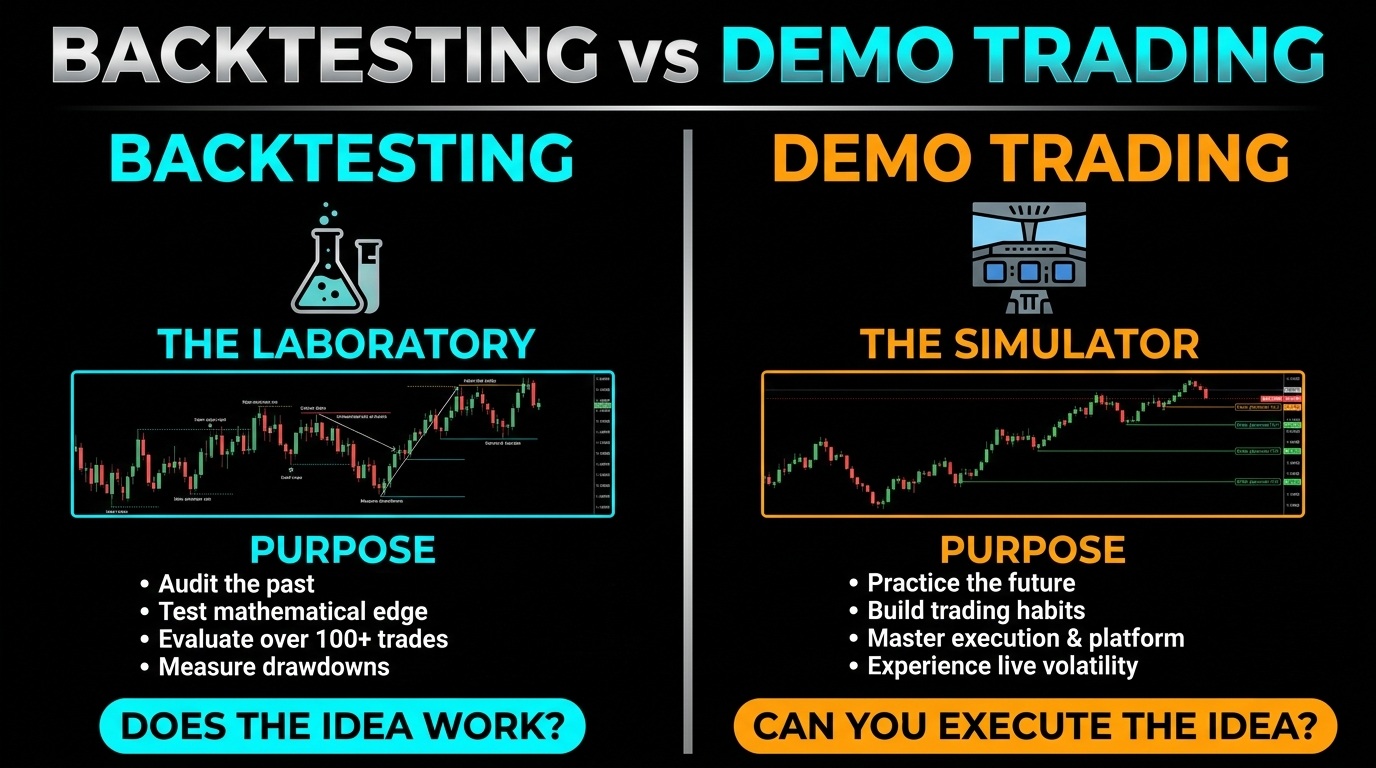
It is crucial to backtest trading strategies and practise on a trading demo account in order to answer two important questions: does the strategy work and how well can it be pulled off? Inexperienced traders often fail to realise both are needed. However, each method must be treated as a separate tool with equal importance and used in the right order before any real capital is put on the line.
Here is how backtesting and a trading demo account answer those questions:
- Does the strategy work?
Backtesting evaluates the strategy, not the trader. It indicates whether the rules can produce a positive result over a meaningful sample – 100 trades or more. The focus should fall not on the win rate, but on what the strategy costs during its worst stretches, since those losses are what destroy accounts. - Can the strategy be executed well?
Once backtesting proves that the strategy works, the next step is to test the trader and the platform using a demo trading account. This is where the gap between knowing the rules and following them is exposed under live conditions. It also exposes any operational errors, such as wrong lot size or stop placement. Using a trading demo account reveals whether the strategy is compatible with the trader’s schedule and temperament.
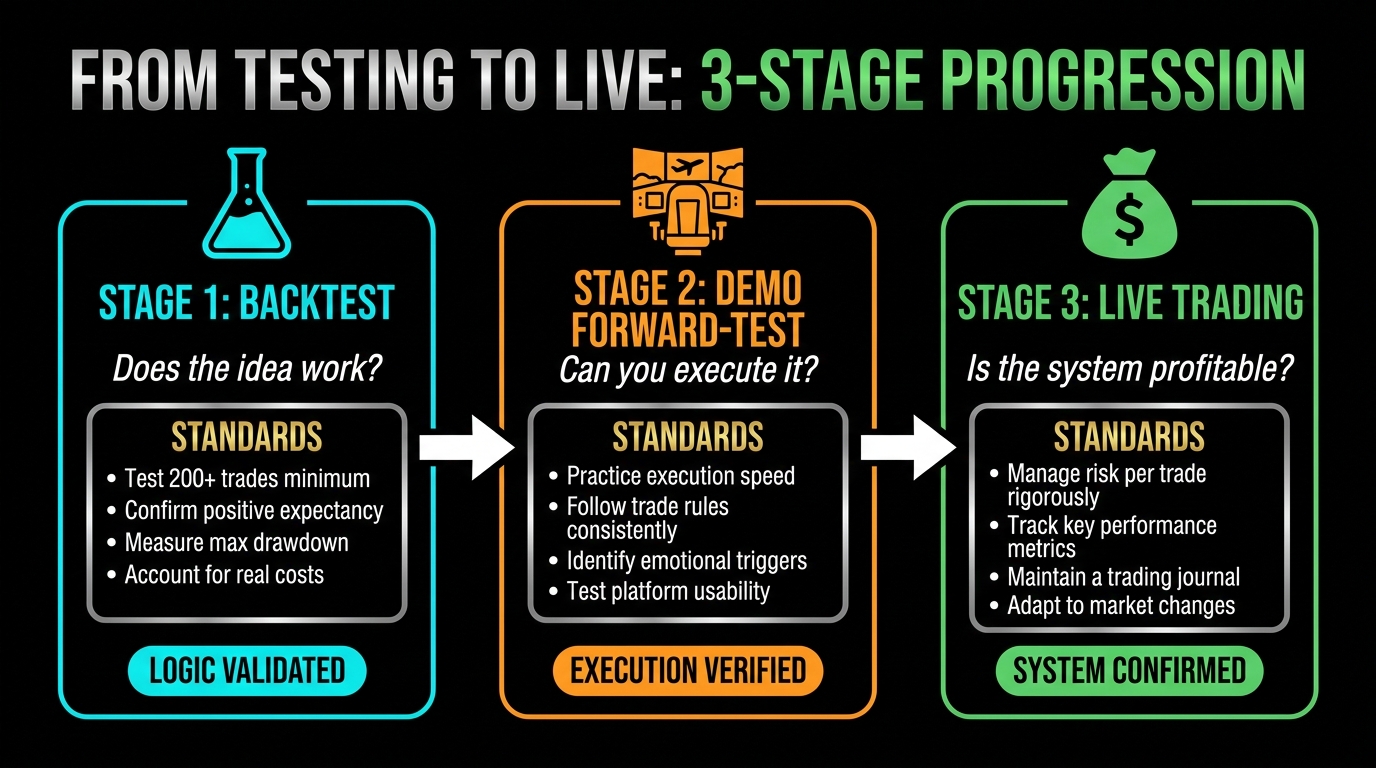
A typical progression:
- Backtest. Confirm the edge exists on historical data across 100+ trades, with a survivable drawdown.
- Demo forward-test. Run the rules in real time for 30 consecutive days – no improvising, no exceptions.
- Micro-live pilot. Go live at the smallest size possible to test what no simulation can: emotion, discipline and genuine risk tolerance.
Backtesting is not a one-off exercise: traders return to backtest trading strategies whenever a rule is adjusted, then re-run the revised version on a demo trading account, because a modified strategy is an untested one.
When to Start Trading on a Live Account
Some traders go live simply because they feel ‘ready’, or because they believe they have tested for long enough. Both are the wrong reason. The goal of the testing phase is to remove execution mistakes and prove that the strategy has a real edge.
A sensible transition from the trading demo account to live trading should happen only after the following three standards are met:
- Rule Discipline: Roughly 50-100 trades completed with no rule breaks. A moved stop, a revenge trade, a valid setup skipped out of fear, or a random entry taken out of boredom does not mean ‘almost ready’ – it means ‘still training’.
- Proven Performance: Results that show profitability across the full sample, not across a good week. Win rate is easy to obsess over, but what matters is whether the average outcome actually works after losers, costs and rough patches. Also, maximum drawdown must sit at a tolerable level to avoid the risk of the trader panicking and straying from the plan if they see a large loss.
- Platform Fluency: Placing orders, setting stops/targets, adjusting positions and closing trades should feel routine. In fast markets, traders do not get ‘extra time’ to figure out the platform – that is what the trading demo account is for.
The move to live trading should not be a jump from $0 risk to full position size. Start with a micro-live phase: the smallest position the broker allows that still feels real. This is where the effect of real money shows up – hesitating before entries, closing winners too early, wanting to widen a stop. If discipline holds at that size, increase it gradually, one step at a time, with the same rules and the same records.
How to Create a Demo Trading Account with EC Markets
It is common for those just starting out to build a fantasy when using a demo account for the first time. However, a live journey starting with $2,000 should not begin with a $100,000 demo. Overfunding the demo trading account creates a psychological ‘God complex’ that leads to over-leveraging.
The most best approach to using of a demo account is to match the virtual deposit to the actual budget. This will not eliminate the gap between simulation and reality, but it will ensure position-sizing habits are built on hard facts rather than imaginary capital. Use this space to master the mechanics, not to hunt for simulated glory.
Setting up a trading demo account is easy and takes only a few minutes.
Here is a full guide on How to Create an EC Markets Demo Account.
Conclusion
An untested strategy is not a plan – it is a gamble dressed in nice clothes. Traders should always backtest trading strategies to know whether or not a strategy can survive the worst stretches. A trading demo account then tests something different: whether the trader can execute those rules accurately when prices are moving. Neither replaces the other, and neither models the psychological effect of live capital. What emerges is not certainty – no simulation can offer that – but evidence, and evidence is what earns the right to risk real money.
Note:
This content is for general information and educational purposes only and does not constitute investment advice or a personal recommendation. Any examples are for illustration only and should not be treated as a signal or invitation to trade. This material does not take into account your investment objectives, financial situation or needs. CFD trading is high-risk; losses may exceed deposits.