












How to Create a Trading Strategy
The biggest mistake beginners make is trading on instinct, which makes a winning trade impossible to repeat. Placing a buy order just because price ‘looks cheap’ is not a strategy – that is just hope. A trading strategy answers what to trade, when to enter, where the idea is proven wrong and how much to risk, to ensure that trading is rules-based and results are consistent. This article covers what a trading plan must achieve, how to build one, how to confirm it works through backtesting trading strategies and how to execute it consistently once real money is involved.
Key Goals of a Trading Strategy
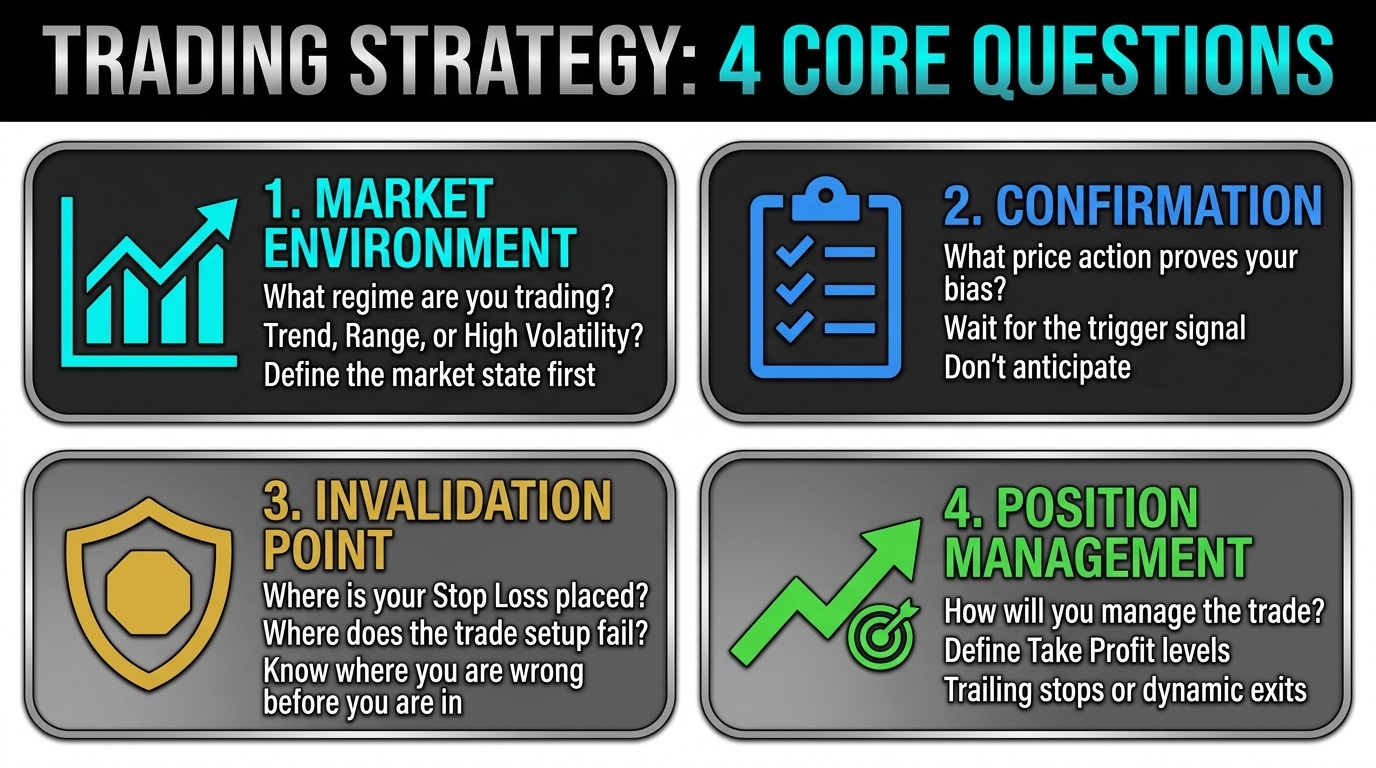
Before any trading decisions are made, a trading plan must answer the following four questions to leave no room for judgement:
- Which market regime will be traded?
Trends, ranges and high-volatility news spikes are different market regimes that each require completely different logic. If the market is not aligned with the strategy’s specific regime, it is best not to open a position. - What does confirmation look like?
Determine what specific price action confirms the signal to trade. Rather than anticipating a move, it is better to wait for the trigger of confirmation. - Where is the point of invalidation?
Determine the exact price at which the trade logic is proven wrong. If that price is reached, then exit the trade – no ifs, no buts and no waiting for a bounce. - What is the position size?
Experienced traders reverse engineer their position size based on the distance between their entry and stop-loss. How much to put at stake should come down to what the math says, not what feels like a ‘good amount’.
Build a Trading Strategy in 3 Steps
Answering the four questions is the thinking. Writing a trading plan is the work, and it takes three steps.
Step 1: Define the entry criteria
There are two parts to this step: location and trigger. First, identify a high-value location, such as a major support/resistance level or a daily trendline. Then the trigger, such as a pin bar or engulfing candle, which proves that the level is being respected. Even if a good candlestick pattern is spotted, it is only a valid entry if it aligns with the market regime.
Step 2: Establish a risk management framework
Two important parts to this are to define the risk per trade (e.g. 1% of account equity) and calculate position size. A useful tool to help with calculating position size is the ATR (Average True Range), which measures market volatility and its figure can be used to set a stop distance (usually a multiple of ATR e.g. x1 or x1.5). From there, the risk amount divided by the stop distance gives the position size. Keep in mind that the wider the stop, the smaller the position size needs to be to keep risk at 1%.
Step 3: Set targets
Use the chart to determine where to exit. Set take-profit targets based off key levels identified on the chart, such as a previous session high or a supply zone. This is better than setting targets based on a fixed risk-to-reward ratio, hoping that the price will eventually get there. It is better to skip a trade than enter one with an unrealistic goal that the market structure does not support.
Backtesting Trading Strategies
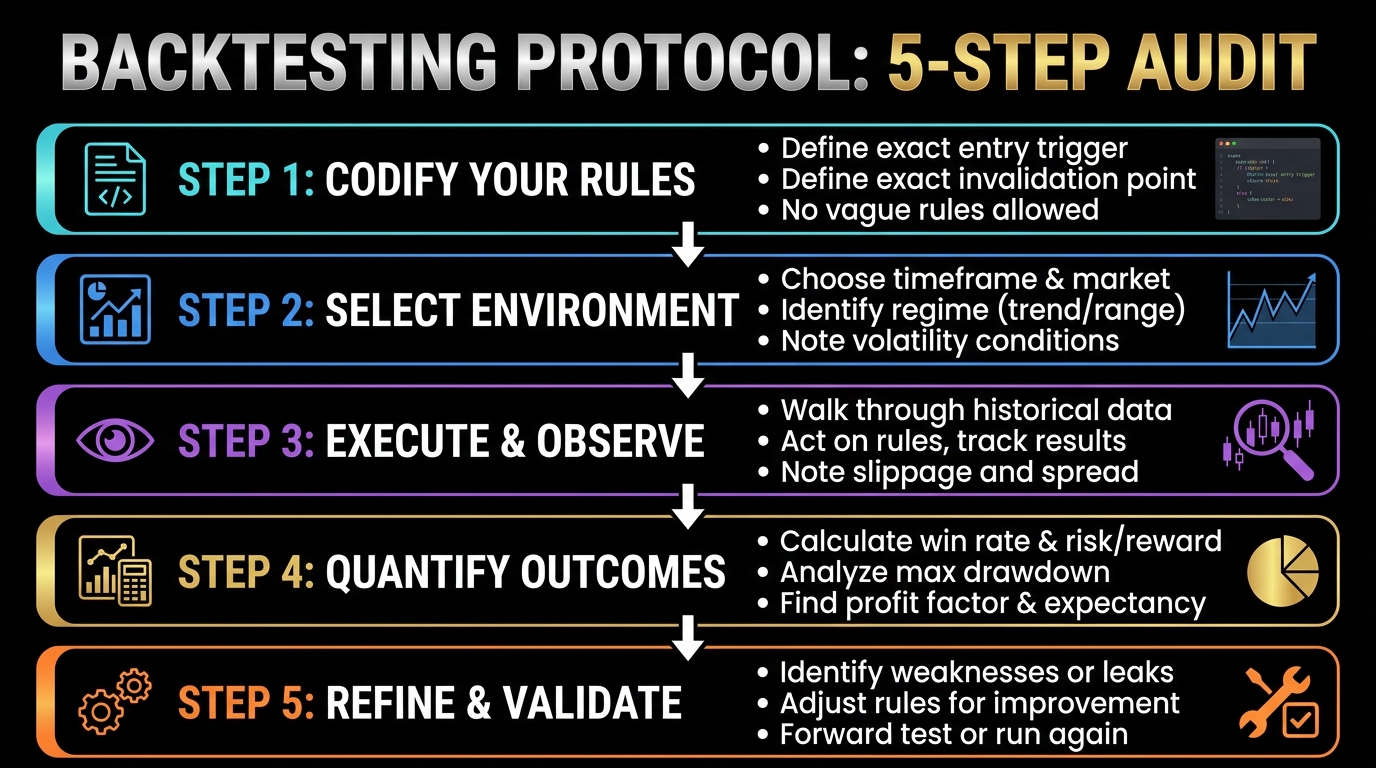
Before risking a single dollar of live capital, backtesting trading strategies is a great way of putting them to the test. This involves putting a trading strategy through a rigorous audit of historical data. The whole idea behind backtesting trading strategies is not so much about proving that a strategy works – it is about finding out where it breaks. It is not about looking for a perfect 100% win-rate but determining its maximum drawdown. The key thing to focus on when backtesting trading strategies is how a strategy performs on its worst days, such as a 10-day losing streak. Here is a 5-step protocol to follow in a backtest:
- Establish the non-negotiables
Define what the exact technical trigger is for entry and what the invalidation point is for the exit. A trading plan with vague rules combined with trading decisions that are based on personal judgement will not produce valid results when the plan is tested. - Determine the market regime
Set the instrument, timeframe and date range before starting. Record the regime each trade was taken in – trending, ranging, high-volatility or low-liquidity. When backtesting trading strategies over the course of 100+ trades, regime shifts will happen. That is why labelling each trade will eventually show which market structures the trading strategy holds a statistical edge in, as well as which ones it does not. - Simulate the trade in real time
Backtesting trading strategies involves using a dedicated tool to help run a fair test. On MT4/MT5, the 'Visual Mode' within the Strategy Tester (or TradingView's 'Bar Replay' feature) allows traders to put their trading plan to the test by replaying price action on a chart from any selected point in the past. Hiding future price action is a great way to eliminate ‘hindsight bias’, which is a common mistake made by traders thinking that they would have made the right trading decision while looking at a chart with price action that has already happened. Analysing the market and committing to decisions without knowing the outcome of the next candle closely replicates the level of uncertainty and pressure that comes with live trading. - Deduct the costs and audit the result
Chart prices are not the prices a trade actually receives, so adjust every entry and exit for spread and slippage – if the chart shows 1.1000, a buy fills at 1.1002, and ignoring those 2 pips inflates every result. Track the equity curve and record the maximum drawdown – the largest drop from a peak balance. If the balance grows from $10,000 to $11,000 and then falls to $9,500, the maximum drawdown is $1,500. What matters is not a high win rate, but a drawdown sustainable enough not to trigger a margin call. - Locate the failure points
Rather than asking whether the trading strategy is profitable, ask under what conditions the logic breaks. Search the losing trades for a clustering of losses, which are repeated failures under the same conditions. Typical clusters include ranging markets, high-impact releases, such as Non-Farm Payrolls (NFP), and the low-liquidity Asian session. These are not flaws to fix – they are boundaries that mark where the strategy holds no advantage. Turn those boundaries into a no-trade list to stay out of the market during the weakest periods.
How to Execute a Trading Strategy with Discipline
Creating a strategy is one part. Mastering its execution is another. Here are three key things to keep in mind when carrying out a trading strategy:
- Strategy hopping is one of the most common reasons traders fail.
A few losses convince most beginners the strategy is broken, so the plan is abandoned and a new one is found the following month. Every system, including the best ones, goes through a drawdown – a normal run of consecutive losses caused by shifting market conditions. Professional results come from holding to the rules through that drawdown until conditions suit the trading strategy again. - Build consistency through repetition.
Execution consistency is the ability to follow the trading plan exactly as written, trade after trade, without deviating when a setup looks unusually promising or a losing run makes the rules feel wrong. The skill of staying consistent builds through repetition. More time spent working with one trading strategy can reveal nuances no manual can teach, such as recognising when price action has become too random to trade. Improvement in trading does not come from a more complex formula, but from narrowing the gap between what the trading plan says and what actually gets done. - Master one method rather than sampling many.
Complexity is not professionalism. In forex, the simplest rules are often the most effective, because they are the easiest to follow without error under pressure. The aim is to become an expert in executing one set of rules rather than a beginner in many, since a method only produces reliable results once it has been traded enough times to be understood. Sticking to one proven method and focusing on process rather than emotion is what separates institutional traders from emotional retail traders, and it is the foundation of long-term survival in the market.
Conclusion
Simple rules, written down and followed properly, beat a complicated approach that changes every few weeks. A trading plan removes the guesswork from a moving chart, replacing instinct with four clear answers about regime, confirmation, invalidation and position size. Backtesting trading strategies then establishes the boundaries of the strategy, leaving execution consistency as the remaining determinant of performance.
Note:
This content is for general information and educational purposes only and does not constitute investment advice or a personal recommendation. Any examples are for illustration only and should not be treated as a signal or invitation to trade. This material does not take into account your investment objectives, financial situation or needs. CFD trading is high-risk; losses may exceed deposits.