













Global Risk Premium: Everything You Need To Know


Financial markets are not only driven by economic data. They are also constantly pricing uncertainty. This is where the idea of the global risk premium comes in.
In simple terms, the global risk premium is the extra return investors expect for taking on risk in an uncertain world. When uncertainty rises, that required return increases, and the impact is often felt across equities, bonds, currencies and commodities at the same time.
What Is the Global Risk Premium?
The global risk premium is not a single number. It reflects how much additional return investors demand to hold riskier assets instead of safer ones.
A simple way to see this is through credit spreads. In the US, the spread between BAA and AAA corporate bonds is currently around 1.16%, which remains historically tight.
These relatively narrow spreads suggest that investors are still comfortable taking on risk, even in a more uncertain macro environment.
Because global markets are interconnected, this premium is not confined to one region. Changes in sentiment in one part of the world can quickly influence pricing elsewhere.
What Moves the Global Risk Premium?
The global risk premium tends to rise when investors feel less confident about the future. This can be driven by economic uncertainty, inflation risks, central bank policy, and geopolitical developments.
Recent inflation cycles and aggressive monetary tightening have already created a more uncertain backdrop. At the same time, geopolitical tensions have become an important driver.
For example, the spread between Italian and German 10-year government bonds widened to around 0.79% and briefly rose above 1% during periods of heightened geopolitical stress.
In simple terms, when the outlook becomes less predictable, investors demand more compensation before taking on risk.
Recent Market Activity
Recent market behaviour highlights how quickly the global risk premium can shift across regions.
In the US, credit spreads remain relatively tight, reflecting expectations of a “soft landing” despite sensitivity to interest rate policy.
In contrast, Europe has seen sharper moves in sovereign spreads during periods of geopolitical stress, particularly as investors shift toward safer assets such as German government bonds.
At the same time, global volatility has remained elevated. The VIX, often used as a measure of market uncertainty, has spiked above 60 during recent stress periods, compared with more typical levels closer to 15 in calmer conditions.
S&P 500 vs Market Volatility Index (VIX)
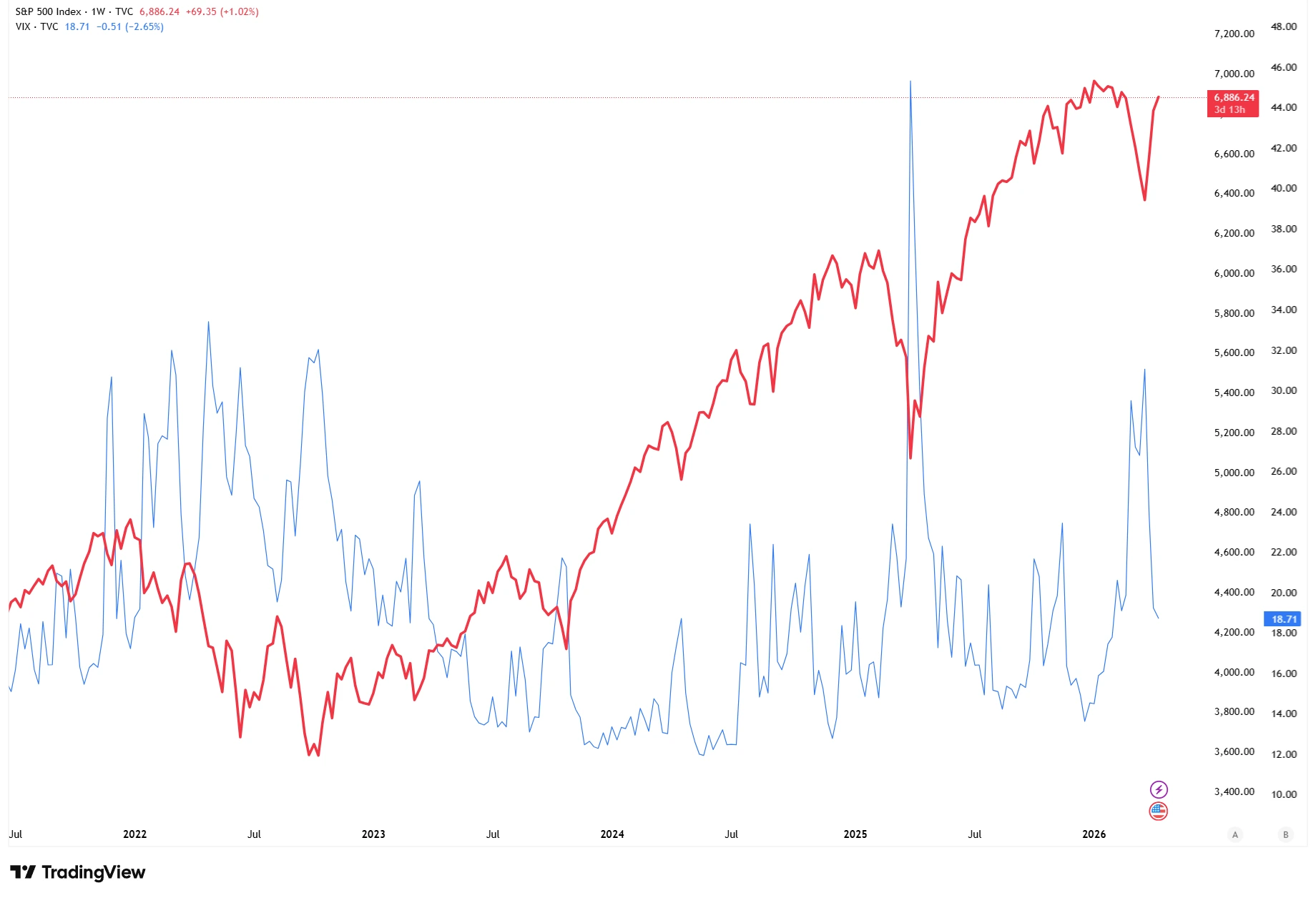
These movements show how quickly risk sentiment can change, even when underlying economic conditions appear stable.
How the Global Risk Premium Affects Markets
Changes in the global risk premium can influence multiple asset classes at once.
In equity markets, a higher risk premium can lead to lower valuations, as investors demand greater returns to justify holding risk assets.
In bond markets, it appears through wider credit spreads and higher yields on riskier debt, increasing borrowing costs for companies and governments.
In currency markets, rising uncertainty often drives capital toward safer currencies such as the US dollar, reflecting a preference for liquidity and stability.
In commodities, gold tends to benefit from higher uncertainty as investors seek a store of value, while growth-sensitive commodities may weaken if economic concerns increase.
Why Markets Can Move Quickly
Financial markets are forward-looking, meaning they react to changes in expectations rather than waiting for events to fully unfold.
Even small shifts in perceived risk can trigger large moves in asset prices. Periods of rising risk premium are often associated with higher volatility and can lead to sharp and sometimes unpredictable market movements.
Why It Matters for Investors
Understanding the global risk premium helps explain why markets do not always move in line with economic data alone. At times, prices are driven more by changes in confidence and uncertainty than by growth or earnings.
For investors and traders, this provides important context. It helps explain why markets may remain resilient even when risks are building, or why they can react sharply when sentiment shifts.
Bottom Line
The global risk premium is essentially the price of uncertainty in financial markets. When uncertainty rises, investors demand more compensation for taking on risk, which can weigh on equities, widen credit spreads, increase volatility and support safer assets.
When conditions stabilise, the opposite tends to happen. The risk premium falls, confidence improves and risk assets can recover.
Markets do not just react to what is happening today. They respond to how investors feel about what might happen next, and that shift in perception often drives price movements.