













Bitcoin vs Gold: Which Asset is the Safe Haven Now?


Bitcoin is often described as “digital gold”, but the two assets frequently behave very differently. Gold has historically been viewed as a defensive asset during periods of economic uncertainty, while Bitcoin has developed a reputation as a higher-risk investment that can deliver significant gains but also experience substantial volatility.
Comparing the relative performance of Bitcoin and gold can therefore provide valuable insight into investor sentiment. It helps traders assess whether markets are favouring growth-oriented assets or seeking the relative safety of traditional stores of value.
Why This Relationship Matters
Gold has long been regarded as a defensive asset and store of value during periods of economic uncertainty, geopolitical tensions and financial market stress.
Bitcoin, meanwhile, is a much younger asset that has attracted growing institutional participation, particularly following the introduction of spot Bitcoin exchange-traded funds. Despite this increasing adoption, it continues to display significantly higher volatility and stronger links to investor risk appetite.
Because of these differences, comparing Bitcoin and gold can provide valuable insight into broader market sentiment.
When Bitcoin outperforms gold, traders often interpret it as a sign that investors are becoming more comfortable taking risk and allocating capital towards growth-oriented assets. Conversely, when gold outperforms Bitcoin, it may suggest that investors are becoming more cautious and increasing their exposure to traditional defensive assets.
Although Bitcoin has increasingly been viewed by some investors as an alternative store of value, its price behaviour continues to differ from that of gold during many periods of market uncertainty.
What Recent Price Action Is Telling Us
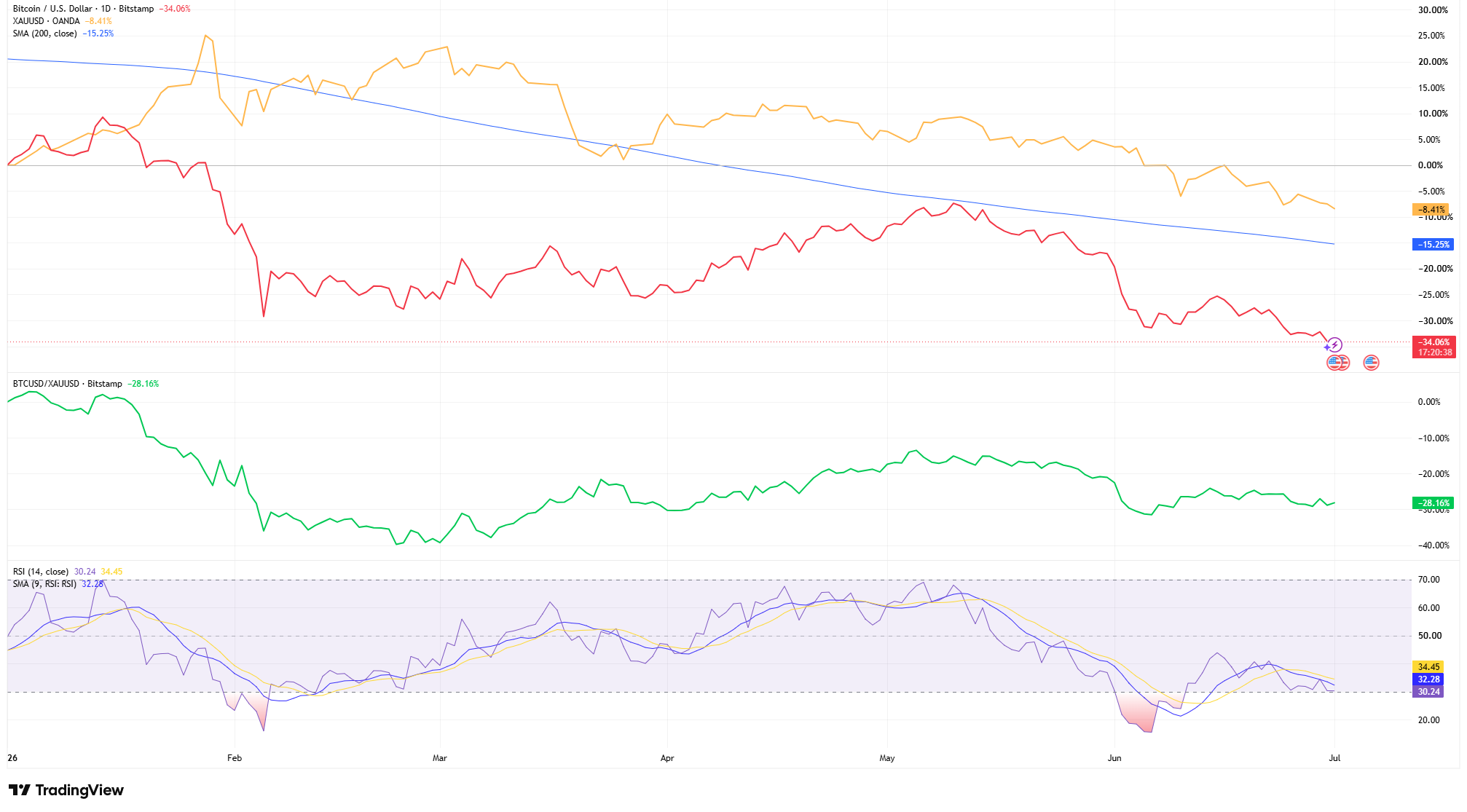
The chart highlights a clear divergence between the two assets over the selected period.
While both Bitcoin and gold have declined on a percentage performance basis, gold has proved considerably more resilient. At the time of writing, Gold Spot is down a modest -8.41%, while Bitcoin has fallen -34.06% over the same period.
This sizable performance gap suggests that investors have continued to favour the traditional safe haven over the more volatile digital asset.
Bitcoin vs Gold Performance Snapshot (1 July 2026)
- Gold Spot: -8.41%
- Bitcoin: -34.06%
- Bitcoin-to-Gold Ratio: -28.16%
- 200-Period SMA Baseline: -15.25%
Key Takeaway: Gold continues to outperform Bitcoin, reinforcing a more defensive tone across financial markets.
Bitcoin vs Gold Relative Performance, Bitcoin-to-Gold Ratio and RSI
Source: TradingView. Past performance is not a reliable indicator of future performance. Data as of 1 July 2026.
Daily three-panel chart showing Gold Spot (orange line) and Bitcoin (red line) plotted on a percentage performance basis with the 200-period simple moving average (blue line). The middle panel displays the Bitcoin-to-Gold ratio (green line), while the lower panel shows the 14-period Relative Strength Index (RSI) together with its moving average.
Reading the Technical Chart
The upper panel compares the percentage performance of Bitcoin and gold rather than their outright prices. Throughout most of the period, gold has remained the stronger performer.
Although Bitcoin experienced several rallies, particularly during the spring months, these moves proved relatively short-lived and failed to close the broader performance gap.
The 200-period simple moving average continues to slope lower and currently sits around -15.25% on the performance scale. Gold has remained much closer to this long-term trend benchmark, while Bitcoin continues to trade well below it, highlighting the difference in relative strength between the two assets.
The middle panel tracks the Bitcoin-to-Gold ratio, which currently stands at -28.16%. A rising ratio indicates Bitcoin is outperforming gold, while a falling ratio suggests gold is attracting relatively stronger demand.
Rather than focusing on every short-term fluctuation, traders typically look for sustained changes in the ratio to identify meaningful shifts in market leadership.
Momentum and Market Psychology
Momentum indicators provide additional context to the relationship between the two assets.
The Relative Strength Index (RSI) currently sits around 30.24, while its moving average is approximately 34.45. An RSI close to 30 suggests recent downside momentum has been relatively strong. However, traders generally avoid using RSI in isolation and instead combine it with trend analysis, price structure and key support and resistance levels.
From a psychological perspective, the relationship between Bitcoin and gold reflects the balance between optimism and caution.
Bitcoin typically attracts stronger demand when investor confidence is improving, liquidity conditions are supportive and appetite for higher-risk assets is increasing. Gold, meanwhile, often benefits during periods of geopolitical uncertainty, inflation concerns, financial market volatility or expectations of slower economic growth.
The recent price action reinforces the view that investors have continued to favour the relative stability of gold over the higher volatility associated with Bitcoin. While institutional adoption of Bitcoin continues to grow, the cryptocurrency has behaved more like a risk asset than a traditional safe haven during this period.
The Bottom Line
The relationship between Bitcoin and gold provides traders with another valuable lens through which to interpret market sentiment and investor confidence.
Throughout the period shown, gold has maintained clear leadership over Bitcoin, reinforcing the more defensive tone reflected across broader financial markets.
Neither asset moves in isolation. Relative performance, trend structure, moving averages, support and resistance levels and momentum indicators all provide valuable context when analysing this relationship.
By combining technical analysis with broader macroeconomic themes, traders can build a more complete understanding of changing market sentiment rather than relying solely on individual price movements.