














Brent Crude Holds Above $77 as Tensions Resurface in Middle East


Oil prices remained volatile on Thursday as renewed tensions in the Middle East continued to keep energy markets on edge. Brent crude traded around $77 per barrel, while West Texas Intermediate (WTI) hovered near $73, as investors weighed the risk of supply disruptions against hopes that the conflict would not spread further.
Despite easing from the highs reached earlier this week, both benchmarks remain comfortably above the levels seen before the latest escalation, highlighting how geopolitical risks continue to underpin oil prices.
The latest move follows a sharp deterioration in relations between the US and Iran after President Donald Trump declared that the interim ceasefire agreement was “over”, prompting a fresh round of US military strikes.
Attention quickly shifted to the Strait of Hormuz, one of the world’s most strategically important energy corridors. Around 20% of global oil consumption, or roughly 20 million barrels per day, passes through the narrow waterway, making any threat to shipping a major concern for global energy supplies.
Supply concerns have also intensified. Alongside the military escalation, the US has tightened restrictions on Iranian oil exports, reducing expectations for the amount of crude available to international buyers. With global inventories already relatively tight, traders have become increasingly sensitive to developments that could limit supply further.
Brent crude briefly climbed above $80 per barrel before easing back as investors reassessed whether the conflict would result in longer term supply disruptions. The move highlights how quickly geopolitical events can influence oil prices, even when physical supplies have not yet been affected.
Brent and WTI Hold Above Pre Escalation Levels Despite Pullback
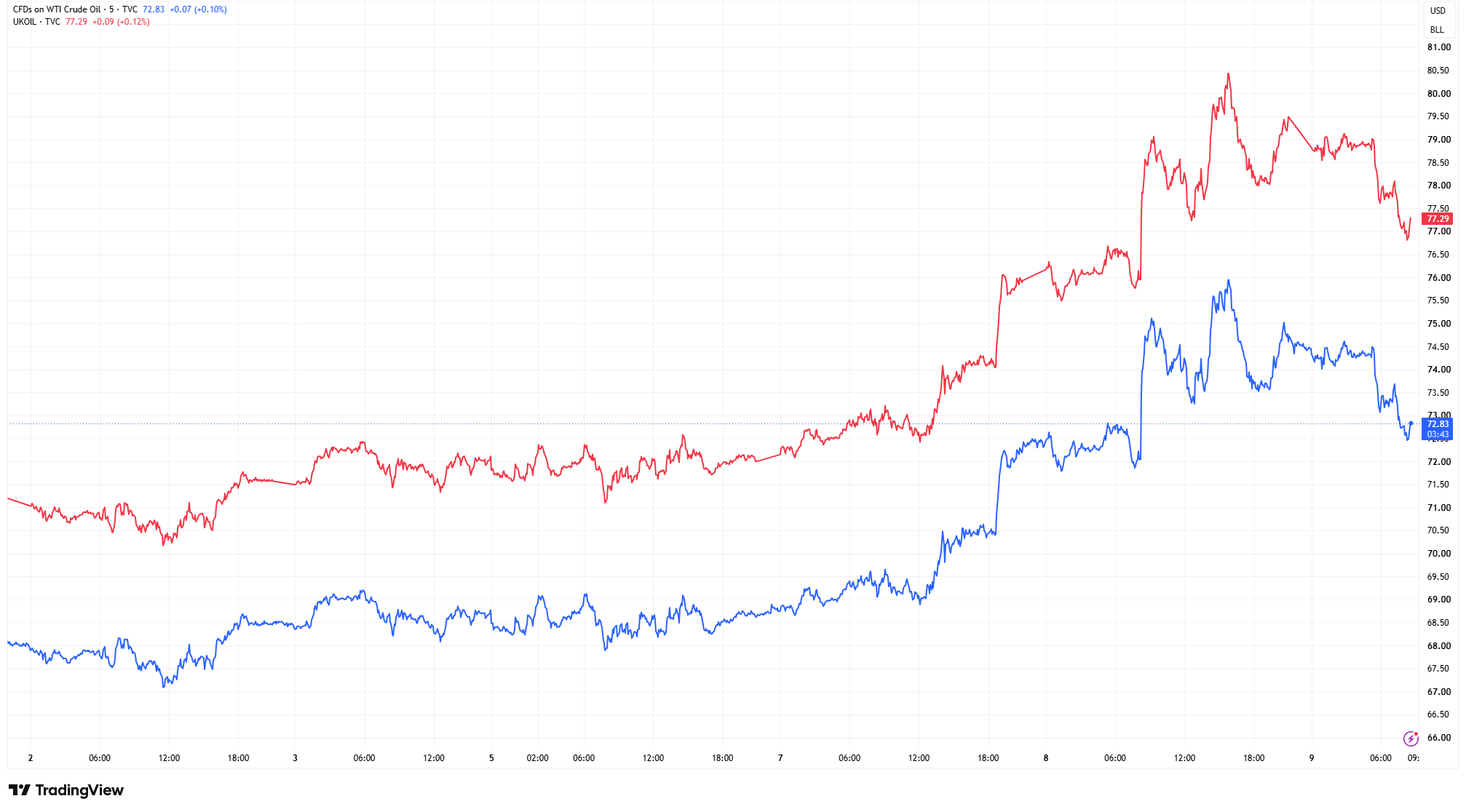
Source: TradingView. Past performance is not a reliable indicator of future performance. Data as of 9 July 2026.
Brent crude (red) and WTI crude (blue) rallied sharply following renewed geopolitical tensions in the Middle East before easing from recent highs. Despite the pullback, both benchmarks remain comfortably above levels seen before the latest escalation, reflecting continued concerns over potential supply disruptions.
For now, the market appears to be pricing in the possibility of future disruption rather than responding to an immediate supply shortage. Oil exports through the region have continued, but the risk of a broader conflict has been enough to keep traders cautious. As a result, geopolitical developments are once again playing a much bigger role in driving prices than the usual supply and demand data.
The impact extends beyond the energy market. Higher oil prices can increase transport and production costs, adding fresh inflationary pressure at a time when many central banks are still trying to bring inflation under control. Periods of heightened geopolitical uncertainty have also supported traditional safe haven assets, including the US Dollar, while contributing to increased volatility across global equity markets.
According to the International Energy Agency (IEA), global oil demand is expected to average around 104 million barrels per day this year, highlighting how even relatively small disruptions to Middle Eastern exports can have a meaningful impact on market sentiment.
Investors will now focus on developments in the Strait of Hormuz, further military or diplomatic announcements, US crude inventory data and any response from OPEC+ producers. Together, these factors are likely to determine whether the recent rally develops into a longer-term supply story or remains a temporary geopolitical risk premium.