














How Energy Prices Drive Inflation and Interest Rates


Energy prices do not just affect fuel costs. They play a central role in shaping inflation, interest rates and broader financial markets. When oil and natural gas prices move, the impact rarely stays contained. It feeds through into the cost of living, influences central bank decisions and shifts expectations across global markets.
That link has been especially visible in recent years. From the post-pandemic recovery to geopolitical tensions in 2026, swings in energy costs have played a key role in shaping inflation trends, policy expectations and asset prices.
How Energy Prices Feed Into Inflation
Higher energy prices tend to push inflation higher in a fairly direct way.
When oil prices rise, fuel and transport costs increase. When natural gas prices rise, household energy bills and industrial costs move higher.
These increases do not stay isolated. Businesses often pass higher costs on to consumers, which then feeds into broader price levels. This is why energy plays a visible role in inflation measures such as the Consumer Price Index.
Recent data reflects this clearly. In March 2026, US inflation recorded its largest monthly increase in four years, with rising oil and energy prices a key driver. At the same time, wholesale natural gas prices in the US rose by more than 50% during 2025, adding further pressure on utility and production costs.
In simple terms, when energy prices rise, inflation tends to follow.
How Central Banks Respond
Central banks closely monitor inflation, so energy-driven price increases often influence policy decisions.
When inflation rises, policymakers may respond by raising interest rates or keeping them elevated for longer than expected.
This dynamic became more visible in 2026. A sharp rise in oil prices linked to geopolitical developments pushed near-term inflation expectations higher, prompting markets to reassess the likelihood of rate cuts.
Central banks that had previously been expected to ease policy became more cautious, reflecting a shift in rate expectations.
At the same time, policymakers recognise that energy markets can be volatile. Short-term spikes are often looked through. What matters more is whether higher energy costs persist and begin to influence broader inflation expectations.
If that happens, central banks are more likely to delay easing or maintain tighter policy for longer.
How Interest Rates Affect Markets
Interest rates are the main channel through which energy-driven inflation affects financial markets.
When inflation rises and policy tightens, borrowing costs increase across the economy.
This has been reflected in bond markets. In early 2026, the US 10-year Treasury yield moved from below 4.0% to around 4.2% as energy prices rose and inflation concerns returned.
Higher yields increase the return available on safer assets, making them more competitive relative to equities.
Brent Crude Oil vs US 10-Year Treasury Yield
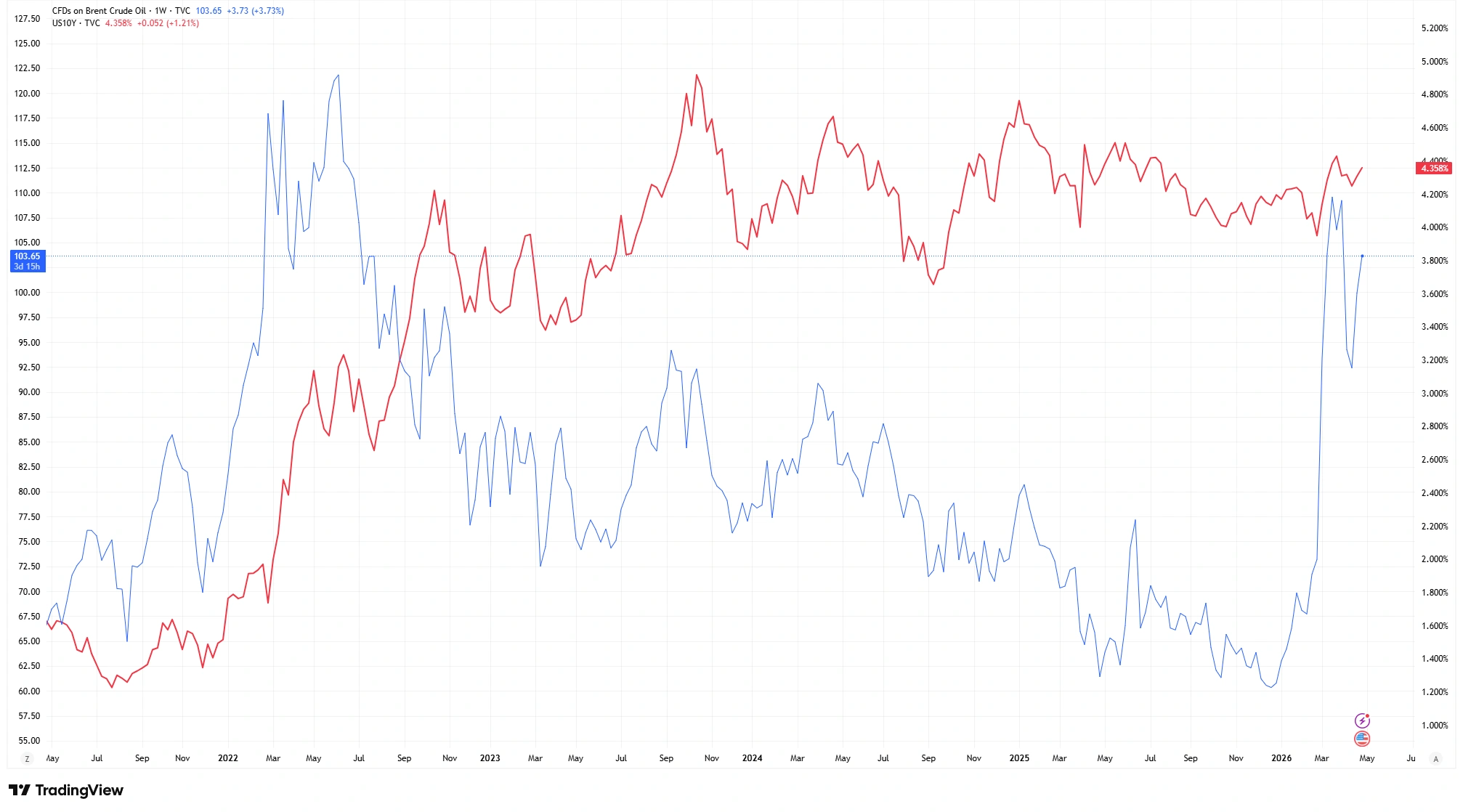
A comparison of Brent crude oil and the US 10-year Treasury yield highlights how rising energy prices often coincide with higher bond yields, as markets adjust to stronger inflation pressures and tighter monetary conditions.
What Recent Market Behaviour Shows
Recent market movements have highlighted this relationship clearly.
Periods of rising energy prices have tended to coincide with:
- higher inflation expectations
- rising bond yields
- more cautious equity market performance
In early 2026, rising oil prices led markets to scale back expectations for rate cuts, with pricing shifting toward a more prolonged period of tighter policy.
At the same time, higher yields acted as a headwind for equities, as investors reassessed valuations and risk.
Conversely, when energy prices stabilise or fall, inflation pressures can ease, supporting expectations for lower interest rates and providing relief for risk assets.
Why the Relationship Is Not Always Straightforward
Despite this clear link, the relationship between energy prices and markets is not always one-directional.
Falling energy prices can help reduce inflation and support consumer spending, which is generally positive for markets.
However, lower oil prices can also reflect weaker global demand. During periods of economic slowdown, energy prices often fall alongside declining industrial activity.
This means markets tend to look beyond price direction and focus on what those moves signal about the broader economy.
Why This Matters for Investors
Understanding how energy prices influence inflation and interest rates helps explain broader market movements.
Financial markets are forward-looking. They react not just to current data, but to expectations about where inflation and policy are heading.
A sustained rise in energy prices can lead investors to anticipate higher inflation and tighter policy, which may support bond yields and weigh on equities.
Falling energy prices can ease those pressures, depending on the broader economic backdrop.
Bottom Line
Energy prices act as a key link between geopolitical developments and financial markets.
Rising oil and gas costs feed into inflation, influence central bank decisions and shape interest rate expectations.
In the current environment, this relationship has become particularly important. Movements in energy prices can influence multiple asset classes at the same time, making them a valuable signal for understanding broader market trends.