














Gold Under Pressure Despite Middle East War, Dollar Surging


Gold’s recent decline highlights a shift in market behaviour. Despite rising geopolitical tensions, investors are moving away from traditional safe havens and into liquidity, with US dollar demand and rising yields driving short-term price action.
Gold Declines as Markets Prioritise Liquidity
Gold prices fell sharply on Monday as rising tensions in the Middle East triggered a shift toward US dollar liquidity, rather than traditional safe-haven demand.
In a counter-intuitive move, gold has come under pressure as investors prioritise cash and short-term positioning during heightened volatility.
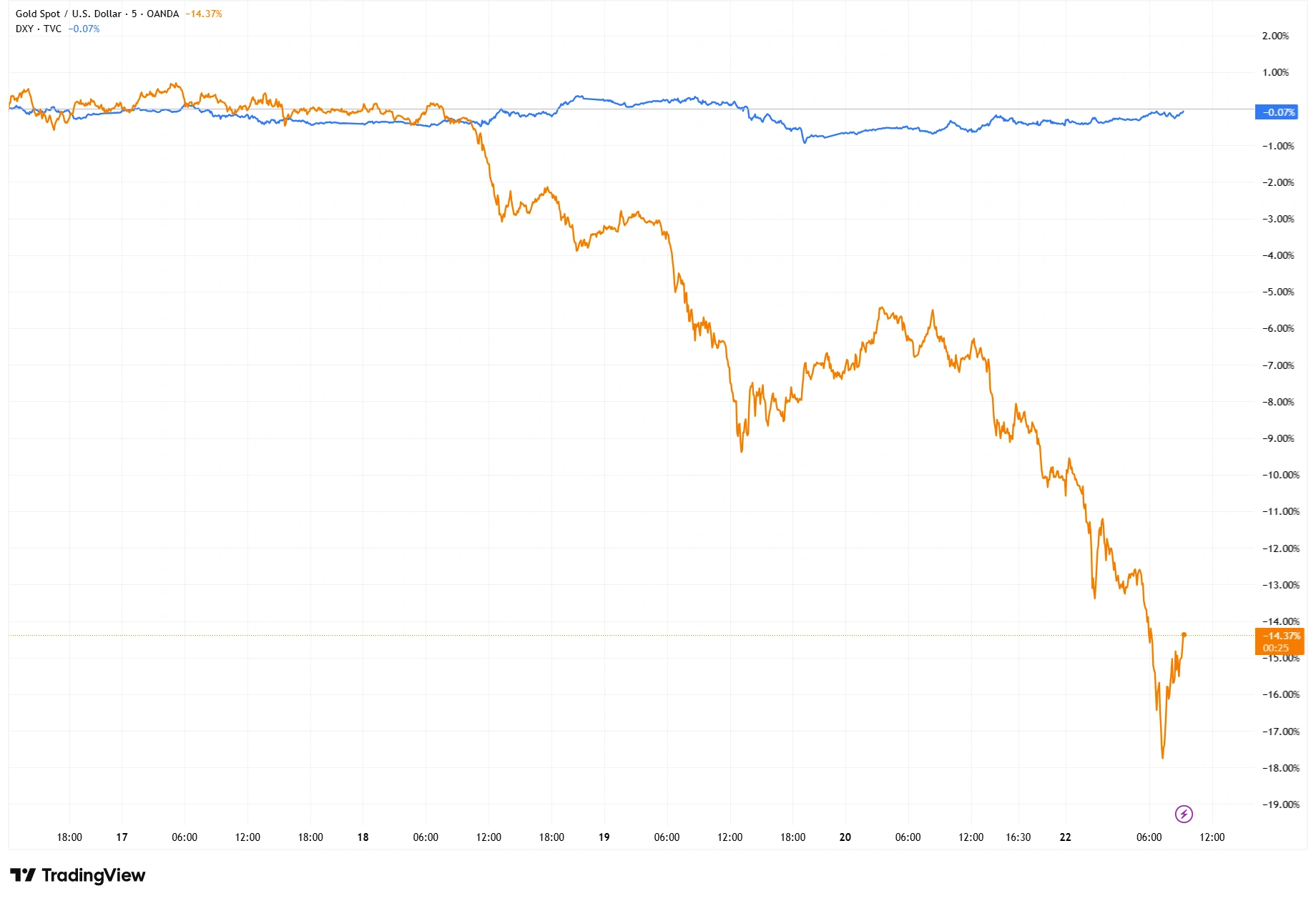
Spot gold dropped more than 2% to around $4,395 per ounce, marking its weakest level since early February. The decline follows a steep weekly loss of nearly 10%, one of the sharpest pullbacks in recent years.
Despite the recent sell-off, though, gold remains significantly higher on a year-on-year basis, after easing back from its 2026 peak near $5,608.
Liquidity Demand Driving the Sell-Off
Part of the pressure is coming from broader losses across global markets.
Sharp declines in Asian equities, particularly the Nikkei and KOSPI, have forced investors to raise liquidity to meet margin calls.
Gold is often among the first assets to be sold in these conditions due to its high liquidity and ease of execution, which can drive prices lower even during periods of geopolitical uncertainty.
In times of stress, liquidity demand can outweigh safe-haven flows.
Stronger US Dollar Adds Pressure
The US dollar has strengthened as investors rotate into dollar-denominated assets for safety.
A stronger greenback typically weighs on gold because:
- It makes gold more expensive for buyers using other currencies
- It reduces global demand
- It reinforces capital flows into US assets
Gold vs US Dollar Index (DXY): Liquidity Shift in Action
Oil Prices and Interest Rate Expectations
Oil is adding another layer to the macro picture. Crude prices holding above the $107-$110 range are fuelling concerns that inflation may remain elevated.
This has led markets to reassess expectations around US monetary policy, with increasing speculation that the Federal Reserve may keep interest rates higher for longer.
For gold, this creates additional headwinds:
- Higher interest rates increase the opportunity cost of holding non-yielding assets
- Rising yields reduce gold’s relative attractiveness
Technical Outlook: Key Levels to Watch
From a technical perspective, gold is approaching key levels that could define its next move:
- Support $4,300: A break below this level would signal continued downside pressure.
- Next target $4,000: A key psychological level where volatility could increase.
- Resistance $4,600: Needs to be reclaimed to stabilise price action.
- Major resistance $5,000: A break above this would signal a broader shift in sentiment.
What this means:
Below $4,300 keeps the downside in focus, while a move above $4,600 would suggest the sell-off is easing.
Market Outlook
Markets are currently prioritising:
- Liquidity and cash preservation
- US dollar strength
- Short-term risk management
What this means:
Gold may remain under pressure in the near term, with price action driven more by dollar strength and yields than safe-haven demand.
Frequently Asked Questions
Why is gold falling despite geopolitical tensions?
Gold is being sold as investors prioritise liquidity and US dollar exposure, outweighing traditional safe-haven demand.
How does a stronger US dollar impact gold?
A stronger dollar makes gold more expensive for global buyers, which reduces demand and puts downward pressure on prices.
What levels are key for gold right now?
$4,300 is the key support, while $4,600 is the level needed to stabilise price action.
Can gold recover in the near term?
Recovery would likely require a weaker dollar, lower yields, or a shift away from liquidity-driven market conditions.