













What Is Forex Trading and How Does It Work?
Table of Contents
- What Is Forex?
- How Does Currency Trading Work?
- Forex Trading Example: EUR/USD
- Types of Currency Pairs | What Is Forex Trading and How Does It Work?
- CFD Trading Meaning | What Is Forex Trading and How Does It Work?
- The Benefits of CFD Trading | What Is Forex Trading and How Does It Work?
- Key Takeaways | What Is Forex Trading and How Does It Work?
- Conclusion | What Is Forex Trading and How Does It Work?
How does currency trading work? This is something you may have heard thrown around in conversation but have never fully grasped. You probably know that when people travel abroad, they must exchange their own currency for the local one in order to spend money in that country. However, many people also trade currencies purely for profit by participating in forex trading. If you have heard about this type of trading before, then you may have wondered 'what is forex trading and how does it work?' This article will answer that question and break down a forex trading example. Forex is often traded via Contracts for Difference (CFDs), so we'll dive into the CFD trading meaning and how CFD forex trading works.
What Is Forex?
To answer the big question, 'what is forex trading and how does it work?', we must first explain what forex is. Forex, short for foreign exchange, is the process of exchanging one currency for another. When doing so, there is always a foreign exchange rate that determines how much of one currency you will receive in return for another. Over time, an exchange rate can move up or down, which can affect the cost of swapping currencies.
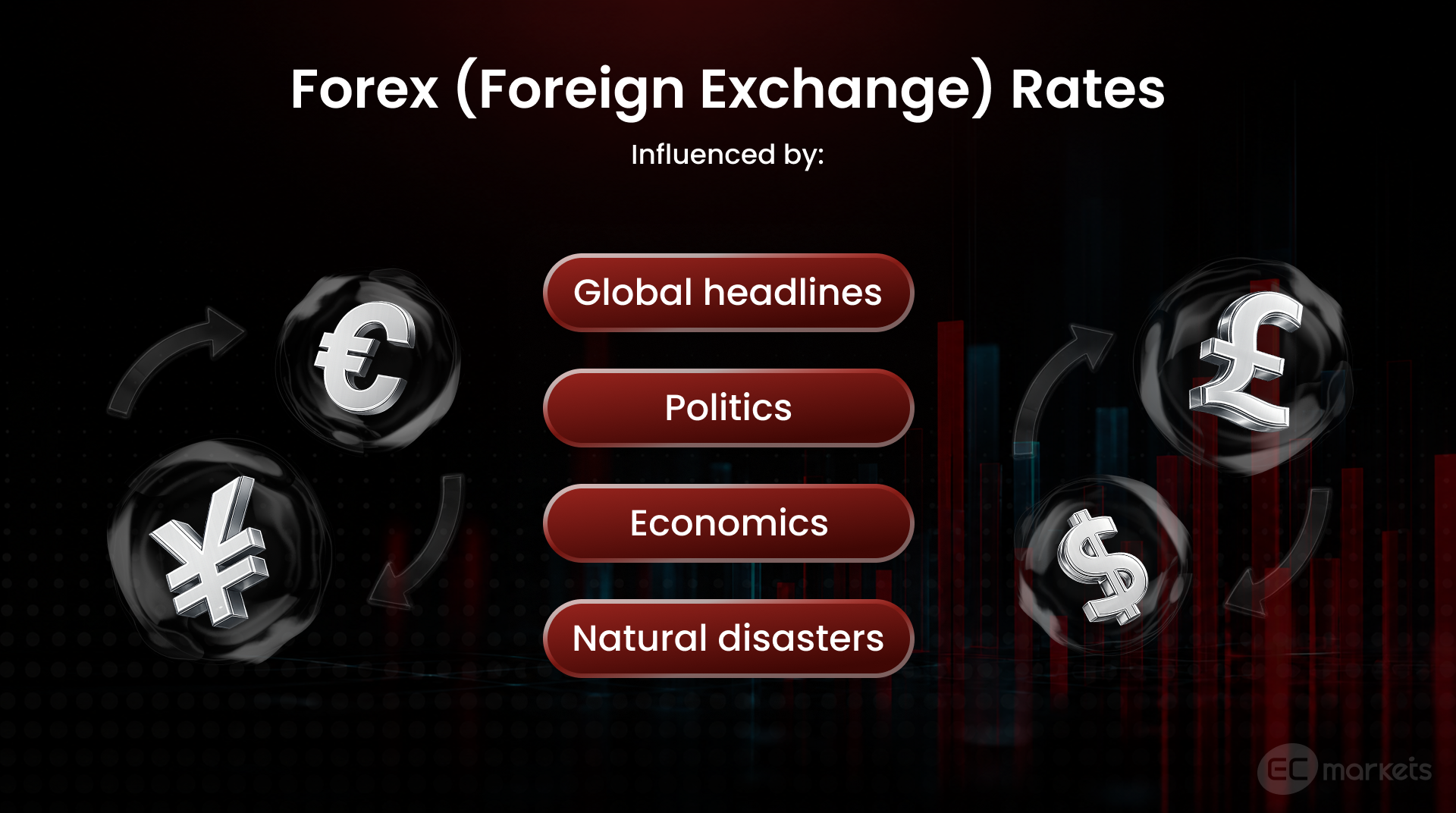
Foreign exchange rates are greatly influenced by external factors, such as global headlines, politics, economics and even natural disasters. All of these factors can drastically change the value of currencies, making some currencies stronger and others weaker. A trader who does the right research and understands how the forex market fluctuates can identify and capitalise on opportunities.
How Does Currency Trading Work?
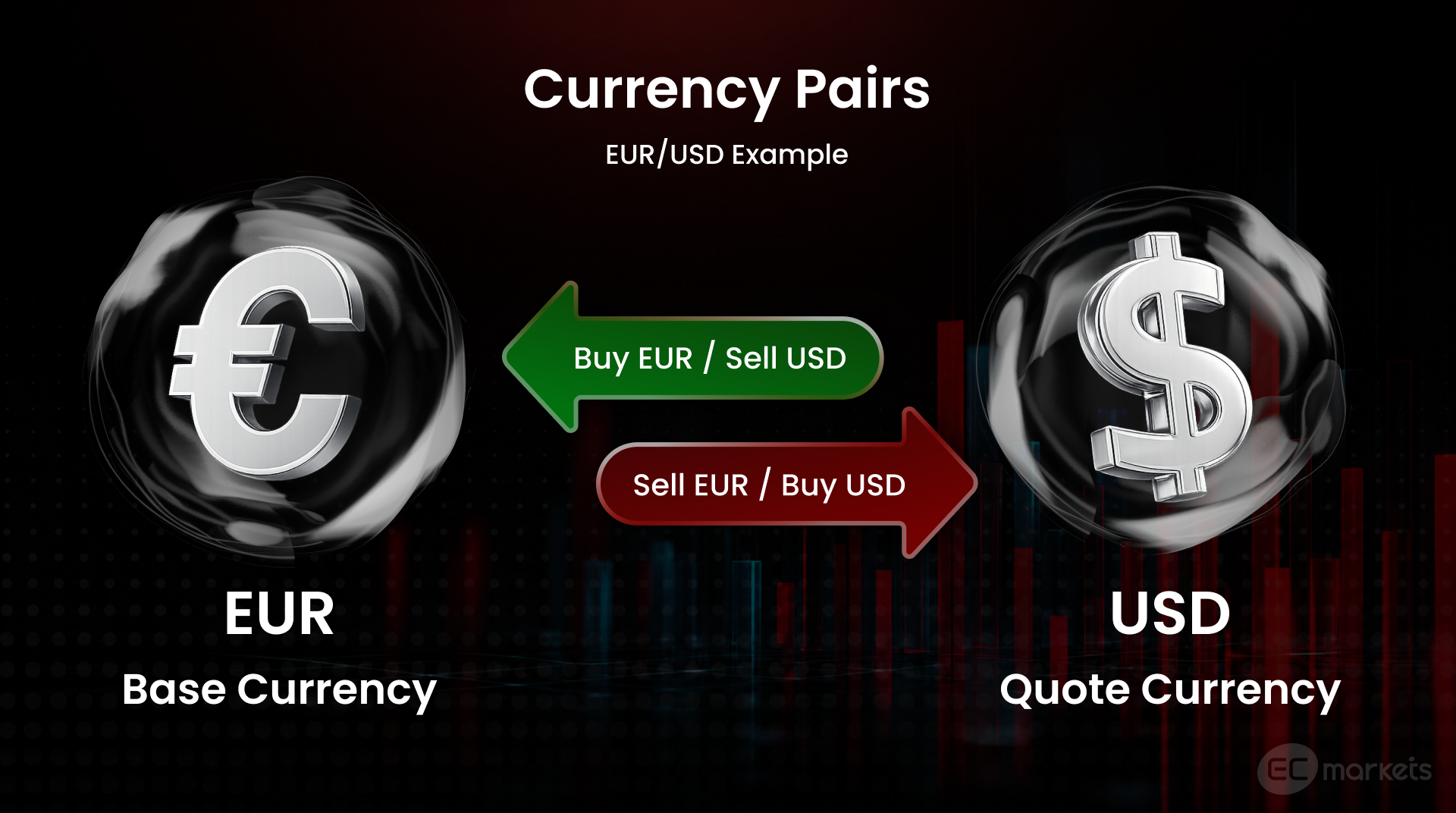
In forex, currencies are always traded in pairs. These are called currency pairs or forex pairs. Currency pairs always involve one currency being sold while the other is being bought, and the exchange rate indicates how much of one currency is required to buy the other.
In order to answer 'how does currency trading work?' you must first understand two core terms. Each currency pair consists of a base currency and a quote currency. The base currency is the first currency listed and it is the currency being bought. The quote currency is the second currency listed and it is the currency used to show how much is needed to buy one unit of base currency.
An easy forex trading example is the EUR/USD pair. In this case, the euro is the base currency and the US dollar is the quote currency. If EUR/USD is trading at 1.1000, that means one euro is worth 1.10 US dollars. Now, a forex trader may predict that the EUR will rise in value over the USD, in which case they'd buy EUR/USD. Conversely, if they predict that the EUR will fall in relation to the USD, then they would sell it.
Forex Trading Example: EUR/USD
Let's continue with our forex trading example, EUR/USD, and look at a realistic trading scenario to further answer 'how does currency trading work?'.
Suppose you bought EUR/USD at 1.1000 (i.e. you bought 1 EUR for 1.10 USD) and a few days later, the price increased to 1.1500. That means the euro has strengthened against the dollar. If you close (sell) your position at that price, you will make a profit.
Let's break this forex trading example down:
- You open (buy) a position of one lot (100,000 units of base currency) in EUR/USD at 1.1000.
1.1000 × 100,000 = 110,000 USD - The euro appreciates against the dollar and the price rises to 1.1500. You close (sell) the position.
1.1500 × 100,000 = 115,000 USD - The profit of this trade is 115,000 – 110,000 = 5,000 USD
(Please note: This is an oversimplified forex trading example and it does not take into account spreads, commissions and other trading costs.)
So far we've provided a basic answer to 'how does currency trading work?' and used a simple forex trading example to establish your foundational knowledge. Now, let's go into more detail by exploring the various currency pairs and what is meant by CFD forex trading.
Types of Currency Pairs | What Is Forex Trading and How Does It Work?
Another key part of answering 'how does currency trading work?' is learning about the different types of currency pairs. Choosing the right type of currency pair is one of the most important decisions a forex trader can make. Each pair comes with its own risks, volatility and typical price behaviour. There are three main types of currency pairs:
- Major Pairs
- Minor Pairs
- Exotic Pairs
Let's dive into each one.
Major Pairs
Major pairs in forex are the seven most highly liquid currency pairs and all include the US dollar. They are the most widely traded currency pairs and make up the majority of the trading volume in the forex market.
Examples of major pairs:
| Currency Pair | Currency Names | Nickname |
| EUR/USD | Euro / US Dollar | Fiber |
| GBP/USD | British Pound / US Dollar | Cable |
| AUD/USD | Australian Dollar / US Dollar | Aussie |
| NZD/USD | New Zealand Dollar / US Dollar | Kiwi |
| USD/CAD | US Dollar / Canadian Dollar | Loonie |
| USD/CHF | US Dollar / Swiss Franc | Swissie |
| USD/JPY | US Dollar / Japanese Yen | Gopher |
Minor Pairs
Minor pairs in forex are the seven most actively traded currency pairs that don’t include the US Dollar. The main ones are the same currencies mentioned in the major pairs traded against each other. There are, however, some exceptions that include the US Dollar, such as USD/SEK (US Dollar against Swedish Krona) and USD/DKK (US Dollar against Danish Krone) which are commonly classified as minors. Minor pairs are not traded as much as the major pairs, but they are still forex pairs with high liquidity. Liquidity matters when you are learning 'how does currency trading work?', because the higher the liquidity, the easier it is to enter and exit trades.
Examples of minor pairs:
| Currency Pair | Currency Names |
| EUR/GBP | Euro / British Pound |
| AUD/NZD | Australian Dollar / New Zealand Dollar |
| EUR/JPY | Euro / Japanese Yen |
Minor pairs are typically better for traders with some experience, as they can be slightly more volatile than majors. So if you’re an intermediate to experienced trader looking to branch out of USD-related trades, these currency pairs might be a good place to start.
Exotic Pairs
Exotic pairs are currencies from emerging economies, such as the Mexican Peso and Thai Baht, traded against currencies from more advanced economies, such as USD and EUR. The liquidity of exotic pairs is much lower than that of majors and minors, which makes exotic pairs less attractive to forex traders.
Examples of exotic pairs:
| Currency Pair | Currency Names |
| USD/MXN | US Dollar / Mexican Peso |
| EUR/PLN | Euro / Polish Zloty |
| GBP/ZAR | British Pound / South African Rand |
Exotic pairs are volatile, which may appeal to experienced traders who want to take advantage of the potential for higher profits.
There is more to answering the big question, 'what is forex trading and how does it work?'. Currency pairs are often traded as CFDs. CFD forex trading is a fast-moving, leveraged market. Let’s introduce another layer and uncover the CFD trading meaning.
CFD Trading Meaning | What Is Forex Trading and How Does It Work?
Anyone serious about becoming a successful trader must become familiar with the CFD trading meaning in order to fully understand 'what is forex trading and how does it work?' So, how does currency trading work in terms of CFDs? Forex pairs are often traded as CFDs, otherwise known as Contracts for Difference. A CFD is an arrangement that a trader makes with a broker that allows the trader to speculate on the price movements of an asset without owning it.
CFD forex trading involves a trader entering a deal based on how much they think a particular currency pair will move over a period of time. A trader's gain or loss comes from the difference between the price at which they open the position and the price at which they close it. The key takeaway from the CFD trading meaning is that traders can gain access to the market without having to own the underlying asset - only the asset's price movements matter. In terms of forex trading, the asset is the currency pair. This is CFD forex trading at its core.
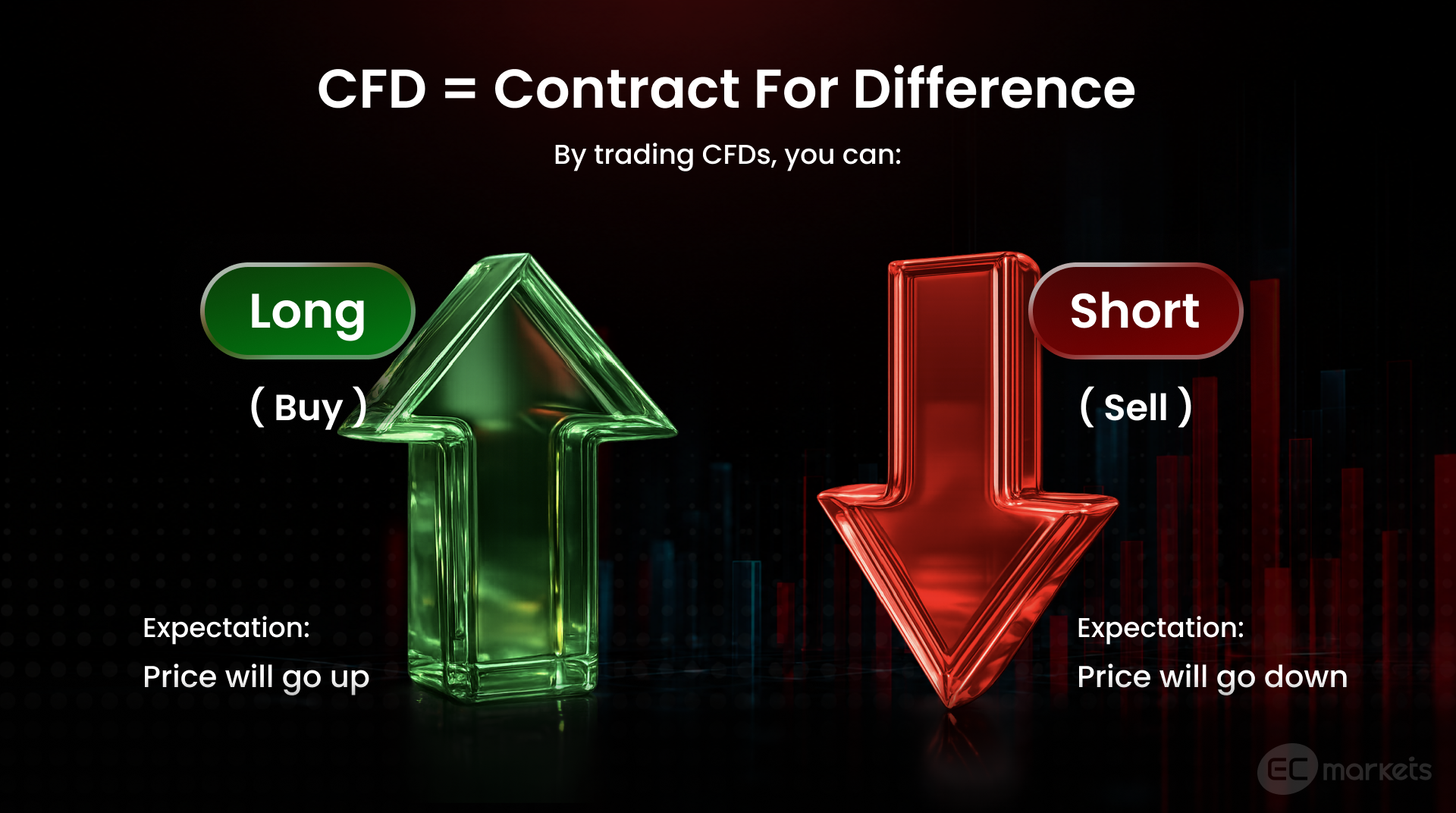
By trading CFDs, you have the ability to go:
- Long (buy), if you believe that the price will increase. For example, you might think that the EUR/USD will rise, so you place a buy order. If the price of EUR/USD goes up, you profit from the difference between your entry and exit prices. If the price goes down, you lose the difference.
- Short (sell), if you believe that the price will decrease. For example, you might think that the EUR/USD will drop in price, so you place a sell order. If the price drops, you would earn the difference between your entry point and your closing price. But if the price rises, you would take a loss.
Pips and Lots | CFD Trading Meaning
To fully understand the CFD trading meaning, you need to know what a pip and a lot are. These are key to answering 'how does currency trading work?' because they are used to measure the size and profitability of a trade.
For most major currency pairs, a single 'pip' refers to the fourth decimal place or 0.0001. Let's use our CFD forex trading example and say you open a position on EUR/USD at 1.1000 and some time later, you decide to close that position at 1.1200, that is a 200 pip increase. So, the move from 1.1000 to 1.1200 represents a shift of 0.0200, because 0.0200 ÷ 0.0001 (one pip) = 200 pips.
In CFD forex trading, a standard 'lot' is exactly 100,000 units of the base currency. If you buy one standard lot of EUR/USD, that means your position size will be 100,000 EUR (at a price of 1.1000, that 100,000 EUR is worth 110,000 USD).
Let's break down this forex trading example to show how that movement can turn into an actual profit or loss.
- Since EUR/USD quotes in USD, one pip on a standard lot is calculated as:
100,000 EUR × 0.0001 = 10 USD per pip. - So, a 200-pip move would amount to:
200 pips × 10 USD = 2,000 USD in profit (assuming no spreads, commission or other costs).
If the price moved the opposite direction, that would be a $2,000 loss instead.
If you've been wondering 'how does currency trading work?' in terms of CFD forex trading, this sums it up in a nutshell. The CFD trading meaning can be defined as a method used to speculate on price changes within the market without buying the currency. CFD forex trading is widely used in the world of trading, and despite our focus on currencies and the forex trading examples above, many traders use CFDs for a variety of asset classes, such as:
- Stocks
- Indices
- Commodities
- Cryptocurrencies
Once you understand the CFD trading meaning, you can then start to learn about different trading strategies that you can implement across various markets.
The Benefits of CFD Trading | What Is Forex Trading and How Does It Work?
Leverage
Most traders would agree that one of the most attractive features of CFD trading is leverage. Leverage is commonly used in CFD forex trading as it allows traders to deposit a small margin to open a larger position. As a forex trading example, let's say you want to trade EUR/USD and you put up a $100 deposit. With 1:30 leverage, you can open $3000 worth of EUR/USD (30 times your deposit). By controlling a larger position, smaller market movements can result in larger gains. On the flip side, using leverage also increases the risk of larger losses at the same time.
Going Long or Short
With mainstream investing, you would normally make a profit by buying low and selling high. But as we mentioned in the CFD trading meaning above, CFD trading gives you the ability to profit from either rising or falling prices. If you think prices will rise, go long (buy), or if you think the prices will fall, go short (sell).
No Ownership Required
When you trade using CFDs, there’s no need to purchase the actual asset. You’re simply reacting to the asset's price movements. Because of this, CFD trading is quicker and offers more room to adjust your positions as opposed to traditional investing, where you must purchase the asset itself.
Access to Multiple Asset Classes
You can trade CFDs on a wide range of markets, all through a single trading platform, including MT4 and MT5. This allows you to diversify your portfolio and find trading opportunities within a variety of sectors.
Key Takeaways | What Is Forex Trading and How Does It Work?
What is forex trading and how does it work?
Forex trading is exchanging one currency for another via currency pairs (e.g., EUR/USD). It works through gains or losses from price movements in the pair, where outcomes are affected by position size, leverage and trading costs.
How does currency trading work?
It involves exchanging one currency for another by buying one while simultaneously selling the other. You receive the currency you’re purchasing and use the other currency as payment for the transaction.
What is a CFD forex trading example?
If you think the euro will rise against the US dollar, you'd buy EUR/USD. If the price rises as expected, you'd close your position. The difference between the opening and closing price is your profit.
What is the CFD trading meaning in simple terms?
CFD trading is when you speculate on whether the price of the asset will rise or fall. With CFD trading, you don’t actually own the asset.
Conclusion | What Is Forex Trading and How Does It Work?
To sum it all up, understanding 'What is Forex Trading and How Does It Work?' comes down to the idea of buying one currency and selling another. Knowing how to answer 'how does currency trading work?' and studying the various types of currency pairs gives you a solid foundation and puts you in a great place at the beginning of your trading journey. If you are CFD forex trading, it is important to educate yourself about the CFD trading meaning and the risks associated with using leverage. Well done on making it to the end of this EC Academy article. See you on the next one!
Note:
This content is for general information and educational purposes only and does not constitute investment advice or a personal recommendation. Any examples are for illustration only and should not be treated as a signal or invitation to trade. This material does not take into account your investment objectives, financial situation or needs. CFD trading is high-risk; losses may exceed deposits.