Why Real Interest Rates Matter More Than Nominal Rates


Nominal interest rates often dominate financial headlines. Investors frequently hear about central bank policy rates or the yield on government bonds such as the 10-year US Treasury. However, in financial markets it is often the real interest rate that matters more.
Real interest rates adjust nominal rates for inflation, showing the return investors actually receive after accounting for rising prices. In simple terms, they measure how much purchasing power an investment truly delivers. For example, if a government bond yields 4% while inflation is running at 3%, the real return is only about 1%. Even though the headline yield may appear relatively high, the investor’s true gain after inflation is much smaller.
Understanding this difference is important because many financial assets respond more directly to changes in real interest rates than to nominal ones.
Nominal Versus Real Interest Rates
US 10-Year Treasury Yield
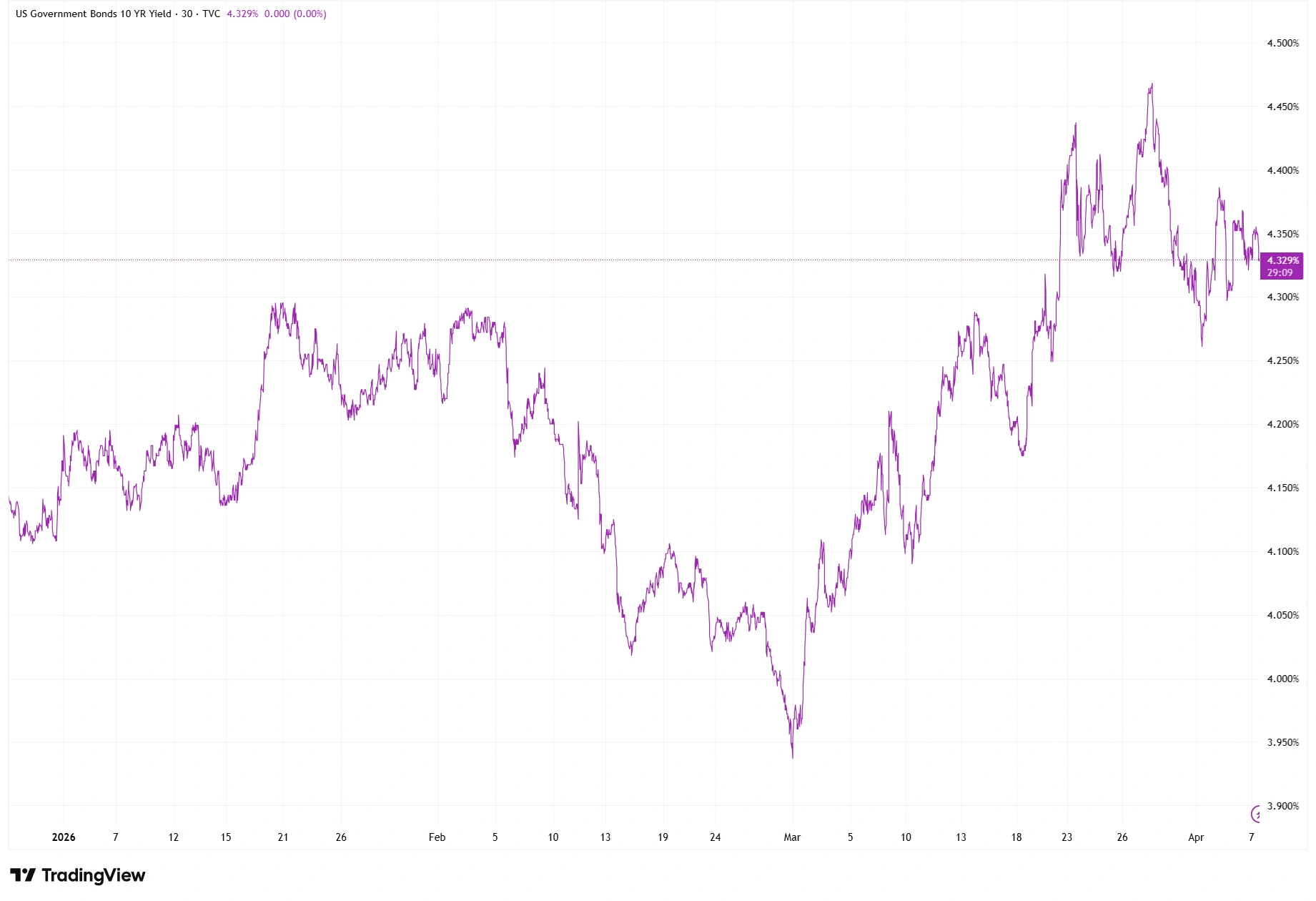
Source: TradingView. Past performance is not a reliable indicator of future performance. Data as of 7 April 2026.
A nominal interest rate is the stated return on an investment. This could be the yield on a government bond or the policy rate set by a central bank. Nominal rates do not account for inflation.
A real interest rate, by contrast, adjusts for inflation and therefore reflects the real increase in purchasing power. The relationship is relatively straightforward: real interest rates are roughly equal to nominal rates minus inflation.
For instance, imagine a bond offering a nominal yield of 5% while inflation is running at 2%. The real return is approximately 3%. If inflation rises to 4%, the real return falls to around 1%, even though the nominal yield has not changed.
Recent market data illustrate this gap. In early 2026, the nominal 10-year US Treasury yield has been close to 4%, while the 10-year Treasury Inflation-Protected Securities (TIPS) yield, which reflects the real yield, has been significantly lower. Despite a relatively strong headline yield, the inflation-adjusted return available to investors has been far smaller.
Why Real Interest Rates Drive Markets
Real interest rates play a central role in determining how attractive different assets appear to investors.
When real yields rise, safe assets such as government bonds become more appealing because they offer higher inflation-adjusted returns. This can draw capital away from riskier assets such as equities or commodities. Conversely, when real yields are low or negative, investors often search for assets that can better preserve purchasing power.
This dynamic has been particularly visible in recent years. As inflation surged following the pandemic, real yields initially moved deeply into negative territory because inflation rose faster than nominal bond yields. During that period, demand for assets such as gold and equities strengthened as investors sought protection from inflation.
As inflation began to moderate and central banks tightened monetary policy, real yields moved higher again. This shift contributed to tighter financial conditions and created pressure on some risk assets.
Impact on Equities, Bonds, Gold and Currencies
Changes in real interest rates can influence several major asset classes.
In equity markets, higher real yields increase the discount rate used to value future corporate earnings. When discount rates rise, the present value of those earnings falls, which can weigh on stock valuations. Periods of rising real yields have often coincided with greater volatility in equity markets as investors reassess growth expectations and valuation levels.
In the bond market, real yields directly influence the inflation-adjusted return available to investors. When real yields rise, bond prices typically fall as markets adjust to higher required returns. This also pushes borrowing costs higher across the economy, affecting mortgages, corporate lending and investment decisions.
Gold is especially sensitive to movements in real interest rates. Because gold does not generate income, its attractiveness depends partly on the opportunity cost of holding it. When real yields rise, investors can earn better returns from bonds, which can reduce demand for gold. Conversely, when real yields fall or turn negative, gold often becomes more attractive as a store of value.
Currency markets can also respond to these shifts. A country’s currency may strengthen when its real yields rise relative to those of other economies, attracting foreign capital seeking higher inflation-adjusted returns. If real yields decline, the currency may weaken as investors search for better returns elsewhere.
Why Investors Watch Real Yields Today
Real yields have become an important indicator in the current macroeconomic environment. Central banks are attempting to balance inflation control with slowing economic growth, and movements in real yields help signal whether financial conditions are tightening or easing.
If inflation continues to decline while policy rates remain relatively high, real yields could remain elevated. This could place further pressure on risk assets and keep borrowing costs high across the global economy. Conversely, if inflation rises again or central banks begin cutting rates, real yields could fall, potentially supporting equities and commodities.
For this reason, investors closely monitor indicators such as 10-year TIPS yields and breakeven inflation rates to understand how markets are pricing future inflation and monetary policy.
Bottom Line
Nominal interest rates may attract the most attention, but real interest rates provide a clearer measure of the true return investors receive after inflation.
Movements in real yields influence bond prices, equity valuations, currency flows and commodity demand. They also provide important signals about the stance of monetary policy and overall financial conditions.
For investors, watching how real yields evolve can offer valuable insight into where markets may move next, particularly during periods of changing inflation and central bank policy.