What Happens to FX Charts Around Central Bank Decisions?


On major decision days, FX charts often appear unusually calm as the market hovers in tight ranges. Then, almost instantly, it turns into chaos. Central bank meetings from the Fed, ECB, or BoE compress a huge amount of macroeconomic expectation into a few minutes of statements, projections, and press-conference remarks. Once released, the market absorbs this information in a single burst, and price action reacts accordingly.
Why Central Banks Matter More Than the Headline Rate
Foreign exchange markets don’t just respond to the rate move itself. Currencies are constantly pricing the path of policy and anticipated economic conditions. The language policymakers use to describe future rate intentions is often more important than the current-day decision.
Shifts in guidance can move FX markets quickly because expectations for near-term interest rate differences are highly sensitive to central bank announcements.
Interest rate gaps still sit at the heart of how currencies are valued, and markets often lean toward the currency with the higher expected rate. But the reaction isn’t always straightforward. Confidence in the central bank, overall market mood, and how traders were positioned beforehand can all shape the outcome.
Very often, currencies react more to the tone of the press conference than to the rate change itself, because even small hints in wording can reshape what traders think will happen next.
Before the Event: Positioning and Quiet Ranges
In the days and hours leading up to a central bank announcement, currency pairs like EUR/USD and GBP/USD often settle into a quieter, tighter range. Trading slows, big players step back a little, and many traders simply wait for the news instead of taking bold positions.
Because fewer people want to take risks right before such an important event, the market can feel unusually still.
The Announcement: The Volatility Spike
As soon as the announcement lands, the market can spring to life. Prices start jumping quickly as traders react to the fresh information, and the first few minutes often feel hectic.
Even a single line during the press conference can push currencies sharply higher or lower as traders reassess what the central bank really means. It’s common to see EUR/USD and GBP/USD swing suddenly in these moments, especially when the message differs from what the market expected.
The chart below shows a typical example of how EUR/USD can spike sharply on a decision day before settling back near key technical levels.
EUR/USD Reaction Around a Central Bank Decision
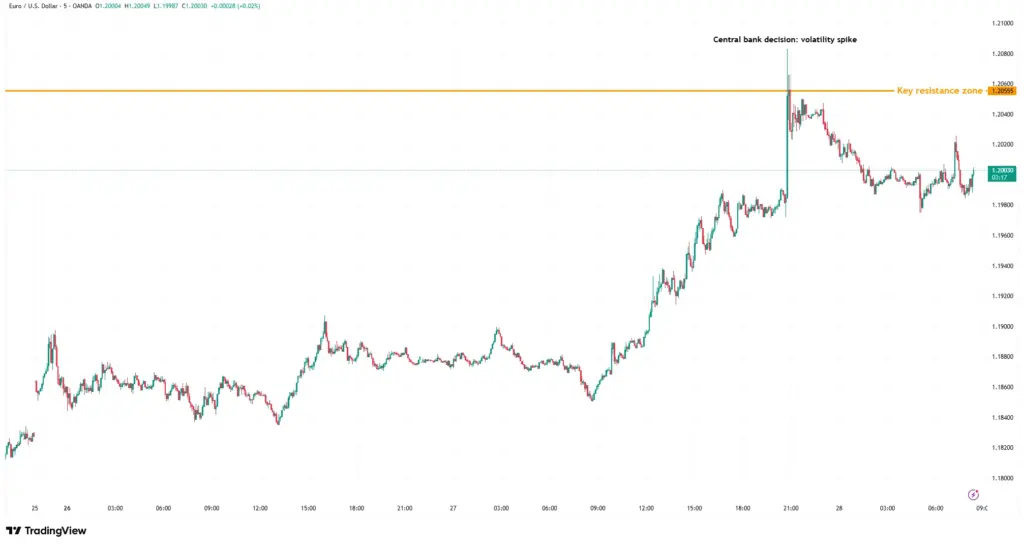
Source: TradingView. All indices are total return in US dollars. Past performance is not a reliable indicator of future performance. Data as of 28 January 2026.
EUR/USD reaction around a central bank decision, showing the volatility spike and reversal near a key resistance zone.
The “Fakeout then Reversal” Pattern
A familiar pattern around major decisions is an initial breakout followed quickly by a reversal. On decision days, the first move is not always the final move. It is common to see price overshoot a key level, then snap back once the market processes the press conference tone and the details behind the headline.
Sometimes headlines appear hawkish or dovish at first glance, and markets react instantly, only for the deeper context revealed minutes later to shift the narrative.
Spreads, Liquidity and Execution Around News
During major releases, trading conditions can feel less stable. Spreads often widen right before and just after a central bank announcement because many participants step back until the dust settles.
With fewer orders in the market, prices can move more sharply and trades may not always fill where expected. This is simply the market adjusting to uncertainty, and conditions often normalise once the initial reaction passes.
This is especially relevant in FX CFD markets, where volatility can increase quickly around major events.
Takeaway
Simple tools can help you avoid reacting emotionally. If RSI is already stretched or price is far from a key moving average, the initial spike may be more of a shakeout than a new trend. Waiting to see whether price holds above a broken level, or slips back into the range, often tells you more than the first candle.
Bottom Line
Central bank days are where big-picture economics and real-time market behaviour meet. Expectations and forward guidance set the tone, while price levels and chart structure show how the market digests the news.
Ahead of the decision, trading often tightens. When the announcement hits, volatility and spreads can jump. The first move may reverse as the message becomes clearer, and familiar support and resistance levels often guide what happens next.
In these moments, staying calm, watching how price reacts, and keeping risk in check usually matters far more than trying to predict every twist.
Central bank decisions are some of the most important volatility drivers in forex. For traders, the goal is not to guess the headline, but to understand how expectations shift, how price behaves around key levels, and why patience often beats speed on decision days.