Walmart Joining the Nasdaq-100: What It Means for the Index and Investors


Walmart’s inclusion in the Nasdaq-100 is more than a technical reshuffle. It reflects how market leadership is evolving in a post-inflation world.
Walmart’s upcoming inclusion in the Nasdaq-100 Index might sound like a routine index mix-up, but it makes a significant structural change in the stock market world. This is more than a headline about a retailer entering a tech-led index. Index changes often appear technical, yet they can represent deeper shifts in market leadership, sector composition, and investor behaviour. The core question is simple: why does a traditional consumer giant joining a tech-centric index matter now?
To understand why this matters, it helps to look at how the Nasdaq-100 works. As you know, the index tracks the 100 largest non-financial companies listed on the Nasdaq exchange and is dominated by technology and growth-oriented firms. It is periodically rebalanced, and constituents can change due to mergers, corporate actions, or listing decisions that alter eligibility. When a company is added, index-tracking funds must buy its shares and sell the company being removed. For Walmart, that means automatic demand from passive investors and a permanent place in global portfolios that track the index.
Beyond the mechanics, Walmart’s inclusion says something about the current market environment. The economy is moving away from the inflation shock of recent years (specifically since Covid) into a more disinflationary, stable-rate backdrop. In that setting, investor priorities have shifted. Earnings quality, margins, and balance-sheet resilience matter more than narrative-driven growth alone now. Walmart fits that profile; and that’s exactly what retail investors want now! The company has long been associated with steady cash flows, pricing power, and scale, traits that tend to be valued when macro uncertainty fades and markets become more selective (like such an environment).
Walmart vs Nasdaq-100 ETF (QQQ)
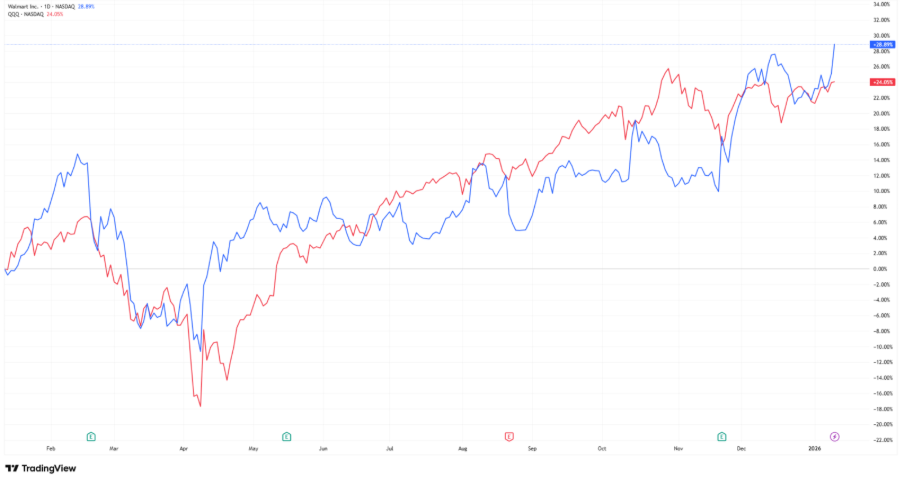
Source: TradingView. All indices are total return in US dollars. Past performance is not a reliable indicator of future performance. Data as of 13 January 2025.
Walmart’s share price has broadly kept pace with the Nasdaq-100 ETF over the past year, reflecting its growing role within growth-oriented portfolios.
At the same time, Walmart is not the static retailer many still picture. Over the past decade, it has quietly transformed into an omnichannel, tech-enabled business. Investments in e-commerce, automation, data, and logistics have blurred the line between traditional retail and tech-driven operations. And that evolution matters! A consumer giant entering a tech-heavy index reflects a broader shift in what markets now define as leadership. Interesting, right? Investors are increasingly rewarding companies that combine operational scale and stability with modern execution, rather than pure innovation narratives alone.
This also has implications for the Nasdaq-100 itself. By design, the index is heavily skewed toward technology. Walmart introduces greater exposure to everyday economic activity and consumer behaviour. Its earnings are more sensitive to wages, inflation, and spending patterns than to software cycles or digital advertising trends. That slightly alters the index’s risk profile. Walmart’s stock has historically been less volatile than many tech companies, which may offer a modest stabilising influence during periods of market stress.
This is not a dramatic transformation of the index. Technology will continue to dominate both weight and direction. However, the change is directionally important. It suggests the Nasdaq-100 is slowly broadening in its economic exposure, even as it remains firmly growth-oriented. Over time, that diversity can influence how the index behaves across different macro cycles. Only time will test this.
For investors, the implications are practical rather than theoretical. Anyone holding a Nasdaq-100 ETF will soon own Walmart by default. That adds a defensive consumer exposure to portfolios otherwise tilted heavily toward technology. In the short term, index inclusion can affect flows, trading volumes, and volatility. Over the longer term, it can influence how a stock is perceived and valued. That said, inclusion alone does not guarantee outperformance. Index changes often reflect what markets have already rewarded, not what will necessarily lead in the future.
A balanced view remains essential. Walmart’s fundamentals are still tied to consumer spending trends, cost pressures, and execution. Labour costs, pricing competition, and supply chain efficiency remain key variables. While index inclusion brings structural demand, it does not insulate the company from macro slowdowns or operational challenges.
In the end, Walmart’s entry into the Nasdaq-100 is less about retail joining technology and more about what markets value in a post-inflation world. Scale, resilience, and earnings visibility are back in focus. Index composition often mirrors where investors believe durable growth will come from next, not where it came from in the past.