













Economic Bubbles: How to Spot One (vs a Trend)


Markets can rise for many reasons, but not all upward moves are created equal. Sometimes prices climb because underlying conditions genuinely improve. Other times, the rise is driven more by excitement, crowd behaviour, or unrealistic expectations. If you can recognise the difference between a real trend and an economic bubble, you’ll have a much better grasp of market behaviour.
When Prices Break Away from Reality
An economic bubble forms when the price of an asset increases rapidly and moves far beyond what fundamentals can justify.
Early on, the rise may still make sense. New technology, changing policy, or positive economic conditions can attract real interest. But as the momentum builds, more traders enter the market simply because the price is rising. Eventually, sentiment becomes the main driver, and this creates a disconnect between price and real value.
Economic theory helps explain why this happens. While traditional models assume markets tend to correct themselves over time, economist Hyman Minsky offers a different perspective. His Financial Instability Hypothesis suggests that long periods of stability can actually increase risk.
As confidence spikes, borrowing increases, and investors take on more aggressive positions. This means that what begins as rational behaviour gradually becomes speculative, creating the conditions for a bubble to form.
What Makes an Economic Bubble?
Most economic bubbles move through four main stages:
- Displacement: Something shiny and new draws attention and prices begin rising.
- Booming: Demand increases sharply and more participants jump in, often driven by fear of missing out.
- Euphoria: Markets become dangerously stretched. Investors grow overly confident, dismiss risk, and focus heavily on positive narratives. Many buy – not because the asset is fundamentally strong – but because they expect someone else to pay more later.
- Panic: Once confidence weakens and buyers step back, selling accelerates quickly. Because prices are far above fair value, the correction can be severe, pulling the market back toward fundamentals.
GameStop Price Surge: A Bubble‑Like Market Pattern (2021)
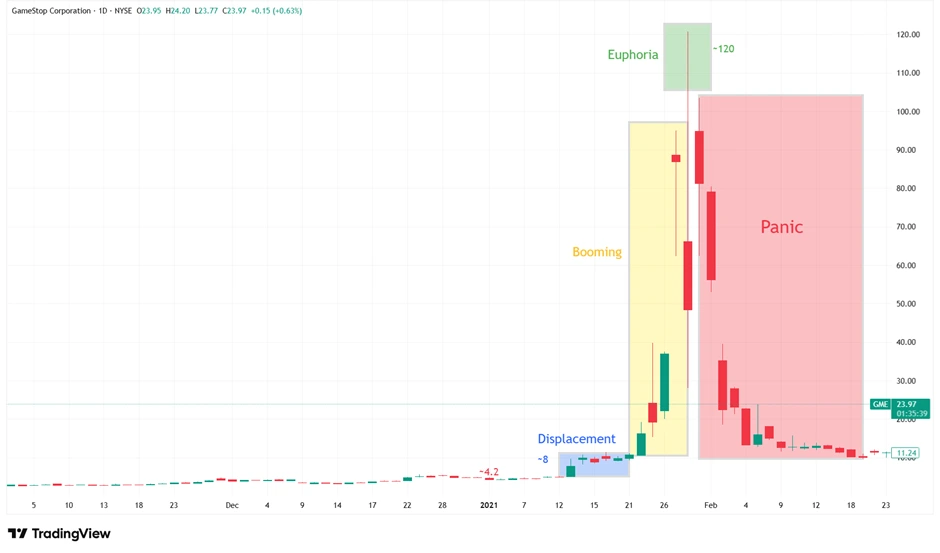
Source: TradingView. Past performance is not a reliable indicator of future performance. Data as of 5 March 2026.
A well‑known example is the sharp surge in GameStop shares during early 2021. The move was driven largely by speculation and social‑media‑fuelled trading rather than business fundamentals. When buying pressure slowed, prices retreated just as quickly as they had climbed, showing just how fragile bubble‑like moves can be.
When Growth Comes from Real Improvement
A real trend looks very different. Here, prices rise because the underlying asset is actually getting stronger. Companies may be reporting better earnings, economies may be expanding, or productivity may be improving. Either way, the demand increases because conditions support it – not because of hype.
S&P 500 Multi‑Year Uptrend Supported by Broader Market Conditions (2022-2026)
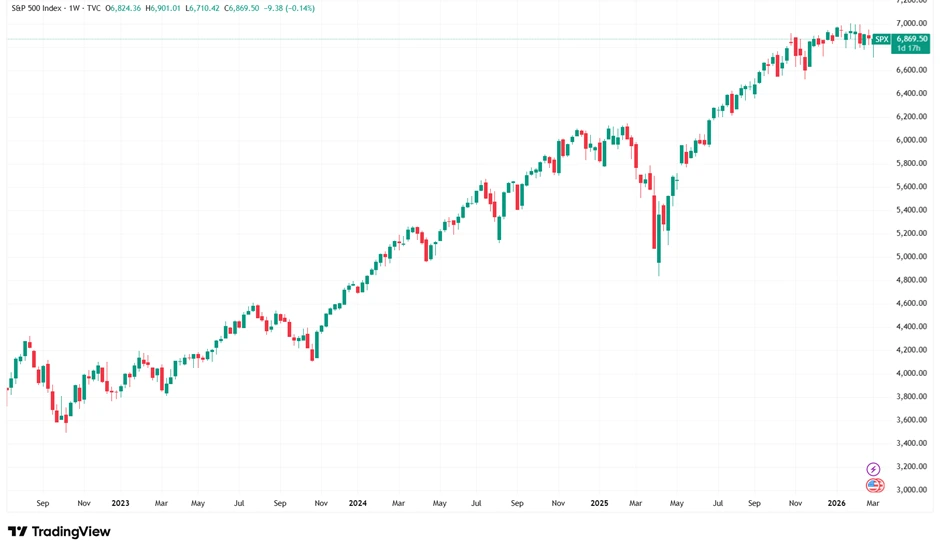
Real trends still include pullbacks and volatility, but the overall direction tends to be more stable and easier to explain.
A useful example is the sustained rise in the S&P 500 from late 2022 to early 2026. While the market moved through normal fluctuations, the broader uptrend was supported by improving earnings, resilient economic data, and more constructive long‑term expectations. Unlike a bubble, this rise was built on a healthier foundation.
Economic Bubble vs Trend: What’s the Difference?
The key distinction is the relationship between price and real progress. In a real trend, prices remain anchored to improvements in productivity, profitability, or economic conditions. The rise may be strong, but it has something solid beneath it, like adding a new floor to a building after reinforcing the structure below.
In a bubble, behaviour shifts. Prices accelerate faster than fundamentals, and investors rely more on crowd behaviour than on analysis. Demand appears larger than reality, and the market becomes increasingly sensitive to changes in confidence. When sentiment turns, prices can fall sharply because they were not supported by genuine value.
The Takeaway
Understanding whether a move is supported by real improvement or fuelled by speculation can help you interpret market behaviour more effectively. While no method can predict the market with certainty, recognising the characteristics of economic bubbles and sustainable trends can provide valuable context when analysing price movements.