Why Do Markets Often Reverse After Big Moves? Understanding Market Exhaustion


Markets often reverse after strong rallies or sharp sell-offs. Price pushes hard in one direction, confidence builds, and just when the move looks obvious, it snaps the other way. This behaviour is often rooted in market exhaustion. After an extended run, the buying or selling pressure that fuelled the trend starts to fade, leaving price more sensitive to changes in liquidity and sentiment. Academic research on short‑term return reversals finds that moves not supported by clear fundamental catalysts are especially prone to retracing as conditions shift.
This pattern appears across asset classes. Whether in FX, equities, commodities, or indices, strong directional moves frequently slow or reverse once momentum begins to weaken.
Understanding Market Exhaustion
Market exhaustion occurs when the forces driving a trend begin to lose strength. A rally might start with strong demand or improving sentiment, while a sell-off may begin with risk aversion. But any trend needs fresh participation to continue. As moves stretch, earlier entrants often begin taking profits, gradually reducing the order flow sustaining the trend and increasing the likelihood of a pause or reversal.
Why Market Exhaustion Occurs
A trend requires continuous engagement from new buyers or sellers. In uptrends, buyers must be willing to pay higher prices; in downtrends, sellers must accept lower prices. Over time, profit‑taking and reduced appetite for new entries slow the move. Crowded positioning can reinforce this. When many traders are already on the same side, fewer remain to carry the trend forward. Work from the International Monetary Fund highlights how herding and crowded trades often precede sharp reversals when sentiment changes.
Markets also cycle naturally. Strong directional moves are often followed by consolidation or corrective phases as prices stabilise.
Signs That a Trend May Be Weakening
Exhaustion usually shows up through a combination of signals rather than a single indicator. One common sign is slowing momentum: price may still make new highs or lows, but with weaker follow‑through. Price action may become choppy as buyers and sellers battle around key levels.
Liquidity conditions can also shift. Research from the Bank for International Settlements notes that liquidity can appear stable right until it suddenly deteriorates, meaning small shifts in order flow can produce outsized moves.
Technical tools can help as well. Indicators like RSI measure the speed and magnitude of price changes. When price pushes to a new extreme but RSI no longer confirms it, known as RSI divergence, it can indicate weakening momentum.
These clues are not guarantees, but they often signal that a trend is tiring.
Identifying Market Exhaustion: Bullish and Bearish Reversal Signals
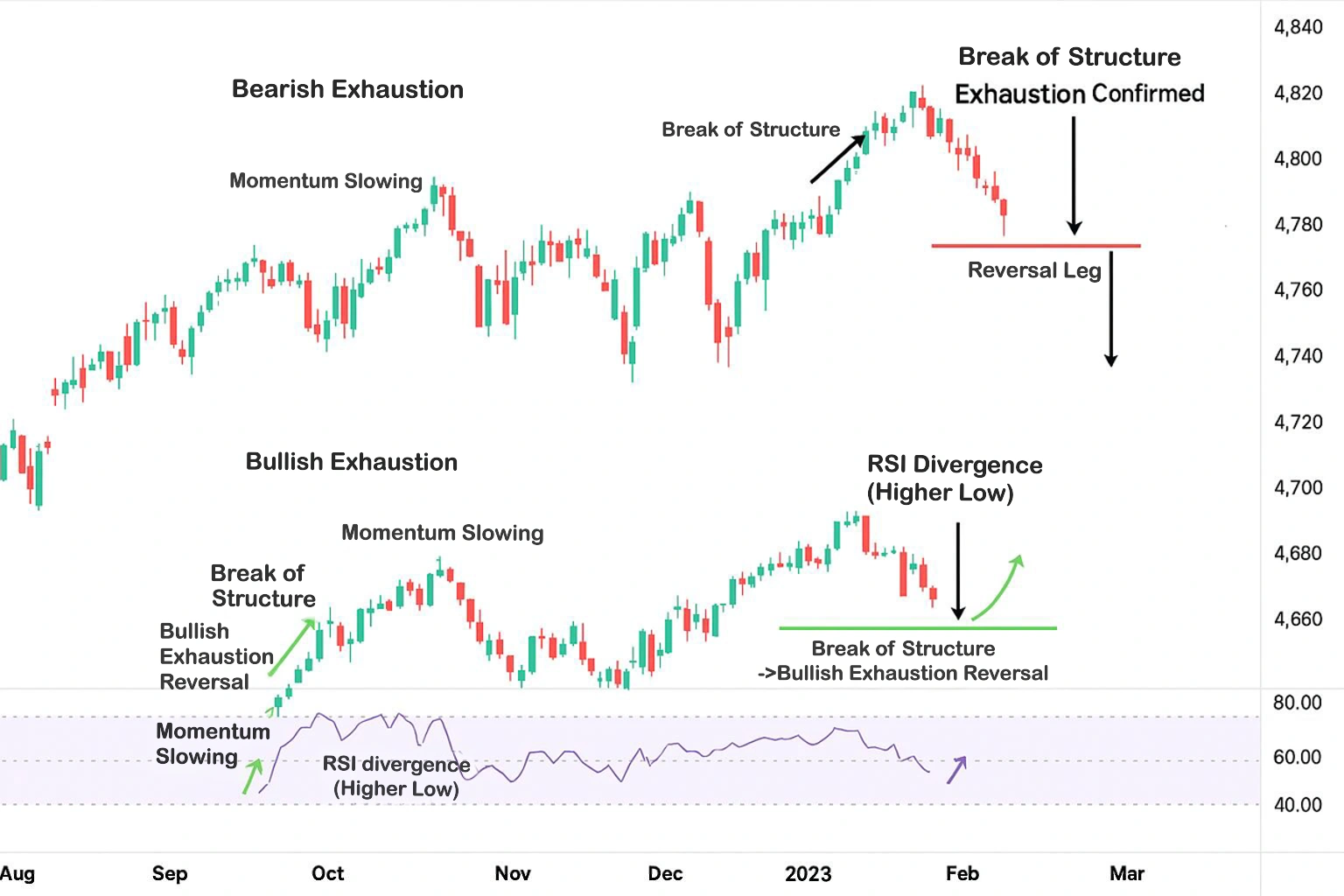
This chart is provided for illustration and educational purposes only and does not represent financial advice, trading recommendations, or actual market signals. Past performance is not a reliable indicator of future performance.
This chart illustrates both bullish and bearish exhaustion patterns, showing momentum slowing, RSI divergence, and subsequent structure breaks that trigger reversals. For educational illustration only; not based on live market signals.
Why Reversals Can Happen Quickly
Once a stretched trend starts to break, market mechanics can accelerate the move. Stop‑loss orders tend to cluster around well‑known levels. When these levels break, stops trigger in waves. Research from the Federal Reserve Bank of New York shows how stop‑loss execution in currency markets contributes to rapid, self‑reinforcing price cascades.
If liquidity is thin, price may skip through levels rather than trade smoothly, making reversals feel sudden and dramatic.
Practical Takeaway for Traders
Understanding exhaustion can help traders avoid chasing late‑stage moves. When a market looks stretched after a strong rally or sell-off, a more cautious approach can help: adjust position size, pre‑define exit levels, and prepare for higher volatility. Indicators like RSI divergence can serve as early alerts for weakening momentum, but they should support, not replace, disciplined risk management.
Bottom Line
Markets often reverse after large moves because trends eventually lose momentum. Profit‑taking, crowded positioning, and fragile liquidity all contribute to conditions where even small shifts can trigger sharp reversals. Recognising these dynamics helps traders identify when a trend may be nearing exhaustion and manage risk more effectively.