What Is the Yield Curve and Why Does It Predict Recessions?


The yield curve is a simple chart showing the interest rates on government bonds with different maturities. Most traders look at the US Treasury curve, which ranges from very short‑term bills to long‑term bonds lasting ten or even thirty years. Because bond yields reflect expectations about inflation, growth, and interest rates, the shape of the curve can offer valuable clues about where the economy may be heading.
How the Yield Curve Normally Works
In normal conditions, the curve slopes upward. This means long‑term bonds typically offer higher yields than short‑term ones because investors want extra return for locking their money away for longer. As of early March 2026, the 10‑year Treasury yield is around 4.15%, while the 2‑year sits near 3.56%, which is a standard upward‑sloping structure.
This shape usually signals confidence in steady economic growth and expectations of fairly stable inflation. When markets feel comfortable with the future outlook, they demand more yield for longer maturities simply because of the additional uncertainty over time.
What an Inverted Yield Curve Is
An inverted yield curve appears when short‑term yields rise above long‑term ones. This is unusual, and typically happens when central banks raise interest rates to control inflation. Higher policy rates push short‑term borrowing costs up quickly. At the same time, if investors expect growth to weaken later on, they tend to buy long‑term bonds for safety, which pushes long‑term yields down.
Although the curve today is not inverted, it recently went through an unusually long inversion, with the 10‑year minus 2‑year spread staying negative from July 2022 until August 2024 before turning positive again.
This long stretch highlighted how strongly markets were anticipating a slowdown.
Why an Inverted Curve Is Seen as a Recession Signal
The reason inversion matters is its historical track record. Before several major US recessions, the yield curve inverted months in advance. Studies show the 10‑2 spread often turns negative well ahead of downturns, with lead times ranging from a few months to over a year.
It is not the curve itself that triggers recessions. Instead, the curve reflects market expectations. When investors believe growth will slow and interest rates may need to fall in the future, long‑term yields decline relative to short‑term ones.
10‑Year Minus 2‑Year Treasury Yield Spread (2022-2026)
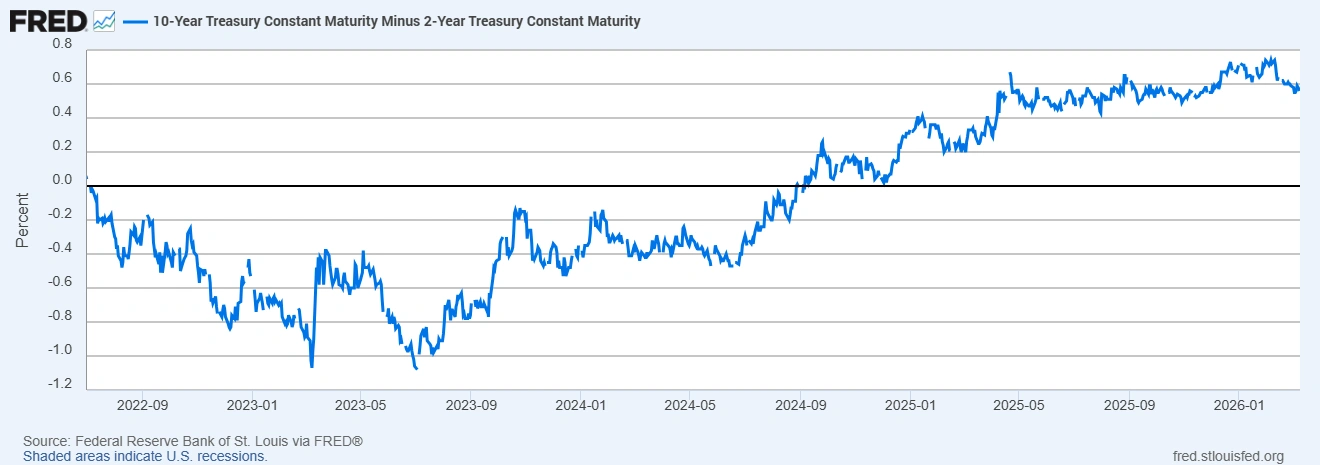
Source: Federal Reserve Bank of St. Louis (FRED). Data as of 9 March 2026.
Why Traders and Investors Pay Attention
Shifts in the yield curve ripple across financial markets. When the curve flattens or inverts, equity markets may turn more cautious because companies tend to struggle during periods of slower growth. Currency markets react to changing interest rate expectations, while commodities often respond to shifting demand outlooks. Even today’s upward‑sloping curve carries useful information. For example, the 10‑year vs 2‑year spread is currently around +0.58%, showing a more normal term structure after years of turbulence.
Limitations of the Yield Curve
Although the yield curve has a strong historical record, it is not perfect. Inversions can last a long time before any recession appears, and occasionally the signal can be distorted by global events or unique policy actions. The long inversion from 2022 to 2024 included brief periods that did not immediately correspond with a downturn.
For this reason, traders usually treat it as one tool among many.
Bottom Line
The yield curve remains one of the clearest and most widely followed indicators of market expectations for growth, inflation, and potential recession risks. While not flawless, its shape offers valuable insights into how investors see the future, making it a powerful tool for both new and experienced market participants.