Key Players in the Forex Market
The foreign exchange (forex) market is the largest and most liquid financial market in the world with trillions of dollars traded each day. Various types of participants buy and sell currency for different reasons, which ultimately plays a part in driving currency movements. But who are these participants and what role do they play in the forex market? That's where it helps to know who the key players in forex markets are. Grasping this allows traders to interpret currency movements from a macro perspective and connect price fluctuations to real-world economic events. This article will uncover who these key forex market participants are, from central banks to retail forex traders and how they affect the forex market.
Central Banks | Key Players in Forex Markets
Central banks sit at the top in terms of the key players in forex markets. They are powerful institutions responsible for helping manage economic and financial stability through monetary policy decisions. Their decisions have a major influence on exchange rates.
How Central Banks Influence the Forex Market
Central banks influence on the forex market in three main ways:
- Monetary Policy (Rate Decisions)
Changes in a country's interest rates have a significant effect on a currency's value. A currency tends to strengthen when its country's interest rate is higher. - Central Bank Announcements
Communications from the central bank, such as statements, press conferences and economic projections, can influence expectations about whether policy will be more hawkish or dovish, which can affect exchange rates. A currency tends to strengthen when policy expectations are hawkish. - Direct Intervention
Central banks occasionally buy or sell their own currency to create an influence on the foreign exchange rates.
How Interest Rates Affect Exchange Rates
Central banks are the ones who control a country's interest rate. While they do not directly determine the value of a currency, their interest rate decisions have a significant influence over their currency's value. That is why forex traders often keep a close eye on central bank interest rate announcements as well as any speeches delivered by the governor of the central bank. When they decide to raise or lower the benchmark interest rate, forex traders tend to react wildly after the decision. Subtle changes in the interest rate or change of tone in the statement given by the governor can trigger significant trading activity. This is why understanding the effect of interest rate decisions made by the central bank have on currency exchange rates is crucial for making informed trading decisions.
Sovereign Wealth Funds | Key Players in Forex Markets
Sovereign Wealth Funds (SWF) are also very large forex market participants. They are state-owned investment funds that manage national wealth. This is money that usually comes from oil sales or large trade surpluses. Unlike central banks, who step in to stabilise markets, SWFs behave more like large institutional investors managing trillions of dollars worth of assets. When that amount of money crosses borders, the effects can last for years.
How SWFs Impact the Forex Market
- Cross-Border Asset Acquisition
When a SWF purchases a foreign asset, such as property in London or stocks in New York, they must swap huge chunks of their own currency for the local foreign one. An exchange of currencies that large can lead to a substantial boost in demand for that foreign currency. - Portfolio Rebalancing
SWFs constantly rebalance their portfolios to manage risk. Because of their sheer size, reallocating even just 5% of their portfolio, like swapping Euros for Australian dollars, can be enough to influence exchange rates between those two currencies. - Recycling Resource Revenues
When countries that are rich in natural resources, such as crude oil, sell those resources, they are often paid in foreign currencies - usually in US Dollars. The role of the SWF is to then ‘recycle’ those dollars back into the market by converting them into other currencies which helps to diversify national wealth.
Commercial and Investment Banks | Key Players in Forex Markets
Banks are considered to be the ‘engine room’ of the forex market. They handle most of the trading volume and they supply the liquidity that enables forex market participants to trade. Without banks, the market would not be able to function. Banks trade in the ‘Interbank Market’, a fast-paced and non-stop network where they deal directly with each other and with large institutional clients.
The Role of Banks in the Forex Market
- Market Makers (Liquidity Providers)
This is their biggest role as forex market participants. Banks are always willing to buy or sell currencies. The prices you see on your platform come from the banks and they make money from the spread i.e. the difference between buy and sell prices. - Proprietary Trading
Banks don’t just process trades, they trade for themselves too. They use algorithms and macro analysis to try to predict where exchange rates and interest rates are heading next. Sometimes they’re right, sometimes they’re not. - Client Services
Banks help large institutional clients make large currency exchanges. These clients can be governments, hedge funds or multinational companies. The banks must manage the transaction and ensure a seamless process.
Multinational Corporations | Key Players in Forex Markets
Multinational Corporations (MNCs), such as Apple, Samsung and Toyota, are commercial forex market participants. Unlike banks, who mainly trade for profit, MNCs engage in foreign exchange to support their global business activities. As forex market participants, their involvement is for operational purposes, not speculative.
How Multinational Corporations Participate in the Forex Market
- Payment Settlement
This is the fundamental function. When a US-based company purchases goods from another country, such as Germany, they must exchange US Dollars for Euros to complete the transaction. - Repatriation
MNCs regularly convert profits earned abroad back into their domestic currency, such as Toyota converting revenue from US operations into Japanese Yen. - Hedging
To manage currency risk, MNCs use the forex market to lock in exchange rates for future transactions, to ensure the company’s financial stability and potential profit in local currency.
Why Multinational Corporations Matter in the Forex Market
Despite their daily trading volume being lower than that of banks and hedge funds, MNCs are still major forex market participants. They play a major role in generating the underlying economic demand for currencies through international trade and cross-border investment.
- Long-Term Trends
While speculators tend to drive short-term price movements, long-term currency trends are influenced by the constant trading of goods and capital investment by MNCs. - Mergers and Acquisitions
Large cross-border mergers and acquisitions can generate a large amount of currency demand in the short-term, creating significant fluctuations in the forex market.
Hedge Funds and Asset Managers | Key Players in Forex Markets
Hedge Funds are one of the most aggressive forex market participants. Unlike MNCs, who exchange currencies to run international business operations, hedge funds trade only for profit by taking large positions to benefit from short-term volatility.
How Hedge Funds Drive the Market
- Macro Speculation
Hedge funds analyse the global economy, then make huge bets on central bank policy, interest rate shifts and inflation trends - sometimes at a very early stage of the macro cycle. - The Carry Trade
This is where the hedge fund borrows in a low interest rate currency, like the Japanese Yen, to then invest in a higher interest rate currency, like the Mexican peso, keeping the interest rate difference as profit. This is one of the biggest weapons in a hedge fund’s arsenal. - News Trading & Volatility
With advanced trading algorithms, hedge funds react instantly to economic data like employment numbers or sudden geopolitical news, aiming to profit from the short bursts of volatility during the news announcements.
Retail Forex Traders | Key Players in Forex Markets:
Retail forex traders are individual traders or investors trading their own money through online platforms such as MetaTrader 4 and MetaTrader 5.
Characteristics of Retail Forex Traders
- Speculative in Nature
Retail forex traders primarily aim to profit from short-term market movements. They prefer to enter and exit the market over short periods of the time. - Technical Analysis Driven
Without access to the deep fundamental data that large banks have, most retail forex traders depend on price charts, patterns and technical indicators to make trading decisions.
Importance of Retail Forex Traders
While retail forex traders make up only a small portion of total trade volume, they are the fastest-growing group of all forex market participants.
- Liquidity
Millions of retail forex traders provide meaningful liquidity to the forex brokerage industry. - Market Sentiment
The trading volume of retail traders is typically too small to have any effect on exchange rates. However, their combined positioning is useful to institutions as a sentiment indicator. If most retail traders are buying, institutions may look to sell.
Forex Brokers | Key Players in Forex Markets
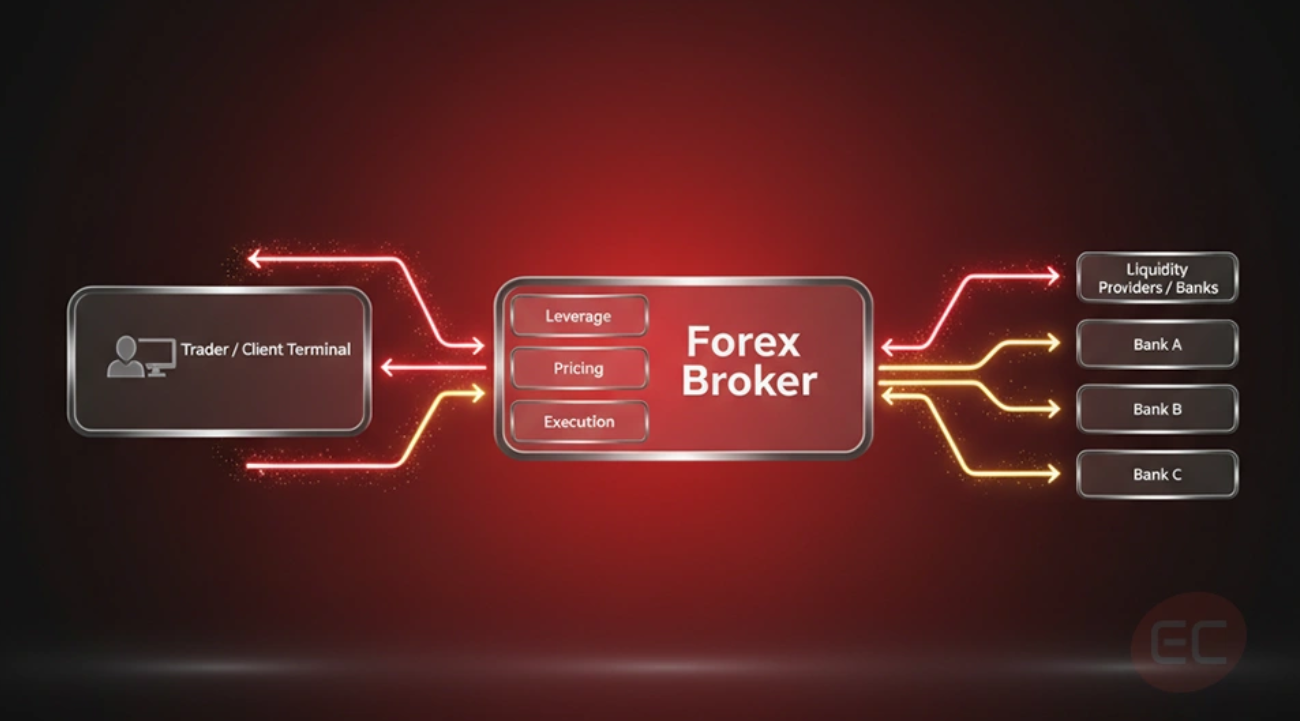
Forex brokers are the intermediaries between retail traders and the global forex market. Without them, retail traders would not be able to trade because brokers are the ones who provide the trading platform, the market data and access to liquidity.
How Brokers Shape your Trading Experience
- Market Access & Execution
Brokers give you the software that connects you to live prices of forex pairs and executes your trades when you click ‘buy’ or ‘sell’. - Leverage
Brokers allow traders to trade large positions with a relatively small amount of capital through margin. Leverage amplifies both potential profits and potential losses. - Transaction Costs
The basic business model of a forex broker is to profit from the spread which is the difference between buy and sell prices. Some brokers also generate revenue from commissions on each trade. - Risk Management
Most importantly, brokers offer tools, such as stop loss orders, allowing traders to manage their trading risk.
Conclusion | Key Players in the Forex Market
Understanding the key players of the forex market is more than just theory. It helps you to understand where you sit within the market structure. Every player has a different level of influence on the market.
- Central Banks have one of the biggest influences on the market. Their interest rate decisions and monetary policy determine the long-term direction of a currency which affects all forex market participants.
- Banks and Hedge Funds trade in massive volumes, shaping day-to-day price action and driving trends.
- Retail Traders don’t influence prices or create volatility. More so, they add liquidity to the market and use technical analysis to ride the waves created by the big players.
For traders and investors, understanding who the key players are and the effect they have is an edge. The next time a price spikes suddenly, don’t just jump in. Pause for a second and ask who’s behind it. Is it a central bank changing the bigger picture or a hedge fund closing positions? These are two very different signals.
In a market where more than $7 trillion worth of trades happen every day, nothing happens in isolation. Knowing who is moving the money explains why prices move. That is the difference between playing a guessing game and trading with knowledge.