












Why Currencies Care More About Expectations Than Rates


Picture this scenario: a central bank raises interest rates, yet the currency weakens instead of strengthening. It sounds counterintuitive, but seasoned traders know it’s not the rate hike itself that matters – it’s what the market expected to happen next. FX markets are forward-looking by nature, meaning they focus on where rates are headed rather than where they stand today.
FX Markets Price the Future, Not the Present
Currencies trade on expectations. Long before a central bank officially changes rates, traders have usually placed their bets on what’s coming. By the time an interest rate decision is announced, the outcome is often already priced in. For instance, exchange rates have both a spot value (today’s price) and a forward value based on future expectations. If markets believe a central bank will ease policy in coming months, its currency can start falling now as traders position ahead of that change and vice versa.
Suppose investors expect the BoE to hike rates soon while the ECB is seen pausing or cutting. Even before any official move, the pound could rise against the euro as markets price in that change. When the announcement hits, what moves the market is whether it surprises or disappoints relative to those expectations.
Moving Before the Move
There’s an old market adage: “buy the rumour, sell the fact”. Traders tend to buy (or sell) a currency in anticipation of an event and then take profit once the expected news becomes official. If the Fed is widely expected to cut rates next quarter, the dollar might start weakening now as investors reposition for lower future yields. In late 2025 the US dollar index slumped to multi-year lows largely because traders were betting on Fed rate cuts ahead.
This dynamic also explains why a currency can weaken even after a rate hike. If a central bank raises rates but hints it might be the last hike (a “dovish hike”), traders adjusting to that softer outlook can send the currency down. In Japan, for instance, the yen stayed flat against the dollar through 2025 despite two BoJ rate hikes.
If the ECB is forecast to cut rates by 0.50%, the euro likely already reflects that. If the ECB then only cuts 0.25%, paradoxically the euro could rise because the cut was smaller than expected. If the bank surprised with a bigger cut, the euro would likely drop sharply.
Market Moved Before the ECB Did
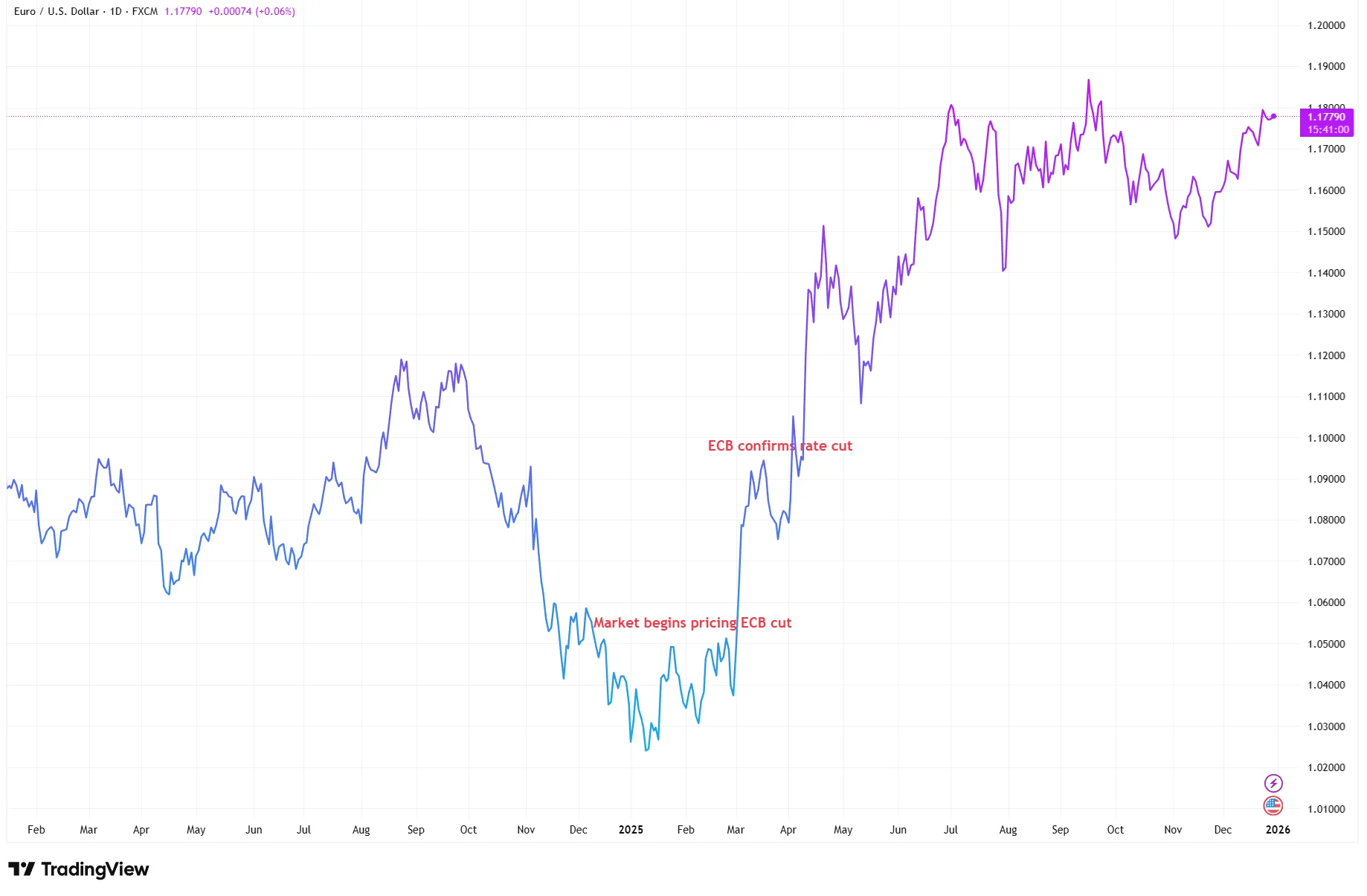
Source: TradingView. All indices are total return in US dollars. Past performance is not a reliable indicator of future performance. Data as of 30 December 2025.
EUR/USD began rising weeks before the ECB confirmed its rate cut in March 2025. The rally wasn’t driven by the decision itself, the market had already priced it in based on expectations.
The Power of Forward Guidance and Outlooks
A major clue comes from forward guidance – the hints and signals central banks give about future policy. If the guidance is credible, traders will move the currency accordingly long before the central bank actually follows through.
Yield differentials are a key driver of FX expectations. Investors compare the interest they can earn in one currency versus another. If US bond yields are expected to fall below European yields, for example, the dollar might weaken against the euro.
Inflation expectations and growth outlooks also feed into currency moves. If inflation is expected to fall sharply, markets might predict rate cuts ahead, which can cap a currency’s strength. A great example is the Japanese yen in 2025: despite rate increases, the yen didn’t rally because investors saw Japan’s growth outlook as weak.
Common Misconceptions About Rates and FX
Myth 1: “Higher interest rates always equal a stronger currency.” It’s the direction of change and context that counts.
Myth 2: “Currencies only move when central banks act.” In truth, currencies move ahead of central bank actions.
Myth 3: “All rate hikes (or cuts) have the same effect.” A surprise 0.5% hike can jolt a currency upward, while a routine 0.25% hike might see it fall.
Mind the Risks: When Expectations Go Wrong
Sometimes the crowd’s assumptions are just wrong, or sudden events shatter the consensus. The Fed delivered an unexpected 0.50% rate cut in late 2024 – larger than investors anticipated – and the dollar swiftly tumbled.
Markets might be confidently pricing in cuts – until a blowout GDP or inflation report flips the script.
Takeaway
Rather than focusing solely on current interest rates, successful traders focus on the narrative: Where are rates and the economy headed, and how much of that story is already in the price? Every rate hike or cut lives in the shadow of what comes next. If you can align your trades with shifts in those collective expectations, you’ll be in a stronger position to navigate the ever-changing currents of FX!