













Advantages of Forex Trading and Managing Trading Risks
Forex trading is an extremely popular market among retail traders for its ease of access and potential to make significant profits. However, it also comes with significant risks, especially when leverage is involved. That is why the most successful traders are those who are highly skilled in managing trading risks. This article will cover two core concepts: the advantages of forex trading, and forex risk management. It will uncover what makes forex trading so popular, as well as its potential downsides and the importance of risk management in trading. It is key for beginner traders to understand that profitability and proper trading risk management go hand-in-hand. The risks that come with forex trading can be avoided, and avoiding them consistently is what allows traders to reap the benefits that the forex market has to offer.
What Is Forex Trading?
Forex is short for 'foreign exchange' and it is the process of buying and selling currencies with the goal of profiting from the movements of currency prices. The forex market operates 24 hours a day, five days a week, unlike stock markets which have certain trading hours each day. Forex trading can be highly lucrative. However, without effective trading risk management, losses can quickly accumulate. Strong forex risk management is a key factor that separates successful traders from the poor performers. But why is forex trading so popular? The following section covers the main advantages of forex trading that attract retail traders worldwide.
Advantages of Forex Trading
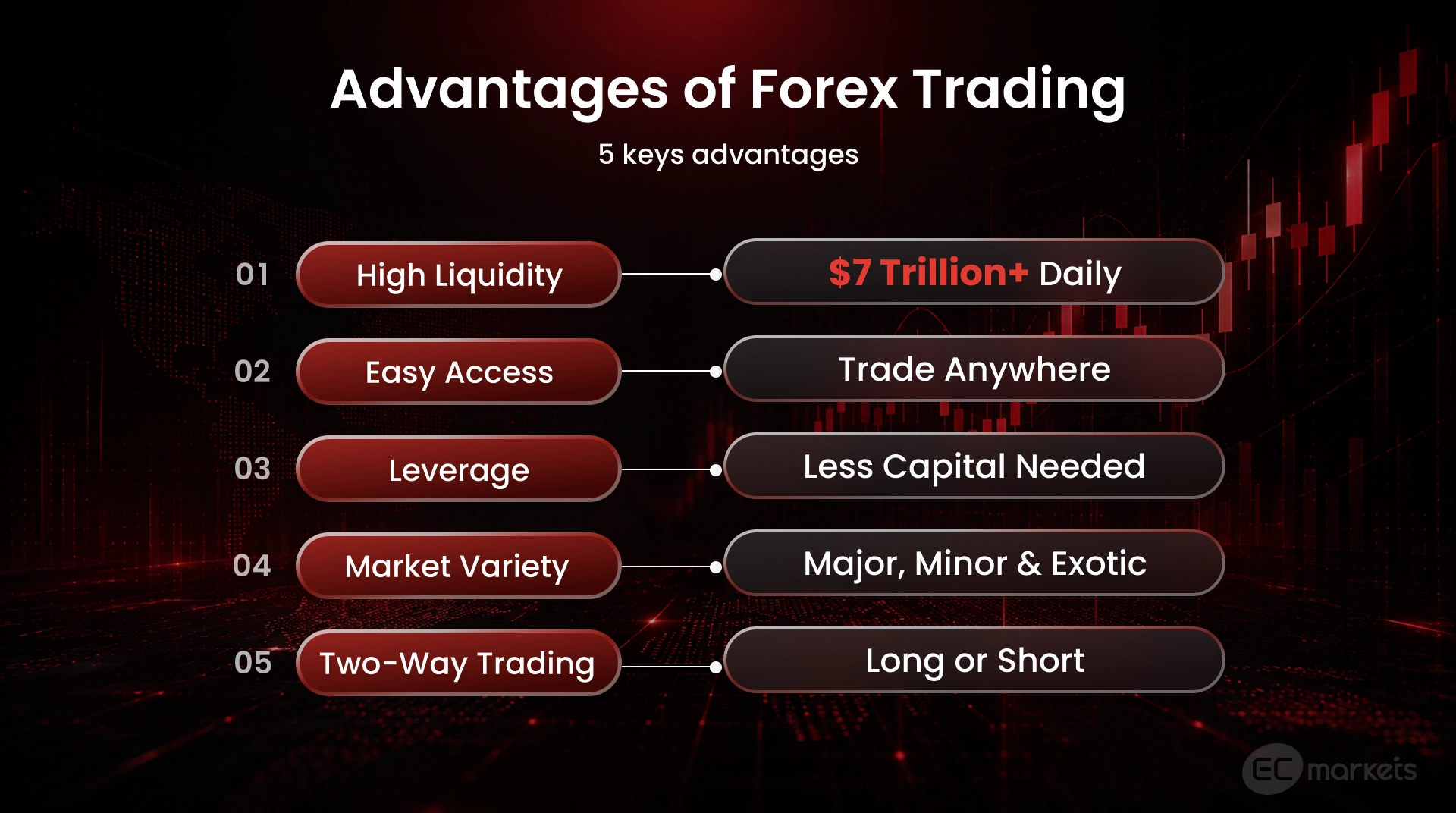
- High Liquidity: The forex market has a daily trading volume that exceeds $7 trillion. That makes it the world's largest and most liquid financial market. Because of this, traders are generally able to execute trades very quickly with minimal slippage, which ensures that orders are filled at or very close to intended market prices.
- Accessibility: The forex market can be accessed from almost anywhere with an internet connection, which is what makes forex trading so popular. In addition, having a large amount of capital is not a requirement to trade forex, as many brokers offer low minimum deposits. This makes it possible for traders with various sizes of capital to participate.
- Leverage: Leverage allows traders to control a larger position with a smaller amount of capital, increasing the potential profit that can be gained from a trade. At the same time, leverage increases the potential losses should the market move against a position, which is why disciplined forex risk management plays a crucial role in protecting capital.
- Variety of Trading Options: Traders can choose from a variety of currency pairs, including major, minor and exotic pairs. Different pairs tend to suit different trading styles; some traders prefer more stable pairs, while others may prefer to trade the larger price swings of more volatile pairs. The variety of options gives traders more flexibility to find opportunities that match their strategy and risk appetite.
- Profit Opportunities in Rising and Falling Markets: In forex, it is possible to trade in both directions; traders can profit from either rising or falling markets. Traders can go long (buy) to profit from a rise, or go short (sell) to profit from a fall.
While these advantages of forex trading make it high attractive, traders must always proceed with caution. As great as forex sounds, participating in this market requires an understanding of risk management in trading.
Managing Trading Risks
Although the advantages of forex trading present many opportunities, strong forex risk management is crucial to ensuring the protection of capital for long-term success. Here are some keys to effective risk management in trading:
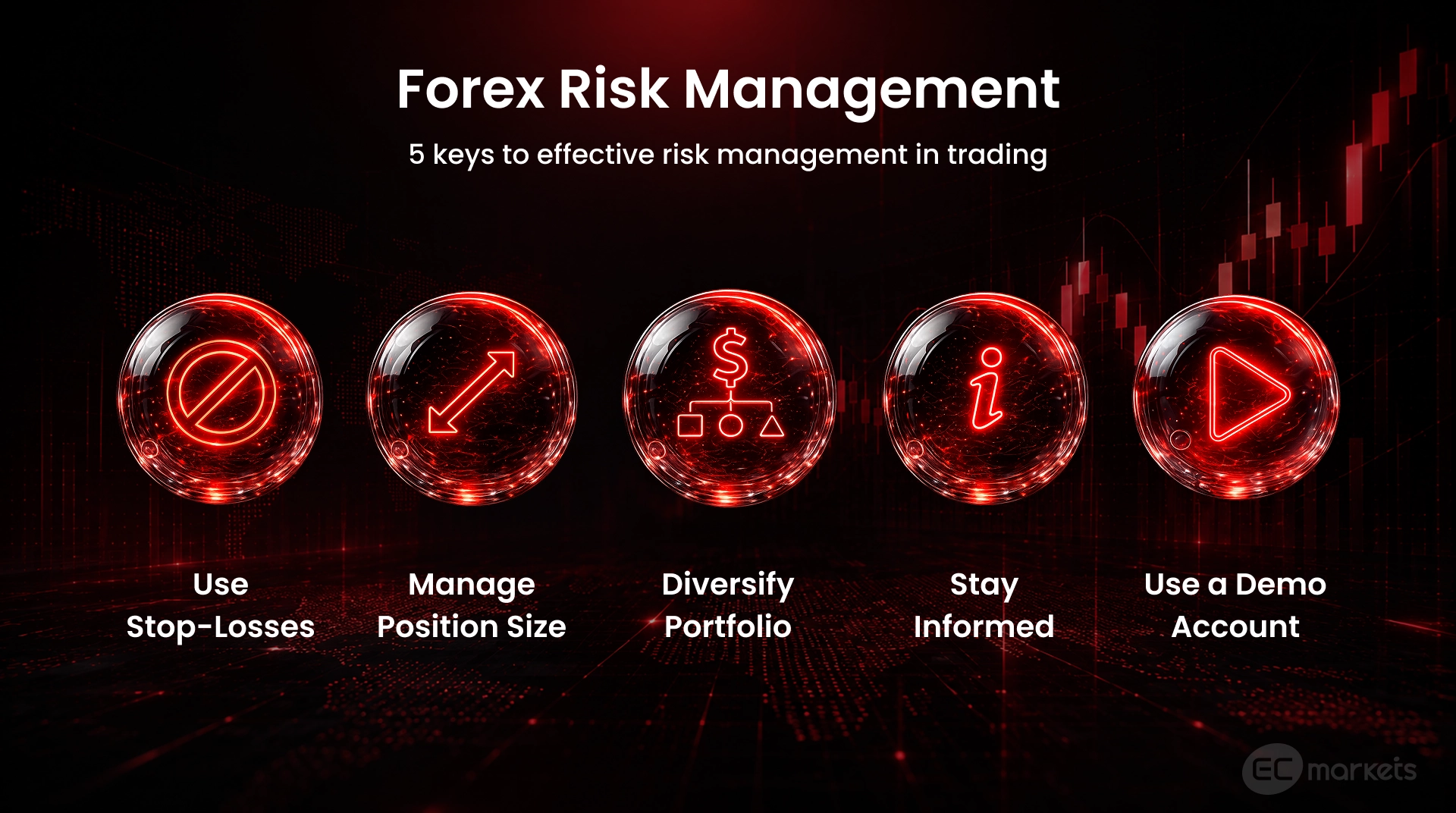
- Implement Stop-Loss Orders: A stop-loss order is a great tool to use in highly volatile markets because it is a way of limiting losses. When placing a stop-loss order, a predetermined price level is set, and if the price of a currency pair hits that level, the trade will automatically close at the best available market price. It is always important to ensure that the price level set aligns with an overall forex risk management strategy.
- Manage Position Sizing: Each position should be sized based on total account equity and how much risk is comfortable to take. To be profitable long-term, it is important to avoid over-leveraging or risking a significant percentage of capital on a single trade. Maintaining a consistent approach to position sizing is one of the most important aspects of risk management in trading and is key to surviving the ups and downs of the market.
- Portfolio Diversification: Diversifying a portfolio means spreading trades across a variety of currency pairs with low correlation, so that results are not reliant on the movements of one currency. Also, traders should be mindful of overlapping exposure to a single currency, such as trading GBP/USD, AUD/USD and EUR/USD, which concentrates risk around the US dollar.
- Stay Informed About Market Conditions: Keeping up with current affairs, geopolitical events and other news that can impact market volatility is essential. Staying informed enables traders to make educated decisions and supports risk management in trading.
- Start with a Demo Account: Even the best traders start with a demo account, especially when testing out a new strategy. This is crucial to managing trading risks as it exposes any holes in a strategy. Less experienced traders should avoid using real money before gaining confidence in their trading skills, establishing strategies and having a solid forex risk management plan in place.
Develop a Trading Plan for Managing Trading Risks
The fear of missing out is a trap too many traders fall victim to, which is why a well-structured trading plan is something every forex trader must have to prevent this from happening. A trading plan provides a clear framework for trading in the forex market. It should specify goals, risk tolerance, trading risk management rules as well as entry and exit strategies. Having a clear plan can help minimise emotion-based decisions and supports consistency in performance.
Here are some key elements that a trading plan should cover:
- What currency pairs to trade.
- A preferred chart timeframe.
- Entry and exit rules.
- The percentage of capital to risk per trade
Goal Setting in Forex Trading
The most essential part of a trading plan is to set a realistic goal. An unrealistic goal can lead to excessive risk-taking and makes risk management in trading much more difficult. For instance, setting a goal of doubling an account within the first week could lead to trouble. By being overly ambitious, a trader may start over-trading, ignoring trading risk management and end up taking unnecessary losses. Instead, starting small and working up gradually is the better approach, such as aiming for a 1–2% monthly gain and ensuring proper trading risk management rather than chasing one big win. This may not be the most exciting approach, but it separates the gamblers from the real and successful long-term traders.
So when setting a goal, consider the following questions:
- What is a realistic return on investment for the first month?
- How much am I willing to lose per trade?
- Can I maintain my trading performance over a long period of time?
- At what level of total monthly drawdown should I stop trading to re-evaluate my strategy?
Focusing on steady progress over quick gains is always the more sustainable approach as it supports following a trading risk management plan, which will help to protect capital.
Having a solid plan for risk management in trading is an essential prerequisite for one of the most powerful trading tools: leverage.
Leverage in Forex Trading
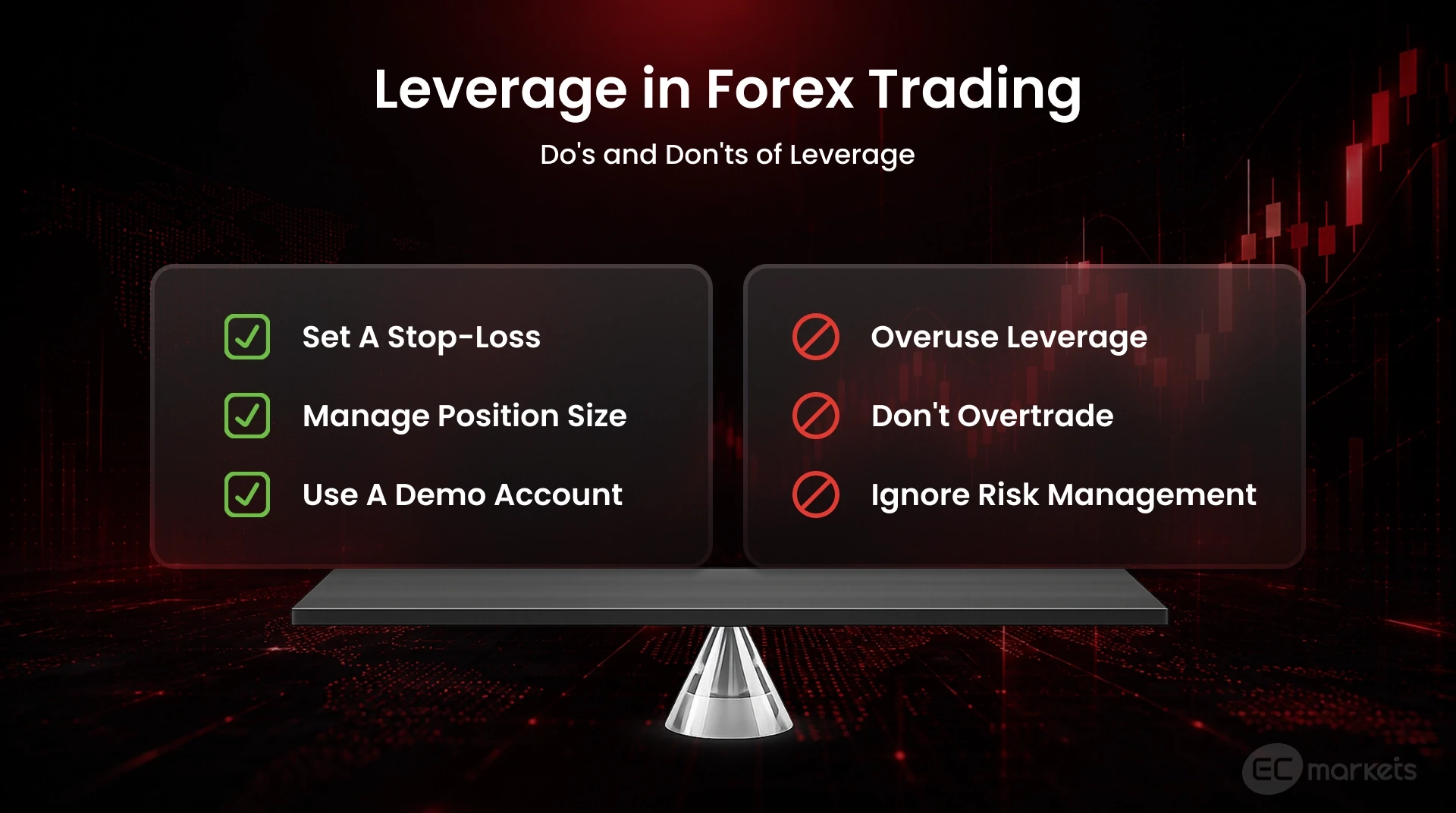
Forex tends to attract traders because of leverage. Leverage is one of the key advantages of forex trading because it can amplify gains, but it can also do the same to losses. That is why in leveraged markets, risk management in trading becomes critical.
Leverage enables traders to control a larger position in the market with a lower initial investment. For example, with 1:100 leverage, a trader can control $10,000 with a margin of $100. This is where being strategic with position sizing and setting stop-loss rules plays a key part in carrying out effective trading risk management. While the potential of significantly increasing profits is appealing, it is just as important to put measures in place to limit losses. Traders who lack discipline when following a forex risk management plan often make the mistake of over-positioning. If high leverage is used to open a position that is too large relative to account equity, even a small market move can trigger a stop-out and deplete capital. Using leverage conservatively is a crucial step to managing trading risks. In reality, most professional traders use far less leverage than what is available, often sticking to 5:1 or even lower. Any strong trader understands that staying in the game is more important than trying to hit a jackpot.
In the world of forex trading, many mistakes happen due to a lack of effective trading risk management. It is normal for these mistakes to be made. However, the more that they are in a demo environment, the better - that in itself is a way of managing trading risks.
Conclusion | Advantages of Forex Trading and Managing Trading Risks
The moral of the story is that the advantages of forex trading offer great opportunities for profit, financial growth and wealth building, but these gains are highly dependent how well a trader implements forex risk management. The most successful traders understand that success comes from managing trading risks and aiming for consistent wins over the long-term, rather than chasing massive short-term gains. Only by setting realistic goals and developing a robust trading risk management plan can traders avoid losing significant capital and build a successful long-term trading journey.
Note:
This content is for general information and educational purposes only and does not constitute investment advice or a personal recommendation. Any examples are for illustration only and should not be treated as a signal or invitation to trade. This material does not take into account your investment objectives, financial situation or needs. CFD trading is high-risk; losses may exceed deposits.