
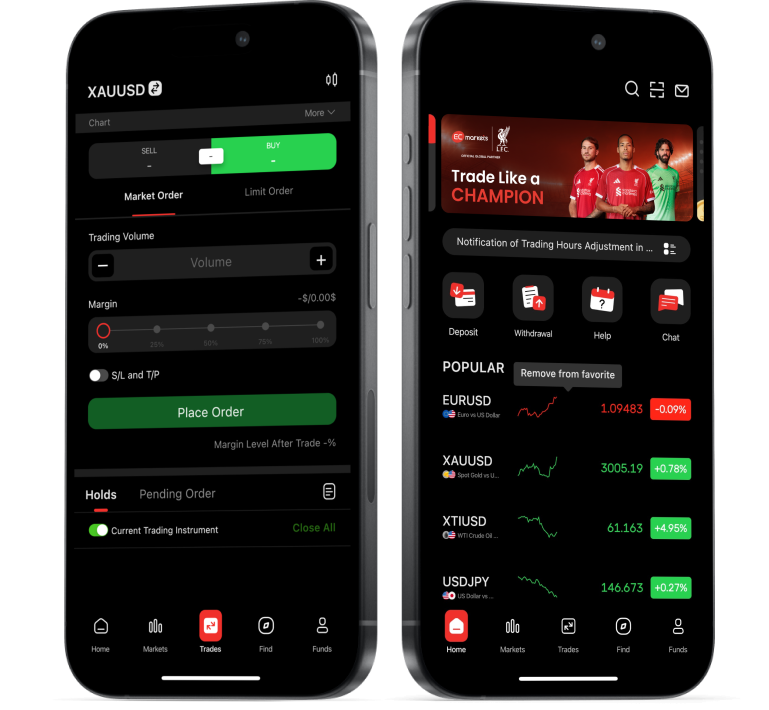













Types of Markets: Forex, Commodities, Indices and Crypto
Table of Contents
- Forex Market | Types of Markets
- Commodities Market | Types of Markets
- Index Market | Types of Markets
- Cryptocurrency Market | Types of Markets
- Which Types of Markets Suit Different Trading Styles?
- How to Get Started in Trading | Types of Markets
- Frequently Asked Questions | Types of Markets
- Conclusion | Types of Markets
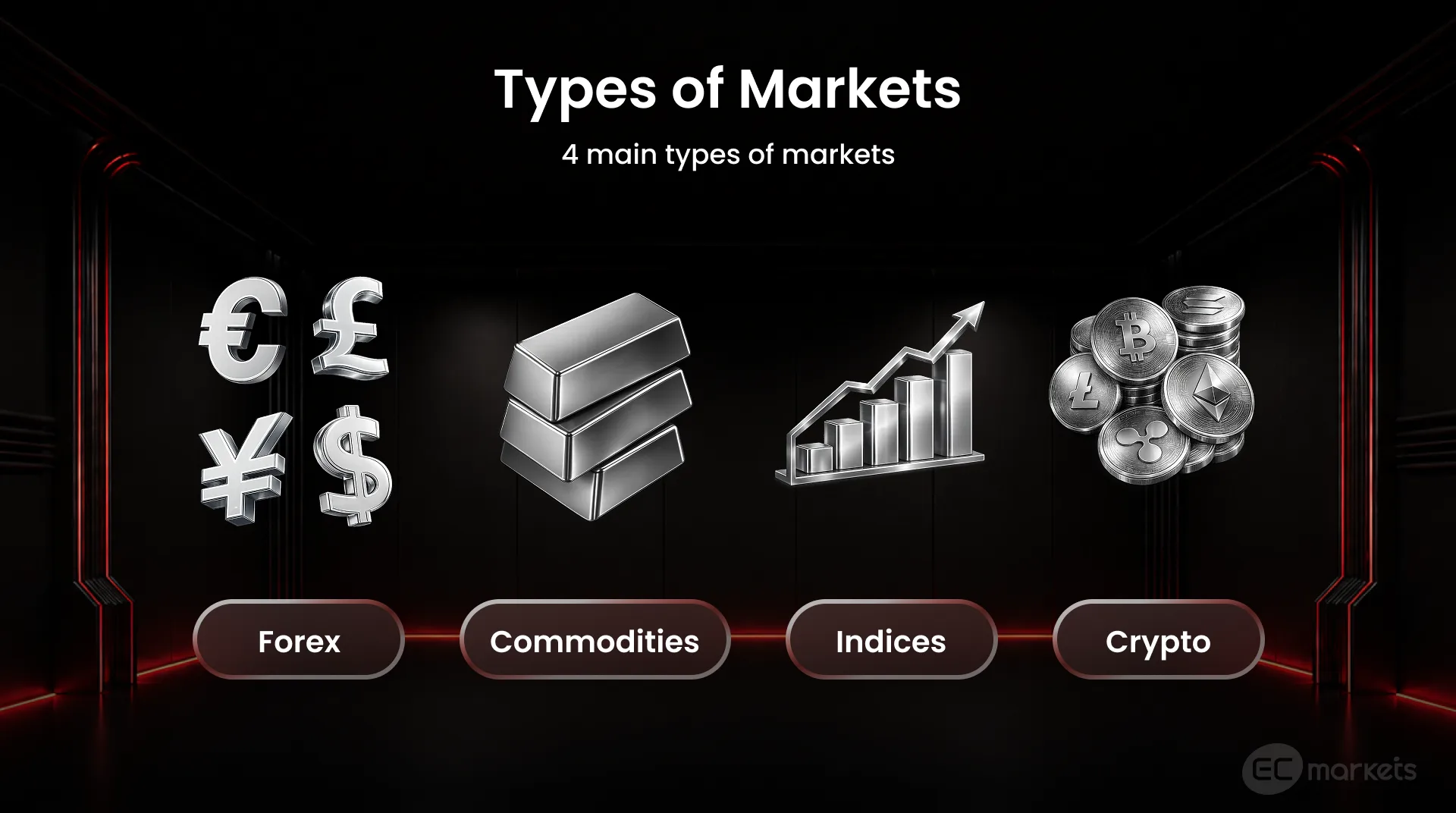
Experienced traders often optimise their strategies and make specific adjustments depending on the type of market. That is because each one behaves uniquely, and understanding how each of the different types of markets works helps traders to make better trading decisions. This article will go through each of the four main types of markets. First up is the forex market and CFD forex trading, which is a common way for traders to get exposure to currency movements. Second is the commodity market with a focus on precious metals trading. Third is the index market and why many choose to trade indices. Last is the cryptocurrency market and what's involved in crypto CFD trading. Let’s dive in!
Forex Market | Types of Markets
What is Forex?
Forex is short for ‘foreign exchange’ and the forex market is a global marketplace for exchanging and trading currencies. Out of all the types of markets, the forex market is the largest and most actively traded financial market in the world. To give an idea of how large it is, the average daily turnover of the foreign exchange market reached approximately $9.6 trillion in April 2025, according to the BIS. CFD forex trading is popular among retail traders for several reasons:
- 24/5 Availability: The forex market is open 24 hours a day, five days a week. It cycles continuously through global sessions (London, New York, Tokyo).
- High Liquidity: Because of the sheer number of participants and huge trading volume, CFD forex traders can usually enter and exit positions very quickly with minimal slippage - though this can change during major events or thin-liquidity periods.
- Lower starting capital (with leverage): Leverage is offered by brokers which allows traders to open larger positions with a smaller amount of money. It amplifies both potential gains and losses – high risk, high reward.
- CFD Forex Trading: Rather than buying the actual currencies themselves, retail traders typically access the forex market through CFD products (Contracts for Difference), which allows them to speculate on price movements without owning the underlying asset.
How Does CFD Forex Trading Work?
CFD forex trading is essentially placing a bet on a currency pair, such as EUR/USD, to move higher or lower without owning the underlying currency. Whether a trader is going long or short, the aim is to profit from the difference in the price at which a position is opened and closed. It is important for anyone participating in CFD forex trading to be aware of two factors that have a direct impact on profit:
- Leverage: This is a multiplier. For example, with 1:10 leverage, a $100 deposit can control a $1000 position. Traders must be careful, especially with the volatile nature of CFD forex trading, because leverage amplifies both potential profits and losses.
- Costs: There are two common costs involved in CFD forex trading. One is the spread, which is the difference between buying and selling price. Second is the swap, which is a charge or credit, depending on the interest rate difference between the two currencies in a pair, for holding a trade open overnight.
Pros and Cons of CFD Forex Trading
Pros
- High Liquidity & 24/5 Access: The forex market is open at all times from Monday to Friday. Its high liquidity makes it easy to enter and exit positions with efficiency in order execution.
- Low Capital Entry: It is possible to begin small initial deposit and use leverage to control larger positions.
Cons
- High Leverage Risk: Using leverage in CFD forex trading amplifies both potential gains and losses. If it is used without managing risk and the market moves unfavourably, losses can quickly accumulate and potentially wipe out a trader's deposit.
- Complex Costs: Beginners participating in CFD forex trading must pay close attention to spreads and swaps, as these trading fees can add up and decrease profitability.
Commodities Market | Types of Markets
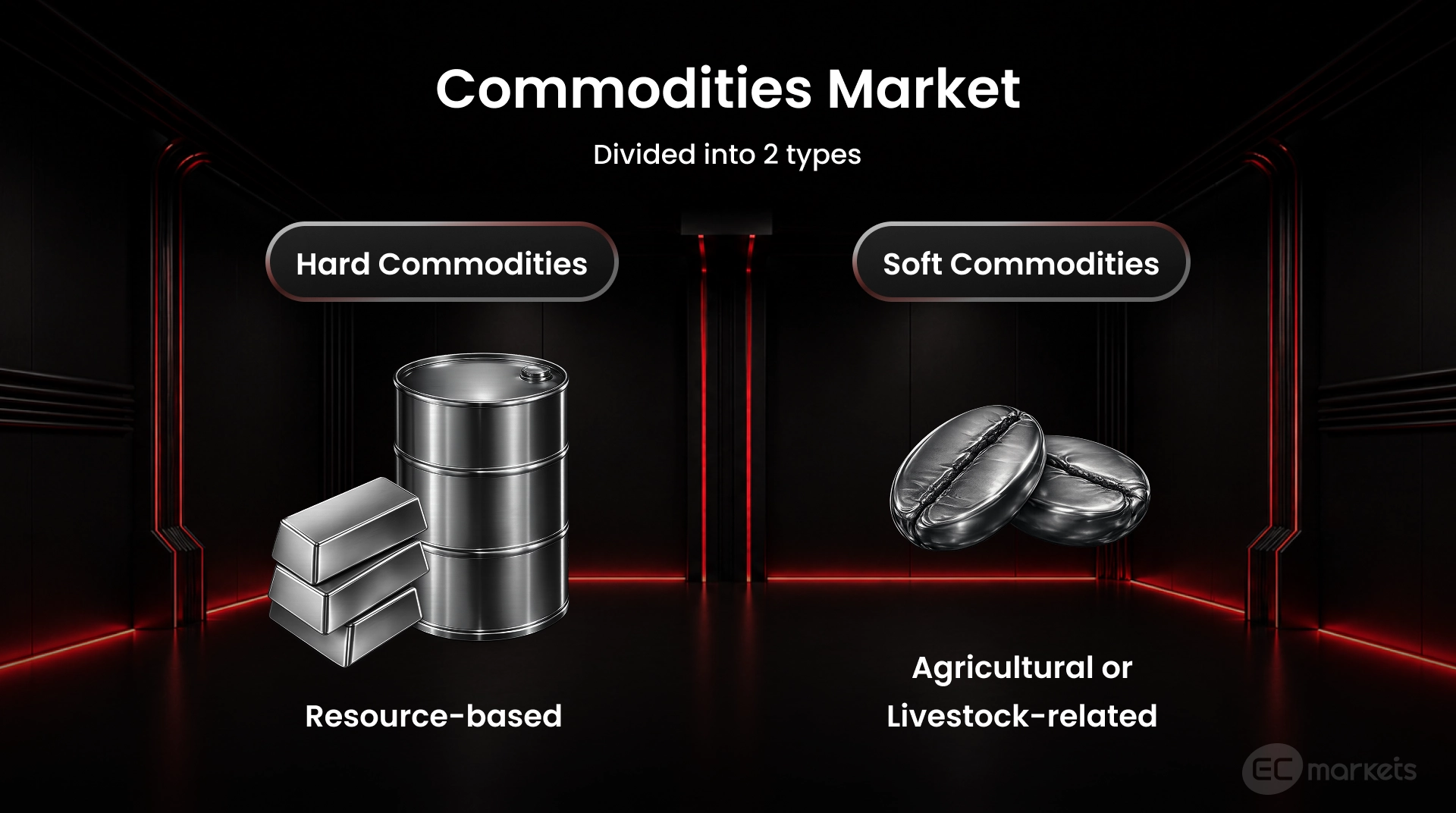
Commodities are physical goods that fuel the global economy. They are generally divided into two types:
- Hard Commodities: Resource-based commodities that are extracted and refined from underground sources, such as crude oil, gold and silver.
- Soft Commodities: Usually agricultural or livestock-related products, such as coffee, cocoa and cotton.
Unlike currencies, commodity prices are highly sensitive to real-world supply and demand. For example:
- The price of agriculture is affected by weather, disasters and harvest quality.
- The price of crude oil is heavily influenced by geopolitics, changes in production and disruptions in transportation.
What is Precious Metals Trading?
Precious metals trading mainly involves gold, silver, platinum and palladium. Metals are priced in US dollars, which means that precious metals trading can move based on the value of the dollar. Many traders use precious metals trading as a way of managing uncertainty. That is why they are commonly known as ‘safe-haven assets’ because when the global economy is unstable or when geopolitical tensions are high, investors tend to shift their funds into these assets.
Why are they popular?
- Intrinsic Value: Unlike stocks or currencies, precious metals are physical assets with real-world industrial applications and consistent investment demand. This gives them tangible worth beyond their market price rather than their value being purely derived from speculation.
- Inflation Hedge: While it is not 100% guaranteed, many investors engage in precious metals trading, such as buying gold, to hedge against inflation. This is done to protect their purchasing power as the value of the dollar falls. Because of this, the level of precious metals trading activity often increases during periods of economic uncertainty.
- Flexible Trading: By participating in precious metals trading through CFDs, there is no need buy or store the metal. Instead, traders can take part in precious metals trading just by speculating on a metal’s price, and depending on which way the price moves, either they will either profit or lose.
Pros and Cons of Precious Metals Trading
Pros
- Macro relevance: Prices are influenced by inflation, interest rates and forex movements. This makes precious metals trading great for macro-focused traders.
- Safe-Haven Appeal: During periods of heightened economic or geopolitical uncertainty, gold and silver are often viewed as stores of value, which can attract investor demand. A weakening USD usually boosts precious metals trading.
- Intrinsic Value: Unlike fiat currencies, precious metals are tangible assets with industrial applications and consistent investment demand, which is one reason why precious metals trading remains popular.
Cons
- Short-Term Volatility: Although precious metals are often thought of as being relatively stable, metals can still be volatile. Prices can fall sharply over short to medium periods of time. This volatility can happen especially during periods of rising interest rates or a strengthening US dollar.
- No Passive Yield: Precious metals do not pay dividends or interest, so profits come primarily from the price changes. Additionally, holding them as CFDs overnight incurs fees.
Index Market | Types of Markets
Firstly, what is an index? An index can be thought of as a benchmark used to track the overall performance of a basket of stocks within a specific country or industry. If getting market-wide exposure is appealing, learning how to trade indices is a good place to start.
What Does It Mean to 'Trade Indices'?
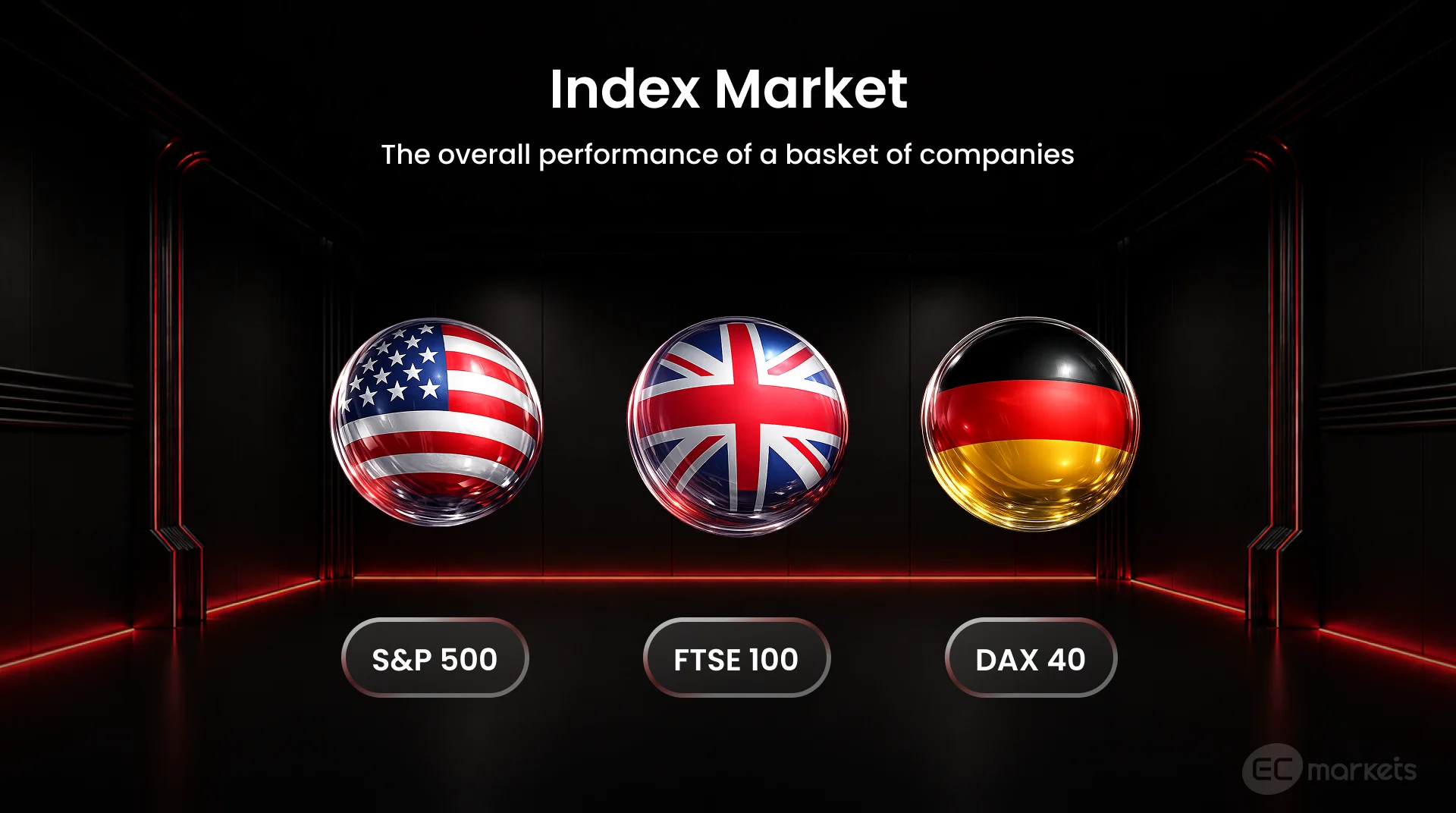
To trade indices is not to bet on one specific company, like Apple. Instead, it means to trade the overall performance of a basket of companies. Indices can often reflect broad market conditions and trends across an economy or specific industry. This is why those who like to keep up to date with central bank policy and economic calendars choose to trade indices. Most who trade indices commonly trade major benchmarks such as the:
- S&P 500: Tracks the top 500 of the leading companies in the U.S.
- FTSE 100: Tracks the top 100 of the leading companies on the London Stock Exchange.
- DAX 40: Tracks the top 40 of the leading companies in Germany.
Reasons Why It Is Popular to Trade Indices
- Diversification: Many choose to trade indices because it allows them to spread their risk across multiple companies. This reduces the risk of one single company's failure hurting the whole investment. However, those who trade indices are still subject to broader market-wide fluctuations.
- Relatively Low Volatility: Indices tend to be more stable compared to individual penny stocks or cryptocurrencies due to them being diversified. Index prices are the combined performance of multiple companies, so the fluctuations of a single constituent stock are often diluted by the performance of the rest, lowering overall short-term volatility.
- Economic Reflection: The performance of indices often reflects macroeconomic and industry conditions. Traders who trade indices, often find that their long-term trends are often closely related to economic cycles. That is why those who prefer to analyse macro-variables, such as interest rates, employment, and economic growth, over tracking company-specific news tend to trade indices.
- Trading Index CFDs: Many traders prefer to trade indices via CFDs as it allows them to just speculate on the rise and fall of index prices without buying the underlying stocks in the index.
Pros and Cons of Indices Trading
Pros
- Instant Diversification: Spreading exposure across a basket of stocks avoids the risk of a single company’s failure destroying the entire position.
- Macro sensitivity: Because indices tend to move with macroeconomic trends, it can be easier for traders to analyse macro data and general news such as GDP or employment data, rather than tracking a single stock.
Cons
- Systemic Risk: Even with diversification, if the overall market falls, it can be expected that most stocks within the index will also fall at the same time.
- Deceptive Stability: Indices may seem more stable than individual stocks, but leveraged index CFD trading can be very risky. That is because even small market moves can have a relatively large impact on a trader’s margin, especially if their account balance is small.
Cryptocurrency Market | Types of Markets
The cryptocurrency market operates 24/7 and is typically more volatile than other markets, which means increased opportunities and increased risks. The movements of this market are often influenced by market sentiment, social-media narratives and regulatory developments. This causes a higher degree of uncertainty when trading crypto CFDs. Although this holds true for any market, those participating in the crypto CFD market tend to find the most success when they prioritise incorporating strong risk management practices into their strategies, such as position sizing and stop-loss planning.
Leverage can also be used when trading crypto CFDs. In a market where 10% swings are common daily, there is potential for massive profits. At the same time, it is just as easy to lose money. This is why it is necessary for crypto CFD traders to have risk controls in place to avoid a total loss of their deposit.
Key Features of the Crypto Market
- 24/7 Access: Unlike traditional markets, the cryptocurrency market is always open. Crypto can be traded 365 days a year, day and night.
- High Volatility: A crypto CFD can move sharply in minutes. These more extreme price swings may present more opportunities, but they also require tighter risk management.
- Variety: Crypto CFD traders can choose from a number of different assets such as Bitcoin, Ethereum, Solana and many other emerging tokens.
- Leverage: Experienced traders can use leverage to amplify their market exposure when trading crypto CFDs, but it must be used with extreme caution.
Who is Crypto CFD trading suitable for?
- Active traders: Those who can handle trading and risk management in a 24/7 market environment.
- High risk-takers: Investors with capital they can afford to lose. Trading crypto CFDs is often high risk, high reward.
- Convenience seekers: Crypto CFD traders can access exposure to crypto prices without the technical complexity of storing coins.
Pros and Cons of Crypto Trading
Pros
- Exceptional Volatility: The crypto market offers traders the biggest potential for large price moves over very short timeframes, compared to other markets.
- 24/7 Availability: The market is open at all hours of the day, including weekends and holidays, unlike other major markets.
Cons
- Highest Speculative Risk: Crypto prices can be heavily influenced by sentiment and narratives, such as social media hype, which can make results highly unpredictable.
- Rapid liquidation risk: Because of the wild price swings, crypto CFDs carry the highest risk of total capital loss when leverage is mismanaged.
Which Types of Markets Suit Different Trading Styles?
Choosing the right market comes down to individual goals and risk tolerance. Here are some common trader profiles to help narrow down the options.
- The macro-focused trader: CFD forex trading tends to suit those who follow global news and politics closely. Exchange rates can react to macro-factors such as global headlines, inflation data and central bank (e.g. Federal Reserve) decisions. CFD forex trading may be the most natural choice for those who value a highly liquid market and like to pay attention to international relations and macro information.
- The safe-haven trader: Precious metals trading may appeal to those who prefer assets with physical backing and long-term value. Gold and silver are tangible commodities with intrinsic value and have historically been used as stores of value for centuries. For those who value stability over speed, precious metals trading can be an option to offset volatility in a risky portfolio. Investors tend to allocate funds towards these kinds of assets seeking stability because they are often seen as 'safe havens', during a bear market or when inflation is high. Some traders like to diversify by mixing in precious metals trading with forex or indices as they are all subject to macro-factors.
- The diversification-focused trader: Those who prefer broad market exposure over picking individual stocks may prefer to trade indices. Rather than concentrating risk on a single company, whose prices can swing sharply due to firm-specific events (like leadership changes or product issues), spreading risk across multiple companies means performance is driven by broader economic and sector forces. For beginners, choosing to trade indices is a way to access equity markets with diversification built in.
- The high-risk trader: Crypto CFD trading tends to suit those who are comfortable with high volatility and are drawn to cutting-edge technology. Because the crypto market is open 24/7 and often reacts quickly to headlines, social media and technical trends, the price fluctuates faster and more drastically than other markets. This makes crypto CFD trading best suited to traders with a higher risk tolerance who can manage positions day and night.
How to Get Started in Trading | Types of Markets
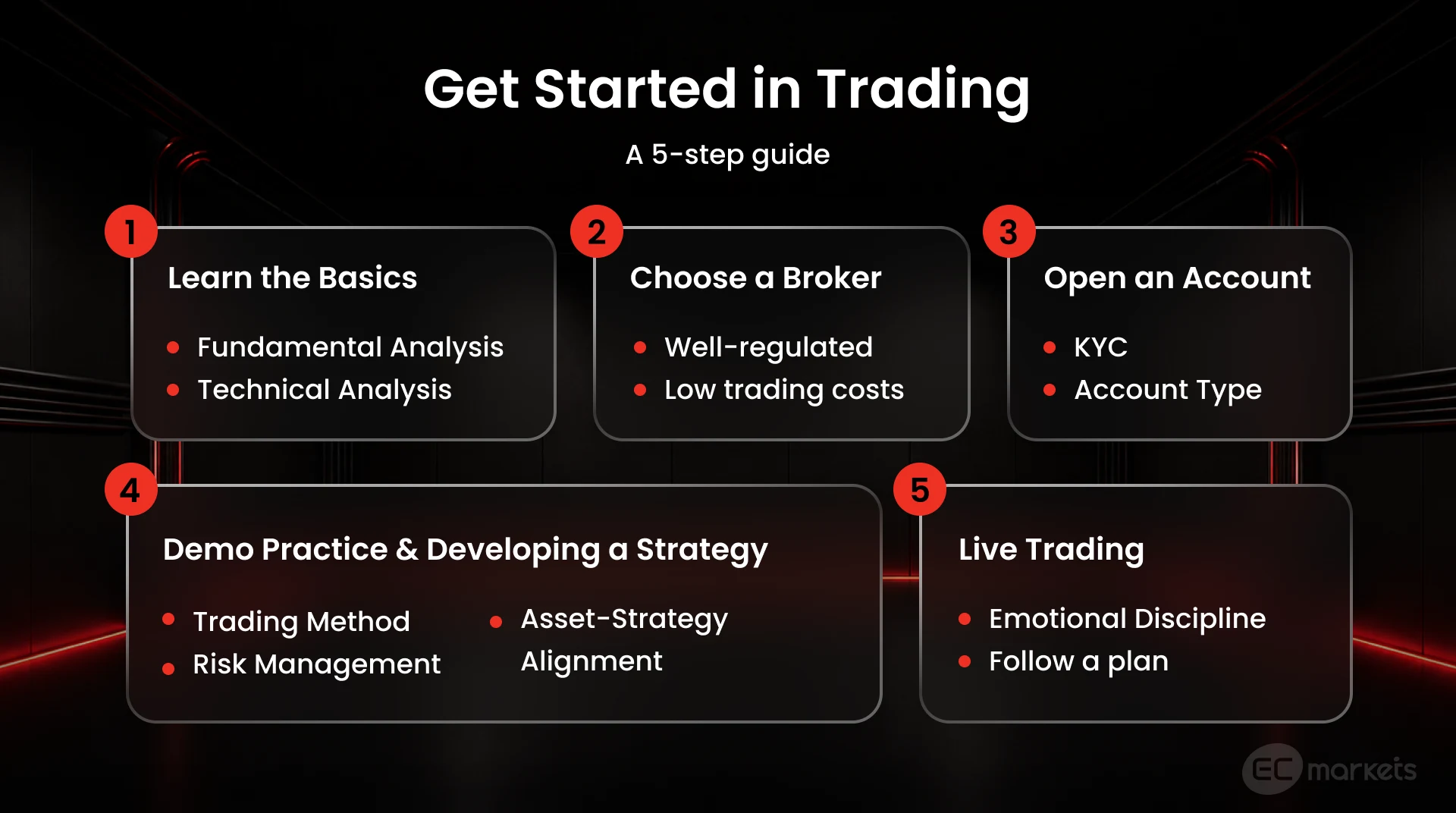
For those at the beginning of their trading journey, here is a simple step-by-step guide on how to get started and what to focus on in these early stages.
Step 1: Learn the Basics
Before placing the first trade, it is essential to understand how the market works. Learning the meaning of pips, spreads, leverage and margin calls is a strong foundation. At the same time, understanding the difference between two core methods of analysis is equally important:
- Fundamental Analysis focuses on economic news.
- Technical Analysis focuses on charts and patterns.
Step 2: Choose a Broker
Choose a broker that is properly licensed and regulated (e.g., ASIC, FCA, or CySEC), as a regulated broker ensures the safety of funds. Different brokers also offer different spreads and swaps, so it is important to compare these — high trading costs can compress profit. Further, pick a broker with a dependable trading platform, such as one that supports MT4/MT5.
Step 3: Open an Account
After picking a broker, traders will need to complete the KYC (Know Your Customer) identity verification process, which requires submitting an ID and proof of address. From there, selecting an account type that best suits the budget and trading style is the next step. For beginners, a STD (standard) account is a common starting point.
Step 4: Demo Practice & Developing a Strategy
This is where many beginner traders struggle. Rather than using a demo account just to click buttons, the focus should be on practising execution and building a rule-based system that can be repeated with discipline. This means building the framework for entry, exit and risk management rules.
Define a trading method:
- Scalping: Making a lot of quick trades a day for tiny profits (often done in Forex or Indices).
- Day Trading: Opening and closing trades within the same day to avoid overnight swaps.
- Swing Trading: A lower time commitment style by holding trades for days or weeks to ride a trend. Ideal for those with full-time jobs.
Asset-Strategy Alignment:
- Forex / Indices: These markets react quickly to news and macro events, often developing momentum, so they suit technical strategies, like trend-following.
- Precious Metals: Metals can have sharp bursts of volatility which can work well for breakout setups. Just be wary of the overnight swaps when planning to hold positions for longer.
Risk Management: Every strategy should include a stop-loss. A common rule is to risk no more than 1-2% of the total balance on a single trade.
Step 5: Live Trading & Emotional Discipline
Transitioning from demo to live trading is a larger psychological leap than some may think because demo trading does not involve the 'pain' of losing real money. Starting with the smallest position sizes (micro lots) and keeping a trading journal to record the reasoning behind each trade and the emotions involved can help bridge this gap. The markets are always going to be volatile, which is why the ability to follow a plan is what leads to long-term success.
Frequently Asked Questions | Types of Markets
What are the most suitable markets for beginners?
There is no such thing as a completely ‘safe’ market, especially in leveraged trading. However, many beginners opt to trade indices when starting out, due to their relative stability compared to single stocks or crypto CFDs. Others may prefer CFD forex trading for its deep liquidity and the abundance of educational material available.
Can I use one platform across all types of markets?
Many brokers offer a single platform, like MT5 or their own web terminal that allows traders to trade CFDs across forex, precious metals, indices and crypto. This makes it easier to diversify across multiple markets in one place.
How much money do I need to get started?
Traders can open an account with as little as $100. Thanks to CFD trading and leverage, there is no need to pay the full value of the asset to start trading.
Conclusion | Types of Markets
By now, there should be a foundational understanding of the major types of markets and what each one offers. Choosing the right market ultimately comes down to personal goals, time and risk appetite. In this article, we explored:
- Forex Market: The largest financial market in the world, CFD forex trading suits those who follow global economic trends and understand the importance of risk management when trading with leverage.
- Precious Metals Market: Precious metals trading appeals to those seeking assets with intrinsic value and safe-haven qualities, though active risk management is still essential given their volatility and overnight swap fees.
- Indices Market: Those who trade indices enjoy diversification and broad economic exposure, making it a popular starting point for macro-focused traders.
- Crypto Market: The most volatile of all the types of markets, crypto CFD trading suits those with a high risk tolerance and an interest in tech-driven assets.
Understanding the different types of markets is one of the first steps to success. No matter which one is chosen, success comes from education, a solid strategy and strong risk management.