












首頁 > 基礎面分析 > Why Cash Flow Matters More Than Earnings

Why Cash Flow Matters More Than Earnings

Jun 16, 2026 3:38 PM

Investors often focus on revenue growth and earnings per share when judging a company. Those figures are important, but they do not always show how much cash a business is actually generating. That is why experienced investors often pay close attention to cash flow. Earnings can look strong on paper, but a company still needs cash to pay suppliers, employees, interest costs and debt obligations. In a higher-rate environment, this distinction matters even more.

Earnings and Cash Flow Are Not the Same

Earnings are based on accounting rules. They include estimates, timing differences and non-cash items. Cash flow, by contrast, tracks the actual cash moving into and out of a business.

This means a company can report profits while still struggling to generate cash. For example, a business may record revenue after making a sale, even if the customer has not yet paid. On the income statement, that sale may improve earnings. On the cash flow statement, however, the money has not arrived yet.

This is why cash flow often gives investors a clearer view of financial strength. It shows whether profits are being converted into usable cash.

Why Free Cash Flow Matters

Free cash flow is the cash left after a company has paid its operating costs and made the investments needed to maintain or grow the business. In simple terms, it is the cash a company has available after keeping the business running.

That cash can be used in several ways. A company can pay dividends, buy back shares, reduce debt or invest in future growth. Strong free cash flow gives management more flexibility, especially when the economic environment becomes difficult.

Free cash flow is also widely regarded as one of the clearest measures of business quality. While accounting earnings can be influenced by estimates and timing differences, cash generation provides a clearer picture of a company’s ability to create value for shareholders.

Companies with strong free cash flow are often better positioned to maintain dividends, repurchase shares, reduce debt and continue investing during economic downturns. By contrast, businesses with weaker cash generation may need to borrow more or raise additional capital.

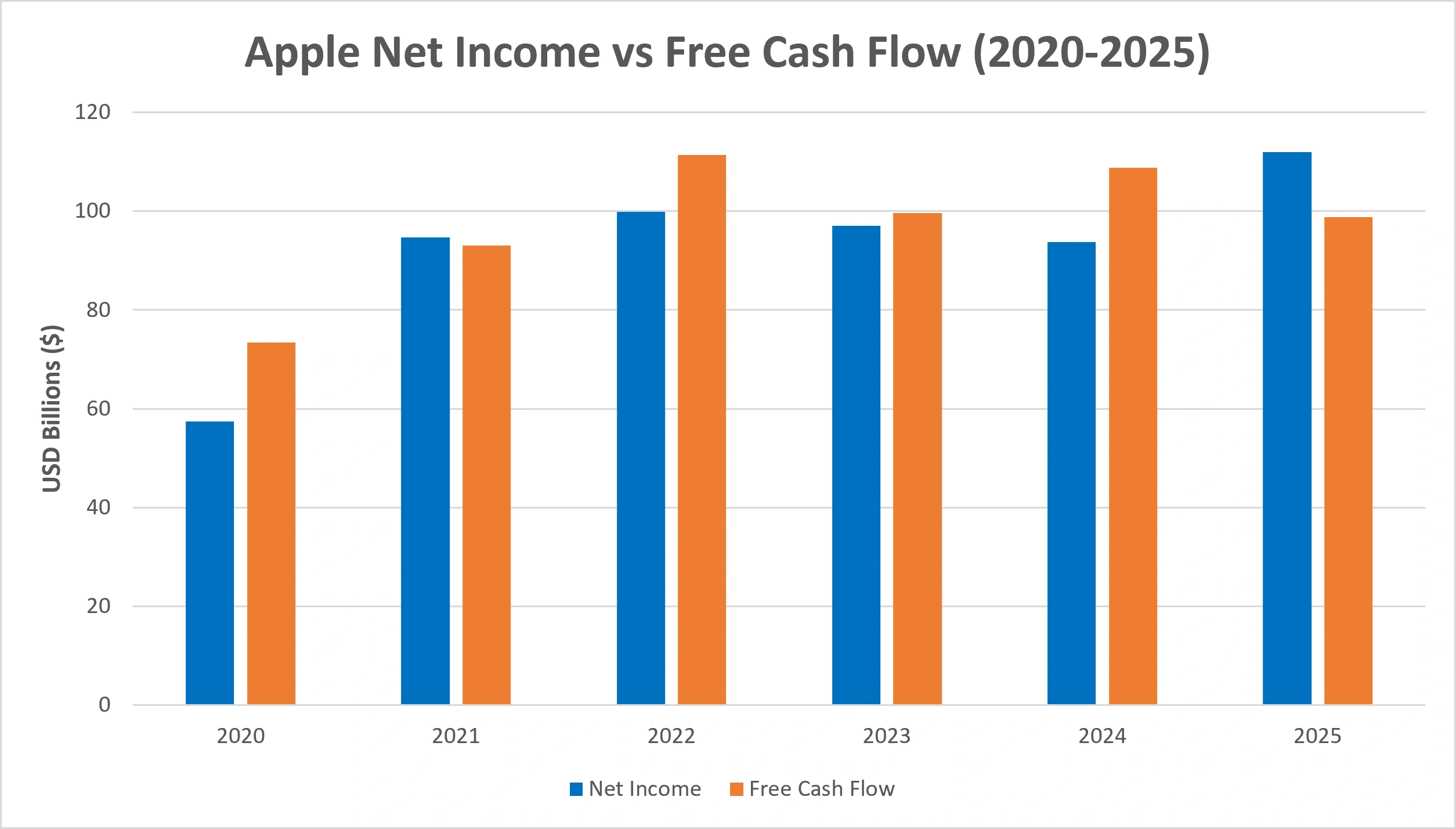
Apple provides a useful example. In fiscal year 2025, the company generated operating cash flow of roughly $111.5 billion and spent approximately $12.7 billion on capital expenditure, resulting in free cash flow of around $98.8 billion. Apple also returned significant amounts of capital to shareholders through dividends and share buybacks.

Microsoft also highlights the importance of cash generation. In fiscal year 2025, the company produced operating cash flow of roughly $136.2 billion. Although capital expenditure rose to approximately $64.6 billion as Microsoft invested heavily in cloud and artificial intelligence infrastructure, free cash flow still remained close to $71.6 billion.

These examples demonstrate how strong cash generation can support shareholder returns while also funding future growth.

Apple Net Income vs Free Cash Flow (2020-2025)

Source: Apple Inc. annual reports (2020-2025). Free cash flow calculated as operating cash flow minus capital expenditure. Figures shown in USD billions. Past performance is not a reliable indicator of future performance.

Apple’s strong cash generation has consistently supported investment, dividends and share buybacks. Note the shift in 2025, where high capital expenditures for AI infrastructure slightly compressed free cash flow despite record net income.

Why Profits and Cash Can Move Differently

Earnings and cash flow do not always move together because businesses operate on timing differences.

A company may sell goods today but receive payment later. It may build inventory before customers buy the product. It may also spend heavily on factories, technology or data centres before those investments generate revenue.

These factors can create a gap between reported profits and cash generation. A company might look profitable, but if cash is tied up in unpaid invoices, inventory or large investment projects, it may have less flexibility than the earnings number suggests.

For example, a company may report strong sales growth but still struggle if customers take months to settle invoices. Profits may appear healthy, but without sufficient cash, the business could still face liquidity pressures.

Why It Matters in a Higher-Rate World

The shift to higher interest rates has changed what investors reward. During the low-rate era, markets were often willing to support companies that promised rapid growth, even if they were not yet producing much cash.

That environment changed after central banks raised interest rates in 2022 and 2023 to combat inflation. As borrowing costs increased, access to capital became more expensive. Investors increasingly shifted their focus towards profitability, balance sheet quality and durable cash generation rather than growth at any cost.

Cash flow matters because it helps companies stay resilient. Businesses that generate strong internal cash flow rely less on external financing and are often better positioned to continue investing, manage debt and support shareholder returns when economic conditions become more challenging.

Can Profitable Companies Still Run into Trouble?

Yes. Profit does not automatically mean cash is available.

A company may report positive earnings but still face liquidity pressure if customers pay late, costs rise quickly or debt payments come due. Businesses need cash to meet daily obligations. Without enough cash, even a profitable company can struggle.

This is why investors often compare earnings with operating cash flow and free cash flow. If earnings are rising but cash flow is weak, it may be a sign that profits are not as strong as they appear.

Why Negative Cash Flow Is Not Always a Warning Sign

Weak free cash flow is not always a sign of trouble. Young and rapidly growing companies may deliberately spend heavily today to support future expansion.

For example, companies investing in new data centres, research or technology infrastructure may experience weaker free cash flow in the short term. Amazon spent years investing heavily in fulfilment centres and cloud computing capabilities before those investments translated into stronger profitability and cash generation.

The key question is whether that spending is creating long-term value. If investment supports sustainable growth, weaker near-term cash flow may be justified. If it reflects poor working capital management, rising costs or deteriorating demand, investors may have greater cause for concern.

This is why cash flow should not replace earnings analysis. Instead, the two should be used together.

Bottom Line

Earnings show what a company has achieved under accounting rules. Cash flow shows how much financial flexibility the company actually has.

For investors, this distinction is important. Strong earnings are valuable, but strong cash generation can reveal whether a business has the resources to invest, reduce debt, pay dividends and withstand tougher economic conditions.

In a higher-rate world, cash flow has become an even more important measure of corporate quality. It helps investors look beyond headline profits and understand whether a company’s growth is supported by genuine financial strength.

別只看市場
親自參與交易

開始使用

交易有風險,請謹慎行事